Reşat Ekrem KOÇU serailaized the story of Petri the Knife the Monster of Galata. I have not seen this and I am trying to locate clippings or microfilms. There is an abridged version from Istanbul Ansiklopedisi that was the basis of "Costak, the Movie"
Historian, novel and storywriter (b. 1905, İstanbul - d. 7 July 1975). He was a graduate of Bursa High School (1927), İstanbul University, Faculty of Literature (1931). He taught history at İstanbul Kuleli Military High School, Pertevniyal and Vefa High Schools.
He is known for his research in the field of history. His columns and interviews about history were published in journals and reviews. He died before he completed the encyclopedia İstanbul Ansiklopedisi (İstanbul Encyclopedia, 1944-51, 1958-71, 11 volumes).
He was writing in the journal Tercüman before he died. He is buried in Sahrayı Cedit Graveyard. Doğan Publishing House started reprinting his works in 2002.
WORKS:
POETRY: Acı Su (Bitter Water, 1965).
HISTORICAL SHORT STORY-NOVEL: Çocuklar (Children, 1930), Forsa Halil (Forsa Halil, 1962), Haşmetli Yosmalar (Regal Pretty Women, 1963), Erkek Kızlar (Male Girls, 1962), Patrona Halil (Patrona Halil, 1963), Kabakçı Mustafa (Kabakçı Mustafa, 1968), Fatih Sultan Mehmet (Fatih Sultan Mehmet, 1975), Haydut Aşkları (Bandit Loves, 1981), Kızlar Ağası Piçi (The Bastard of The Black Chief Eunuch in the Sultan’s Harem, 2002).
RESEARCH-PAPERS: Eski İstanbul'da Meyhaneler ve Meyhane Köçekleri (Bars and the Bar Dancers in Old İstanbul, 1947), Osmanlı Padişahları (The Ottoman Sultans, 1960), Hatıralar (Memories, with some chapters from Aşçı İbrahim Dede’s periodical and M. A. Akbay, 1960), Dağ Padişahları (Mountain Sultans, rebellions in the Ottoman history, 1962), Yeniçeriler (The Janissary Corps, 1964), Türk Giyim Kuşam ve Süslenme Sözlüğü (Dictionary of Turkish Clothes, Finery and Adornment, 1969), Yangın Var (Fire! - The Firemen of the Old İstanbul, 1981), Tarihte İstanbul Esnafı (İstanbul Tradesmen in History, 2002), Aşk Yolunda İstanbul'da Neler Olmuş (What Happened for Love in İstanbul, 2002), Köşem Sultan (Köşem Sultan, 2002).

Tuesday, May 23, 2006

Sunday, May 21, 2006
1891 | Plan de Galata
This plan gives a good idea of the streets of Galata and its environs during Petri's times.
Plan de Galata de l'Annuaire Oriental au 1/4000ème, dessiné par l'ingénieur Godeffroy (1891)

(click on image to enlarge)
Plan de Galata de l'Annuaire Oriental au 1/4000ème, dessiné par l'ingénieur Godeffroy (1891)

(click on image to enlarge)
Saturday, May 20, 2006
Friday, May 19, 2006
Levirentos of Galata
Petri worked as a server in similar Galata meyhane/wine pub.

Mavi Boncuk |
From left Barbo(owner), ahci (cook), tezgahdar (counter help/bar tender), saki padimu or mugbace (server) and kocek (dancer). Wine barrels at he back. Samiha Ayverdi sketch drawing.
(source: Istanbul Ansiklopedisi)
Barbo:
Italian, Spanish, and Portuguese: from barbo ‘barbel’ (the fish), hence a metonymic occupational name for a fisherman or possibly pub owner since fishermen opened these original pubs to begin with.
Source: Istanbul Ansiklopedisi | istanbul Encyclopedia | Kocu Publication (1972) Issue 165 Volume 11 | pages 5888-5892 | item written by Husnu Kinayli |
Wednesday, May 17, 2006

Mt. Athos

Detailed map of Mt. Athos where Perti found refuge with the fishermen.
(Detail from Map)The Balkans. Entitled Turkey and Greece, this map by Edward Weller, Issued by Blackie & Son about 1875
Mt Athos/Ayranoz is an island famous with its monastery established during the period of the Ottoman Empire on cliffs near Greece. This place, which the Orthodox women cannot enter even today, represents Christianity with its a thousand-year old history. 'Mara Hatun', the mother of Fatih Sultan Mehmet, sends a message to the priest of Ayronaz when Fatih is the shahzade. She says that the shahzade is indulgent for other religions and it is good to ask for intercession in advance. Thereupon, the priest visits Fatih and asks for intercession. 'Hz Ömer used to send firmans (imperial order), by sealing the print of his own hand, to the cities he conquered when he spread Islam and make promises that their rights would not be interfered. Fatih Sultan Mehmet also sends a firman with a seal of Hz Ömer’s hand to Ayranoz after he conquered Istanbul. Today, there are many Ottoman artworks in Ayranoz, along with this firman.
Santa Maura and Cephalonia

Detailed map of Petri's home. Island of Ayamavri and Lefteri Kaptan's Kefalonya
Santa Maura/Leukadia and Cephalonia(Detail from Map)The Balkans. Entitled Turkey and Greece, includes the provinces of Roumania, Servia, Bulgaria, Bosnia and Montenegro, as well as Moldavia, Roumelia and Greece. Map by Edward Weller. Issued by Blackie & Son about 1875.
formerly Levkás (both: lfkäs´)or Leucas (l´ks), mountainous island (1991 pop. 19,350), c.115 sq mi (300 sq km), W Greece, in the Ionian Sea; one of the Ionian Islands. Lefkás (1991 pop. 6,344), the chief town and the capital of Lefkás prefecture, is at the northern end of the island. Olive oil, currants, wine, and tobacco are produced. The island was colonized (7th cent. B.C.) by Corinthians, and Corinth and Lefkás were allies in the Peloponnesian War. Lefkás later was the capital of the Acarnanian League (3d cent. B.C.). The island was captured (1697) from the Ottoman Turks by Venice, which held it until 1797. There are ruins of Cyclopean walls and a temple to Apollo Leukates. Sappho is said, probably falsely, to have committed suicide by plunging into the sea from a cliff of the island. Lefkás is also known as Santa Maura.
Sunday, May 14, 2006
Eight Murders of Costak
Since Costak is a fictional story based on Petri the Blade all events were re-structured, re-arranged and murders do not replicate the descriptions of real life police reports of 1880's.
Costak Basic Structure (90 min. Breakdown of events)
Opening Titles Dipsamena, Dipsamena Petri's Tavern Song (01:45)
Part I (45 min.) "I die everyday"
1880 Petri's death in a Galata cul-de-sac (05:00)
MURDER 1 Kefalonians get their man Blood Feud
Today Dishwasher kills a man and jumps to his death from the police station (08:00)
MURDER 2 hotel kitchen Innuendo
1865 A Mother's Love (01:00)
1865 Daskalos rapes Petri (07:00)
Today Curator is trying to get the slippers from the dishwashers apartment (03:00)
1870 Petri's first murder (06:00)
MURDER 3 Aya Mavri Kafeneion Escape
Part II (45 min.) "My name is Petri "
Today Curator talks to shoemaker in Istanbul (05:00)
Life at Sea With Lefteri Kaptan (15:00)
MURDER 4 LEFTERI KAPTAN at Hotel de Marseille Money
Life of Petri The Monster of Galata (28:00)
MURDER 5 Policeman on Cadde-i Kebir Rebel
MURDER 6 Dragoman in Galata Mercy "This my love will end your pain"
MURDER 7 Eshter on the ship Escape from a Lover
MURDER 8 Sailor at the Pirincci Music Hall and Gazino Jealousy
Today Curator finishes the notes (02:00)
1865 A Mother's Love (07:00) "I will live forever"
End Credits (01:15)
Ten Songs for Costak
Opening Titles Dipsamena, Dipsamena
Song 1 Petri's Tavern Song (01:45)
Part I (45 min.) I die everyday Songs 2/3/4/5
1880 Petri's death in a Galata cul-de-sac (05:00)
Song 2 Istanbul Laterna
Today Dishwasher kills a man and jumps to his death from the police station (08:00)
1865 A Mother's Love (01:00)
Song 3 Costak Theme
1865 Daskalos rapes Petri (07:00)
Song 4 Island Song from Ionian Seas 1
Today Curator is trying to get the slippers from the dishwashers apartment (03:00)
1870 Petri's first murder (06:00)
Song 5 Tavern Song 1
Part II (45 min.) My name is Petri Songs 6/7/8/9/10
Today Curator talks to shoemaker in Istanbul (05:00)
Life at Sea With Lefteri Kaptan (15:00)
Song 6 Island Song from Ionian Seas 2
Life of Petri The Monster of Galata (28:00)
Song 7 Sea Songs of Catania Trieste Beirut
Song 8 Mt. Athos | Songs of Greek Fishermen
Song 9 Black Sea | Kanto
Song 10 Tavern Song 2
Today Curator finishes the notes (02:00)
1865 A Mother's Love (07:00)
Song 3 Costak Theme
End Credits (01:15)
Song 1 Dipsamena, Dipsamena Petri's Tavern Song (0:45)
Song 3 Costak Theme (0:30)
Costak | Basic Structure for 90 Minutes Cut
Costak Basic Structure (90 min. breakdown of events)

Opening Titles Dipsamena, Dipsamena Petri's Tavern Song (01:45) Song 1
Part I (45 min.) I die everyday Songs 2/3/4/5
1880 Petri's death in a Galata cul-de-sac (05:00)
Today Dishwasher kills a man and jumps to his death from the police station (08:00)
1865 A Mother's Love (01:00)
1865 Daskalos rapes Petri (07:00)
Today Curator is trying to get the slippers from the dishwashers apartment (03:00)
1870 Petri's first murder (06:00)
Part II (45 min.) My name is Petri Songs 6/7/8/9/10
Today Curator talks to shoemaker in Istanbul (05:00)
Life at Sea With Lefteri Kaptan (15:00)
Life of Petri The Monster of Galata (28:00)
Today Curator finishes the notes (02:00)
1865 A Mother's Love (07:00)
End Credits (01:15)
May 2006 Chantilly
A Marine Chart for Petri
These are some of the locations Petri sailed in the Mediterannean. I do not know if Lefteri Kaptan used a similar map.
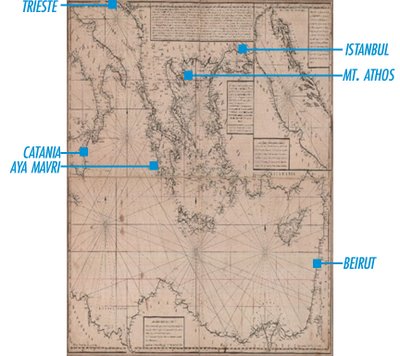
Kephalas. [Nautical map of the eastern Mediterranean], in Greek. Paris: Nikolaos Kefalas, 1818. 1 map. 97 x 66,5 cm. with 2 insets: Dardanelles hydrographic maps. This is the first chart to be constructed by the sea captain and adventurer Nikolaos Kephalas.
Between the 14th and early 17th centuries, portolan (or pilot-book) charts provided the main navigational aids between the seaports of the world. The term portolan (from the Italian 'portolano') refers to written sailing directions for seafarers. By networks of lines indicating the direction of one port from another, navigators were able to set their necessary courses. From such works, accumulated over generations, the first marine charts were drawn.
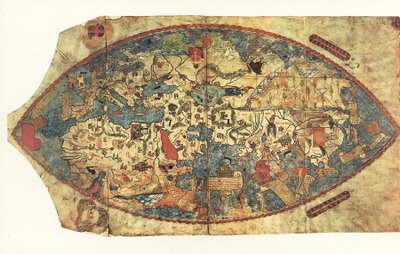
Genoese World Map (1457) [a portolano, or sea-chart, with scale bar]

Kephalas. [Nautical map of the eastern Mediterranean], in Greek. Paris: Nikolaos Kefalas, 1818. 1 map. 97 x 66,5 cm. with 2 insets: Dardanelles hydrographic maps. This is the first chart to be constructed by the sea captain and adventurer Nikolaos Kephalas.
Between the 14th and early 17th centuries, portolan (or pilot-book) charts provided the main navigational aids between the seaports of the world. The term portolan (from the Italian 'portolano') refers to written sailing directions for seafarers. By networks of lines indicating the direction of one port from another, navigators were able to set their necessary courses. From such works, accumulated over generations, the first marine charts were drawn.

Genoese World Map (1457) [a portolano, or sea-chart, with scale bar]
Saturday, May 13, 2006
Sappho's Tragic End
Not only Petri but Sappho had a tragedy connected with Lefkada.
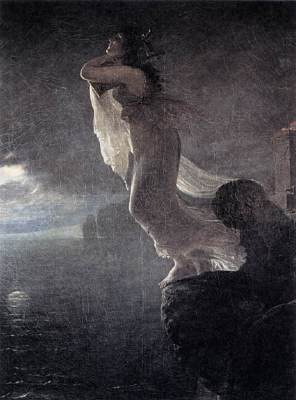 (Left) Sappho at Leucate by, Antoine-Jean Gros (b. 1771, Paris, d. 1835, Meudon) 1801 Oil on canvas, 122 x 100 cm Musée Baron Gérard, Bayeux
The young Gros moved his Salon audience in 1801, with his unearthly Sappho at Leucate, in which the poetess, in agonies of rejection, casts herself into the sea. Touched by the moonlight shimmering through her transparent veil, Sappho seems poised between two worlds; behind her on the cliffs stands a sacrificial altar.
Lefkada, or Leucas (Greek: Modern: Λευκάδα, Ancient/Katharevousa: -as) is a Greek island in the Ionian Sea, connected to the mainland by a long causeway and floating bridge, as well as the island's capital city.
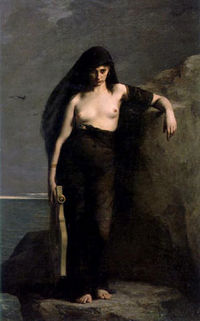
Sappho, an artistic notion of the Greek poet by Charles-August Mengin (1877).
The myth about Sappho's suicide at Cape Lefkatas is related to other myths linking the island to the ancient Greek goddess of love, Aphrodite, and to Odysseus, the hero of Homer's Odyssey. The German archaeologist Wilhelm Dörpfeld proposed the theory that the island of Nidri off the southwest coast of Lefkada was the real historical Ithaca, home of Odysseus.
Sappho was born into an aristocratic family, which is reflected in the sophistication of her language and the sometimes rarified environments which her verses record. References to dances, festivals, religious rites, military fleets, parading armies, generals, and ladies of the ancient courts abound in her writings. She speaks of time spent in Lydia, one of the wealthiest and most powerful countries of that time. More specifically, Sappho speaks of her friends and happy times among the ladies of Sardis, capital of Lydia, once the home of Croesus and near the gold-rich lands of King Midas.
A violent coup on Lesbos, following a rebellion led by Pittacus, toppled the ruling families from power. For many years, Sappho and other members of the aristocracy, including fellow poet Alcaeus, were exiled. Her poetry speaks bitterly of the mistreatment she suffered during those years. Much of her exile was spent in Syracuse on the island of Sicily.
 (Left) Sappho at Leucate by, Antoine-Jean Gros (b. 1771, Paris, d. 1835, Meudon) 1801 Oil on canvas, 122 x 100 cm Musée Baron Gérard, Bayeux
The young Gros moved his Salon audience in 1801, with his unearthly Sappho at Leucate, in which the poetess, in agonies of rejection, casts herself into the sea. Touched by the moonlight shimmering through her transparent veil, Sappho seems poised between two worlds; behind her on the cliffs stands a sacrificial altar.
Lefkada, or Leucas (Greek: Modern: Λευκάδα, Ancient/Katharevousa: -as) is a Greek island in the Ionian Sea, connected to the mainland by a long causeway and floating bridge, as well as the island's capital city.

Sappho, an artistic notion of the Greek poet by Charles-August Mengin (1877).
The myth about Sappho's suicide at Cape Lefkatas is related to other myths linking the island to the ancient Greek goddess of love, Aphrodite, and to Odysseus, the hero of Homer's Odyssey. The German archaeologist Wilhelm Dörpfeld proposed the theory that the island of Nidri off the southwest coast of Lefkada was the real historical Ithaca, home of Odysseus.
Sappho was born into an aristocratic family, which is reflected in the sophistication of her language and the sometimes rarified environments which her verses record. References to dances, festivals, religious rites, military fleets, parading armies, generals, and ladies of the ancient courts abound in her writings. She speaks of time spent in Lydia, one of the wealthiest and most powerful countries of that time. More specifically, Sappho speaks of her friends and happy times among the ladies of Sardis, capital of Lydia, once the home of Croesus and near the gold-rich lands of King Midas.
A violent coup on Lesbos, following a rebellion led by Pittacus, toppled the ruling families from power. For many years, Sappho and other members of the aristocracy, including fellow poet Alcaeus, were exiled. Her poetry speaks bitterly of the mistreatment she suffered during those years. Much of her exile was spent in Syracuse on the island of Sicily.
Got Costak?
Costak as a word and as a name has no meaning. Maybe it sounds a bit like Constantine (in Greek Kostak). We do not want you to have any concrete ideas about the film based on it's name. We want it to be as if it is an untitled work, a nameless piece. However as a feature film "untitled" did not sound right. We feel it has the right sound and musicality by itself if we called it "costak" and if you really force us to come up with anything... we think it is about a certain feeling of love and loss unique to Levantine ports and sleepless nights wasted on whatever passion one has. If you know what this state of mind is ... you have "Costak".
Costak...Synopsis
The film interweaves story of Petri the Knifer (Blade), with a police investigation of a murder suicide of an immigrant dishwasher in an unnamed North American city and a curator that is in preparation for an exhibit at a shoe museum. One of the items he is researching is a sipidik, a slipper style backless street shoe, that ruffians wear during Petri's times.
The byline of Costak the movie at the time of pre-production tells it all:
"Costak...10 songs, 8 murders and a pair of slippers..."
Costak, the movie is based on Petri. GALATA CANAVARI BICAKCI PETRI | PETRI THE KNIFE, GALATA MONSTER . Source: Istanbul Ansiklopedisi | istanbul Encyclopedia | Kocu Publication (1972) Issue 165 Volume 11 | pages 5888-5892 | item written by Husnu Kinayli |
Thursday, May 11, 2006
Petri as a "Zenane" of Lefteri Kaptan

Sabiha Bozcali drawing for R.E.Kocu's serialized but unpublished in book form novel "Galata Canavari Bicakci Petri / Galata Monster Petri the Knife" showing Lefteri Kaptan, his crew and Petri on the far right Petri as a "Gemi Zenanesi/male lover on boat".(Below) Dancing Köçek with a tambourine.Photograph,late 19th c. Private collection.
 Zenane (from Zenne) man acting in a woman's role (in a dress or with sexual behavior). In the Ottoman tradition of zenne (boys dressed up as women who sing and dance to entertain others. The köçek phenomenon is considered to be one of the most significant symbols of Ottoman Empire culture. The köçek was typically a very handsome young male rakkas, "dancer," usually dressed in feminine attire, employed as an entertainer and sex worker. Similarly derived from the Persian kuchak, "little," "small," or "young, "The köçeks (plural köçekler in Turkish) were usually children of non-Muslim peoples living under Ottoman rule. Their ranks were filled from the ethnic groups colonized by the Turks (such as the Albanians, Circassians, Balkan Slavs, Armenians, Jews, Roma, Moldavians and Greeks) since the profession was held to be below the dignity of a Muslim and thus forbidden to Muslim boys.
Tuesday, May 09, 2006
Peruz Terzekyan | Kanto Singer
Peruz Terzekyan...Dates do fit. Could she be the "Little Peruz", a singer of cantos and a love interest of Petri.
1876 He fell in love with the bordello owner Kaloferiya's 12-13 year old daughter Peruz. He gave a valuable jewel from Lefteri Kaptan's belt to her mother, took the young girl to his Dolapdere shack and raped. Later he had her picture taken at a potrait studio. (unknown location, possibly a Pera Studio. The photo was lost.)
1880 Upon hearing rumors of a new singer named Peruz in Galata casinos, Petri with fishermen buddies from Kalikratya decided to check if she was his Little Peruz. indeed she was. Petri killed a sailor named Ahmet when he found the unlucky suitor in an amourous embrace with Peruz at the bar of Avrupa Tiyatrosu in Galata. Peruz escaped. So did Petri. Possibly police found a pair of slippers at the crime scene.
Peruz Terzekyan (b. Sivas 1866?- d. .....Istanbul) , the Kanto Singer
Started singing cantos in 1880 ies when she was almost 14. She composed her songs and was also the lyricist. Her stage life lasted until 1912. Her songs were published as "Nese-i dil ". Peruz was a pioneer with Şamiram, Baydzar, Büyük Amelya, Küçük Eleni, Virjin Avantiya, Mari Ferha and Agavni all non-muslim (mostly Armenian) canto singers.
Peruz was also credited as a lead in 1919 silent short " Fahri Bey Makarna Tenceresinde/Mr. Fahri in Pasta Pot" by Ismet Fahri Gulunc. Rusen Hakki and Gulunc himself were other actors. Gulunc directed another short film of the same year "Tombul Asigin Dört Sevgilisi/Four Darlings of Plump Lover" . The film was not completed de to a legel dispute and there were no credit records for Peruz. However we know that Peruz was really a plump woman at her youth and could be the women in this film also.
See also: http://costak.blogspot.com/2005/12/kantocu-peruz.html
GALATA - TOPHANE
During the times of Petri there were no piers in Galata. Only in in 1879, the construction of modern piers began.
Throughout history, the Golden Horn has been the harbor of İstanbul. During the Byzantine period, piers constructed along the shores of the Golden Horn provided links to other commercial centers within the city. In subsequent periods, the Latin colonies constructed their own piers at Galata. When the Genoese began using these piers in the 13th century for trade, İstanbul became an international maritime port.
In the 17th century, Tophane was the primary port of call for foreign vessels from Europe. Then, every maritime agent had his own buoy and team of boatmen. Passengers and cargo were transported to and from the shore on caiques. But as maritime traffic got heavier and the number of passengers arriving at Istanbul increased, the need for modern piers grew. In order to satisfy this need, in 1879, the construction of modern piers began.
1891 saw the establishment of the Ottoman Pier, Warf and Warehousing Company of Constantinople with the financial support of Dupracy and Credit Lyonnais. In October 1895, the 785-meter long pier between Tophane and Karaköy was completed.
Pirinççi Music Hall / Gazino
1978 | After the murder (Murder #4) in Labanon, Petri left on Captain Humberto's italian ship as a sailor. On a trip from Selanik he met Esther (Star/Yildiz) a jewish singer on her way to Pirinççi Music hall in Galata. She became his lover (kept woman) in istanbul.
Pirinççi Gazinosu | KEMANÎ TATYOS EFENDİ (1858-1913) performed with musicians like Hanende Karakaş, Tanburî Ovakim and Kanunî Şemsi at Galata's Pirinççi Gazinosu. At the beginning of the twentieth century, in the waning days of the era of modern reforms in the Ottoman Empire (1808-1918), gazino customers were Turkish intellectuals and non-Muslims of the Beyoglu district of Istanbul.
See: Article by Münir Nurettin Beken "Aesthetics and Artistic Criticism at the Turkish Gazino"
http://www.muspe.unibo.it/period/ma/index/number8/gazino/bek_00.htm
The history of the word casino reveals a transformation from a cottage to a gambling palace. The source of our word, Italian casino, is a diminutive of casa, “house.” The term originally meant a small villa, summerhouse or pavilion built for pleasure, usually on the grounds of a larger Italian villa or palazzo. There are examples of such casinos at Villa Giulia and Villa Farnese. Central to the transformation is the development of the senses of casino in Italian. The word then came to be used for a social gathering place, a room or building where one could dance, listen to music, and gamble. This last pastime seems to have gained precedence over the others, at least as far as the development of the word is concerned, and casino took on the meaning “gambling establishment.” These senses of the Italian word have all been borrowed into English, the sense “social gathering place” being recorded first in the 18th century, the sense “gambling establishment” first in 1851.
Poetry by R.E. Kocu

Bitter Water / Aci Su (Kocu publications, 1965)
Aci Su
girdik
gün ışığı değmemiş denize,
yattık
altımızda çakıl, kum,
üstümüzde acı su,
omuzlarımıza kadar örten,
topuklarımıza kadar çekilen
acı su,
bizi kıskanmayan büyük acı su.
from Külhan Türküleri
yavrum
gönlüm tüyleri boz, gözleri al
dağlar üstünden uçan bir kartal.
yaylalarda güheylan istiyorum:
yavrum,
seni istiyorum
gönlüm bir yarasa, gözleri kan
kanadı mehtap, sesi kehkeşan.
bilmem ki canım, ateş mi, kül mü istiyorum,
bilmem taranmış baş mı, perişan kakül mü istiyorum,
yavrum,
seni istiyorum
gönlüm yol kesen asker kaçağı,
belinde öndördünde bir ceylan bıçağı...
beni öldürecek candarma, kurşun istiyorum,
bağrıma bir bıçak da bu güzel vursun istiyorum:
yavrum,
seni istiyorum.
SABiHA RÜŞTÜ BOZCALI (1903-1987)

Illustrator of the Galata Canavari/Monster of Galata, article on Petri the Knifer in R. E. Kocu's Istanbul Encyclopedia
SABiHA RÜŞTÜ BOZCALI (b. istanbul 1903- d. Istanbul 1987)
 Sabiha Rüştü was the daughter of Rüştü Pasha and the granddaughter of Memduh Pasha, a former Minister of the Interior. She was born in Istanbul. In those days girls never went to school, normally receiving their education from private tutors, but with the help of her uncle. Sabiha Rüştü managed to go to Italy and study to Rome, making copies of the works in the Vatican collection in order to be able to afford lessons from a famous teacher. During the Armistice period after the end of the First World War she worked in the Haiman studio in Berlin, and then studied for three year in the Munich Academy. She also worked for a year together with Namık İsmail in the Corinth studio. She contributed works to the Galatasaray exhibitions of 1922 and 1923, but these consisted entirely of sketches. She revealed herself as having a fine command of line in the style of the Western masters. “Design is the basis of all painting”.
After her return from Europe she spent the years 1926-1928 continuing to paint in her old friend Namık Ismail’s studio in the Academy of Fine Arts. At the same time she regularly contributed works to the annual exhibitions in the Galatasaray Lycee. Many years passed by in this way. As a painter she gave great importance to mirroring truth and reality in everything she painted. She visited Paris and Rome, and in 1931 she worked in Paris with the pointillist painter Paul Signac. During her three years stay in Paris she painted portraits of Signac’s wife and daughter. She was particularly successful in three types of painting: landscapes, flowers and portraits. She converted the stable of her villa at Kireçburnu into a studio and produced very large-scale paintings there. In 1 947-1949 she worked in Rome with Severini, Massimo Cam pigli, De Pisis and the founder of modern Italian painting, De Chirico.
Sabiha Bozcalı, was at the same time a highly accomplished illustrator, and for twenty-five years she contributed illustrations to the newspapers. She also illustrated works such as Nezihe Araz’s Anatolian Saints (Anadolu Evliyaları), and Yunus Emre, and made a number of designs and sketches for the Istanbul Encyclopedia edited by Reşat Ekrem Koçu.
EXHIBIT | Painter Sabiha Rüştü Bozcalı December 22, 2015 – March 6, 2016 SALT Galata, Bankalar Caddesi No. 11, Karaköy
SOURCE
This exhibition explored the artistic career of the painter Sabiha Rüştü Bozcalı (1904–1998), a relatively unknown artist who lived through the transition of the Ottoman Empire to the Turkish Republic and is now considered a key figure in the cultural history of Turkey. The exhibition will feature her drawings and paintings, as well as photographs, letters, postcards and the various publications she contributed to. Many of these works and documents were donated to SALT Research in 2014.
Bozcalı, who was born into a privileged diplomatic family, began painting at the age of five with her mother’s encouragement and was first tutored by Ali Sami Boyar, a painter and museum director. At the young age of 15, Bozcalı went to study abroad in Berlin, Munich, Paris and Rome, working in the studios of prominent painters such as Lovis Corinth, Moritz Heymann, Karl Caspar, Paul Signac and Giorgio de Chirico. She then attended the studio of Namık İsmail at the State Academy of Fine Arts in Istanbul between 1928–1929, where her portraits aroused the most serious interest.
Between 1938–1943, during the early years of the Republic, Bozcalı took part in the government program ‘Yurt Gezileri’ (Trips to Homeland), organized by the Cumhuriyet Halk Partisi (People’s Republican Party) and Halkevleri (People’s Centers). The aim of this program was to document the process of modernisation and the creation and implementation of a new cultural identity across Turkey. In this scheme Bozcalı was officially sent to Zonguldak in 1939 to paint aspects of industrial development. She also contributed to the visual language used in advertising and publishing during this period with her drawings for important institutions such as Yapı Kredi Bank and the İnhisarlar İdaresi (Directorate of Monopolies), which changed its name to TEKEL in 1946. After 1953, Bozcalı started to work as a newspaper illustrator for various dailies and was one of the principle illustrators of historian Reşad Ekrem Koçu’s İstanbul Ansiklopedisi(Istanbul Encyclopedia).
Subscribe to:
Posts (Atom)