Tuesday, May 09, 2006

Lloyd Austriaco /Triestino


1875 | Petri worked as a stoker for an Austrian shipping company. (Galicya Vapuru ?) there are two ships owned by Austrian Lloyd with similar names. Only one matches in date
Galatea built 1871 in service until 1908. 1,352 tons
Galicia built 1902 in 1919 transferred to Lloyd Triestino, Trieste. 2,836 tons

Lloyd Triestino was founded as Austrian Lloyd in 1836 and became one of the World's biggest shipping companies by managing most oversea trade and passenger travel of Austria-Hungary until 1918. The Austrian Lloyd was running regular services from Trieste to the Near East, India, China and the Far East, Brazil the USA and Northern Europe. It also was the first to use steam ships.

Lloyd Triestino was formed in 1919 as the successor to Lloyd Austriaco following the incorporation of Trieste into the Kingdom of Italy on January 3rd 1919. Lloyd Triestino or Triestian Lloyd is a shipping company based in Trieste, Italy.

Sunday, May 07, 2006

Laterna of Istanbul


It is quite possible that laterna music will be included in Costak | Sources CD and will influence the soundtrack of the film.

Istanbul Laternasi: nostalgic music from the old times

According to author Cemal Unlu, the laterna traveled from Turkey to Greece in 1923. Some excerpts (edited and condensed):

The laterna, a mechanical instrument which repeated programmed melodies, first appeared in Istanbul at the end of the 19th century. This type consisted of the laterna and a "civili laterna" (laterna with pins). The civili laterna was a model developed by the Swiss Aristide Janivier in 1776.

A Leventine [one born in an eastern Mediterranean land] by the name of Guiseppe Turconi began to sell laternas which he imported from Italy to his shop in Istanbul. Naturally these laternas were programmed to play Italian melodies and waltzes. Most of the laterna masters were primarily Istanbulites who migrated to Greece after the population exchange of 1923. (Fearing Turkish reprisals, an estimated 50,000 Greeks fled Istanbul following the Asia Minor Campaign of 1919 and the Greek destruction of Turkish Smyrna (Izmir) in 1922. The Treaty of Lausanne of 1923 caused even more Greeks to flee, even though Istanbul was specifically exempt from the population exchange.) In taverns in the countryside and in Greek religious festivals, the laterna constituted the mainstay of musical entertainment, replacing performances by live musical ensembles.

In Pire, Istanbul-born Nikos Armaos dedicated his life to this instrument and was probably the greatest master of all time. Thus the Istanbul laterna came to life again in Athens, Greece. Nikos Armaos organized, collected and made new arrangements of many zeybek and kasap melodies. He added some "2,000 works, of which the majority were his own compositions that were not drawn from songs", by attaching pins. Nikos Armaos was recorded on two LP records in Greece; he died in Athens in May 1979 at the age of 90.

Label reads: Giuseppe Turconi Fabricante Pianoforti Ed Cilindro 1900

Tuesday, May 02, 2006

Petri...a Greek Pirate

Petri pobably was a Greek Pirate on the ship of Lefteri Kaptan.The Latin term pirata -- from which the English "pirate" is derived -- derives ultimately from the Greek for "to attempt."

Pirates of Greece

The coves and small islands of Greece have long sheltered enterprising shipowners who preyed on the unwary. Sometimes, the unwary was the enemy, and the pirates became national heroes. Ship flags that once inspired fear instead inspired hope. Piracy knew no gender barriers - Spetses' Laskarina Bouboulina is a famous, and now revered, pirate turned freedom fighter. And the hopeful still search the island of Skopelos for Adrina's pirate treasure while staying at the hotel of the same name.

Often, the victim of Greek pirates was another Greek island. Paros suffered greatly from pirate attacks. Skiathos built fortresses to deter them, but still endured their depredations. On Corfu, the pirate attacks forced the inhabitants to seek Roman help, and so established the first Greek foothold for the Romans.

Greek Island CruisesSpectacular Savings on Select 2006 Sailings from Holland America.experience-hollandamerica.com
TrueGreeceAn authentic, intimately luxurious Greek islands travel experience.www.truegreece.com
Windstar cruisesCruise schedules, photos, ship reviews, detailed itinerarieswww.cruiseweb.com
Later, pirates abducted a young Pelekas bride on her wedding day. Legend says her mother cursed the pirates, who turned into stones still visible offshore. The bride turned to stone along with them, the result of some unfortunate phrasing on the part of her mother. On the mainland near Thessaloniki, the village of Pefkohori appears to have recovered nicely from being destroyed by pirates in 1805.

Some islands became known as pirate lairs. The fortress built by one Genoese pirate Pascatore still stands at Ierapetra on Crete. Saracen pirates earlier made a base out of the interesting small island of Gavdos, where the inhabitants had to cultivate their fields secretly to avoid the enemy. Monasteries chose their locations carefully, always aware that the convenient ports and bays of small islands would be equally convenient for pirates on the attack. Want to find a monastery? Look up, as at Patmos, where hillsides made defense a little easier for the religious recluses. The threat of invasion from the sea made its mark on the architecture of the islands. Narrow pathways and twisting, winding streets were a practical deterrent to attack.

Monday, May 01, 2006

Caravel

CARAVEL: from the Greek karabos or Arabic qârib

The caravel (also spelled carvel) is a light sailing ship that that was developed by the Portuguese in the late 1400's, and was used for the next 300 years. The Portuguese developed this ship to help them explore the African coast.
The caravel was an improvement on older ships because it could sail very fast and also sail well into the wind (windward). Caravel planking on the hull replaced thinner, less effective planking. Caravels were broad-beamed ships that had 2 or 3 masts with square sails and a triangular sail (called a lanteen). They were up to about 65 feet long and could carry roughly 130 tons of cargo. Caravels were smaller and lighter than the later Spanish galleons (developed in the 1500's).

Two of Christopher Columbus' three ships were caravels (the Niña and the Pinta).


Source: Henry C. Murphy. The Voyage of Verrazzano: A Chapter in the Early History of Maritime Discovery in America. New York: 1875. Memorial University of Newfoundland & Government of Newfoundland and Labrador

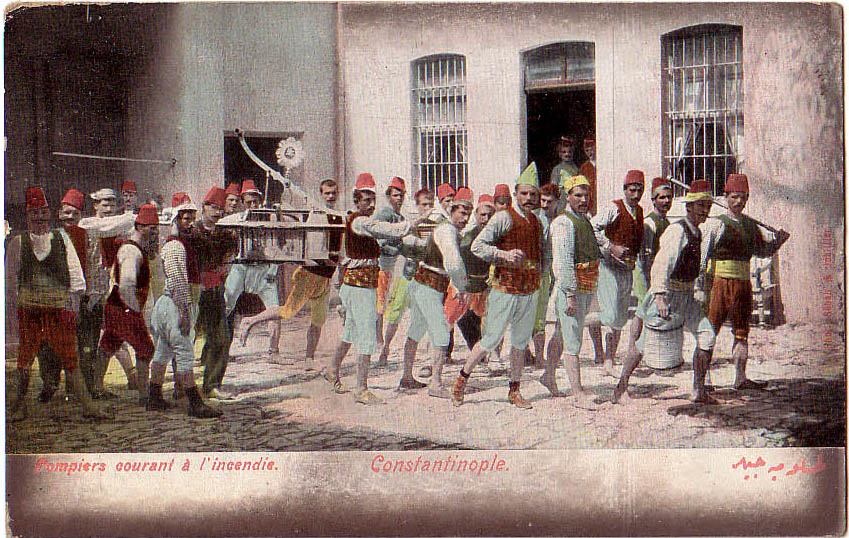
1900 | Fire Brigade


1900 | Fire Brigade | Tulumbaci(s) | Pompiers courand a l'incendie

This picture gives a good idea to certain dress codes of the time and some members wear a certain backless street shoe "yemeni / sipidik / slipper" that Petri must have used.

At the time Istanbul had no fire brigade. What it did have were tulumbaci, who would run to the scene of the fire carrying water pumps on their backs, more of a competitive sport than a public service. Each neighbourhood had its own team of firefighters. They were young men, good-looking, fast runners, and, of course, poor. The point of the competition was not putting out the fire but getting to the scene of the fire first. The sport had its own rules. A person would think twice before asking "Where’s the fire?", for fear of insult. The first proper fire brigade was set up by the Hungarian Count Szecseny, who was made a pasha in 1874, after the famous fire of Pera in 1870 when 3,000 buildings burned down.

The last surviving tulumbaci, Kemal Güleçin at Balat in Saffet's cafe playing card games like melot, prafa or pişpirik. He gets in the mood and shouts like the tulumba crew called “Tulumbacı Narası” .“Yaman gelir, yaman gideriz, Fethiyeli aslan tulumbacılarız”... “Karada aslan, denizde kaplan, var mı bize yan bakan”!

Thursday, April 20, 2006

"Costak...10 songs, 8 murders and a pair of slippers..."


This is Costak's first official logo (April 23,2006)

Petri committed more murders during his short life. "Costak" is however a film that brings characters from today into the times and tribulations of Petri and is not his full life story. Changes were made for the film and the real life provides only an inspiration. It is a legend that after each murder as he ran away he casted his slippers to run faster. Police in many cases connected the murders to Petri solely on the base of slippers found near a crime site.


Saturday, March 25, 2006

Kanto Article by Cemal Ünlü

Kanto by Cemal Ünlü

Italian theater and opera has had a profound effect on Turkish culture in the past century. Like the terminology ofseamanship, the terminology of music and theater derived from Italian. In the argot of the improvisational theater of Istanbul the stage was called "sahano", backstage was referred to as "koyuntu", backdrops depicting countryside were "bosko", the appiause was "furi" and the songs sung between the acts and plays were called "kanto".

The improvised pieces were stage adaptations of the Karagöz (shadow puppet) and Ortaoyunu (traditional form of Turkish theatre performed in the open) traditions, aithough in much more simplifled form. The themes explored in these traditional theater arts as well as their stock characterizations and stereotypes were used as the framework tor the new extemporaneus performances of the tuluat (improvised) theater.

As with their Italian counterparts the Turkish troupes employed songs and music before the show and between the acts to peak people's interest and draw in customers.

Kanto: songs sung between the acts as solos or duets, based on traditional eastern makam (modes) but performed on western instruments.

Kanto: "first the introduction, then the lyrics, shake your shoulders to a violin, solo, cock your head and shimmy in oriental dance style, leap around like a partridge, then slowly disappear behind the curtain."

Kanto: the irreplaceable unifying feature of ali Turkish tuluat theater.
We can divide kanto into two periods. The division, particulariy in terms of musical structure, is very clear between the early kanto and the kanto of the Post-Republic perlod. It is further possible to identify two styles within the early period. Galata and Direklerarası (both neighbourhoods of Old Istanbul).

Kanto first took root in the musical the aters of Galata, a part of town frequented by sailors, rowdies and roustabouts. Ahmet Rasim Bey paints a vivid picture of the Galata theaters in his novel Fuhs-i Akit (An Old Whore).

"Everyone thought Peruz was the most flirtatious, most skillful and the most provocative. The seats closest to the stage were always crammed full... They said of Peruz, 'she is a trollop who has ensnared the heart of many a young man and has made herself the enemy of many. 'Her songs would hardly be finished when chairs, flowers, bouquets and beribboned letters. Come flying from the boxseats. It seemed the building would be shaken to the ground."

Direklerarası was a littie off the beaten track and İn comparison to Galata was a more refined center of entertainment. Direklerarası was said to be quite lively at night during the month of Ramadan (Ramazan in Turkish) and certainly once its attractions was its family atmosphere. It was here that the troupes of Kel Hasan and Abdi Efendi and later that of Neshid enjoyed a great popularity. It was under the influence of these masters that kanto experienced its golden years.

The troupes orchestra would be made up ofsuch instruments as the trumpet, trombone, violin, and trap drum and cymbals. The orchestra would start to play popular songs of the day and marches in front of the theatre about and hour before the show to drum up interest. This intermission or Antrak music ended up with the well known Izmir March, a sign that the show time was approaching. The play began as the musicians went in and took their places at the side of the stage.

The kanto singers of the period were also composers. Set to extraordinarily simple melodies which were the fashion of the day, the lyrics relied heavily of tensions between men and women as well as reflecting topical events. The compositions were in such fundamental makams as Rast, Hüzzam, Hicaz, Hüseyni and Nihavent. Kanto songs are remember both by the names of their interpreters and by their creators, artists such as Peruz, Shamran, Kamelya, Eleni. Küçük and Büyük Amelya, Mari Ferha and Virjin. That kanto brought an erotic element to the stage performance was an important aspect and one that should not be overlooked or separated out.

Art and cultural life gained new dimensions with the changes brought about by the 1923 formation of the Turkish Republic. It was a period of rapid transformation and its effect were widespread. Turkish women had finally won the freedom to appear on the stage, breaking the monopoly previously held by Rum (Istanbul Greek) and Armenian women who performed in musical and non-musical theatre. Institutions like Darulbedayi (Istanbul City Theatre) and Darulelhan (Istanbul Conservatory of Music) had long been turning out trained artists.

Western lifestyles and western style art put pressure on the traditional Turkish formats and these were swept off to the side. The operetta, the tango then later the Charleston and the fox-trot overshadowed kanto. Kanto's popoularity began to fade, the citys centers of entertained shifted and the theaters of Galata and Direklerarası were closed down. Turkish female artists were unreceptive to kanto's inherent ribairy and chose to keep their distance from it.

But there came a change agah in the 1935's, there was a revival of interest in the kanto form. Aithough rather far from its fundamental principles a new type of kanto was önce again popular.

It is important to point out that kanto had now moved from the stage to the recording studio. While the subjects dealt with in the lyrics were stili the same old quarreis between men and woman, mixed in with satirical takes on fashion and current events. the songs were being written with the 78 rpm phonograph in mind. So much so that every record label hired their own kanto composers-and rather famous ones at that! With Columbia at the fore, record labels commissioned kanto from Kaptanzade Ali Rıza Bey, Refik Fersan, Dramalı Hasan, Sadettin Kaynak, Cümbüş Mehmet and Mildan Niyazi Bey. The makams were the same but the instrumentation had changed. Kanto were now accompanied by cümbüş (a fretlees banjo like instrument) the ud (a fretless) lute, and calpara (castenets). Foxtrot, Charleston and rumba rhythms dominated. The tunes were being written and sung more tor listening than tor dancing. Female soloists include Makbule Enver, Mahmure, and Neriman; Beşiktaşlı Kemal Senman was the most sought after male singer tor duets.

Among the topics explored by the new kantocu (singer or composer of kanto) perhaps the most frequent subjert of satire was the new role of women brought about by the formation of the Republic. Songs like Sarhoş Kızlar (Drunken Girls) or Şoför Kadınlar (Women Drivers) were sung seemingly in revenge tor ali the suffering they had endured at the hands of men in the past. Other topical songs include Daktilo (The Typewriter) whic brought to mind the newly formed Secretaires 7 Society. Songs such as Bereli Kız (The Girl with the Beret) and Kadın Asker Olursa (Women Were Soldiers) were full of mockery and ridicule.

The early period kanto were largely nurished by Istanbul culture. It was much the same in the Post-Republican period. The city's large and diverse population provided both the characters and the events that were the mainstay of kanto. Kanto was heavily influenced by musical theatre. Roman (gypsy) music and culture. which was itself of the subject of satire, left its mark on kanto form. Another major influence was Rum music. The importance of the Istanbul Rum, who were so fond of entertainment and of singing and playing, must not be underestimated. It is a natural and inevitable resuit of cultural exchange. As it was, almost all the kanto singers were either Rum or Armenian, artist like Pepron, Karakas, Haim, Samran and Peruz who performed during the period following 1903.

Eventually kanto became more of a definition, a generalized genre than a musical term. Any tune that was outside of the days musical conventions, anything light that appealed to current trends and tastes was labeled kanto. Any music played with different instruments that was free rhythmic or somehow novel was labeled kanto, it was the product of a middie class urban culture, of urban Istanbul.

This music, kanto, from the beginning of this century has been accepted as the forerunner oftoday's pop culture and it succeeded in remaining popular tor close to halt a century.

Çiçekçi yosmaları

Sinema ses mühendisi Necip Sarıcıoğlu'ndan, yüzyılbaşı İstanbul'unu titreten bir numaralı kabadayı Hrisantos'un bu sokakta büyüyüp yetiştiğini öğreniyorum. Bir çok güzel kadını kapatan, eşcinsellere düşkünlüğü ile de bilinen Hrisantos'un Çiçekçi Sokağı'nda 46 numaralı evde oturmuş olabileceğini söylüyor Necip Sarıcıoğlu. Daha o yıllarda travestik ve eşcinsel fuhuşun da bir geleneği olsa gerek Çiçekçi Sokağı'nda. Özellikle iki tane ev var ki, bu evlerin sermayeleri olan delikanlılar kadın kılığına girip pencere ve kapı önlerinde, civar kahvehanelerde ve sokaklarda boy gösteriyorlar. Bütün evlerin uşakları da aynı boydan gençler ve adamlar. Çiçekçi Sokağı'nda fuhuş yapan kadınlara "Çiçekçi yosmaları" veya "Çiçekçi'nin gülleri" deniyor.

Bir de sokak ile aynı adı taşıyan bir koltuk meyhanesi var. 1880 ile 1890 arasında Doktor lakabı ile anılan İstelyo isminde bir Yunan uyruklu tarafından işletiliyor. Çiçekçi Sokağı ile Yeniçarşı Sokağı kavşağındaki bu mekan her iki sokağın fahişelerinin uğrak yeri olarak tanınıyor. Fuhşun acemisi olanların eşiğinden içeri adım atamadıkları "Çiçekçi"nin müşterileri ise Yunanlı, İtalyan, Rus, İngiliz ve Fransız gemiciler. İçeride Rumca konuşulur, kapısından sokağa neşeli kahkahalar, küfürler, Rumca şamata ve yaygarası taşarmış. 1890 kışında işlenen bir cinayet sonucu kapanan "Çiçekçi"nin sahibi doktor hakkında da cinayet davası açılmış. Daha sonra da doktor sınır dışı edilmiş.

ÇİÇEKÇİ SOKAĞI CİNAYETİ

ÇİÇEKÇİ SOKAĞI CİNAYETİ

Çeşitli zabıta vakaları ile ünlenmiş bu sokakta işlenmiş benzeri az rastlanır bir cinayet olayı.

Katil 17 yaşındaki Kız Yani. Bir yıldan beri beraber yaşadığı Perikli adındaki kayıkçı ile bir gece müdavimi oldukları tavernadan çıktıktan sonra Çiçekçi Sokağı'ndaki genelevlerden birine giderler ve birer kadınla yatarlar. O gece Kız Yani'yi konuk eden, asıl adı Viyolet, muhitindeki takma adı Deniz Kızı Despina olan 35 yaşındaki kadın güzel oğlana aşık olur ve kendisinden on sekiz yaş küçük olan bu delikanlıyla sevgili olur. Üç ay süren yakın dostlukları sonunda birbirlerine hayat hikayelerini anlattıklarında korkunç gerçek ortaya çıkar. Despina ve Yani kardeş olduklarını öğrenirler. Facia bu kadarla da kalmaz. Despina kendisini kandırdıktan sonra yüzüstü bırakan ve fuhuş girdabına düşmesine neden olanın kayıkçı Perikli olduğunu söyler. Despina Aranvutköy'deki baba evinden ayrıldıktan sonra Yani dünyaya gelmiştir. Daha sonra iki kardeş intikam amacı ile kayıkçıyı öldürme kararı alırlar. Kız Yani kopuk aşığıyla bir gece Çiçekçi Sokağı'ndaki geneleve geldiklerinde bir işret sofrası kurulur. Perikli sarhoş olup sızar ve iki kardeş tarafından kendi kuşağı ile boğularak öldürülür.
Cinayet davası iki yıl sürer. Suçlu olarak yalnız Yani sorguya çekilir. Ablasının adı, en küçük ayrıntıya dahi girmeden, "Müntehir Despina," diye geçer. Cinayeti işlediği zaman 17 yaşını doldurmamış olması, ağır tahrik ve başka hafifletici nedenlerle Yani yedi yıl hapse mahkum edilir.

Kanto

Polyphonic music, which developed in the West over many centuries, is alien to traditional Turkish music. Polyphony finally entered Turkey with light music such as operettas, tangos and kantos in the Nineteenth Century. Erken Dönemde Kanto Kantoyu iki döneme ayırabiliriz. Gerçekte de hem biçimi hem müzikal yapısı ve yorumlanışı açısından erken dönem kantoları ve Cumhuriyet sonrası kantoları önemli farklılıklar gösterir. Erken dönem kantoya, Galata tiyatroları ve Direklerarası kantosu demek de mümkündür. Daha çok gemicilerin ve bıçkınların uğrakyeri olan çalgılı Galata tiyatroları. Ahmet Rasim Bey'in naklettiğine göre "Birinci perdeleri ekseriya soğuk, pandomima usulunde; bir komediyen veya zamanın komikleri Paskal Andon, Corci, Todori gibi aktörlerin Rum şivesiyle, bozuk Türkçeyle oynayıp, namına tiyatro dedikleri, Ortaoyununun sahneye çıkarılmış kaba bir taslağından ibaret, saçma sapan söz döküntüleridir". Birinci perdeden sonra, ikinci derece şantözlerin okuduğu kanto faslı başlar. Tiyatronun "devşirme orkestrasının ahengi" arasında kemani Kıvırcık Toni yahut klarnetçi Salih Efendi, "Peruz'un ya da Küçük Amelya'nın gelişini müjdeler" Ahmet Rasim Bey Fuhş-i Atik kitabında, Galata tiyatrolarırı ayrıntılı bir biçimde anlatır. 

"Peruz daha işveli, daha marifetli, daha şehvetli daha munis görünüyordu. Onun için tiyatronun sahneye yakın yerleri dopdolu bulunurdu. Tersane topçu neferlerinden, sıkma potur üstüne kukuletalı sako giyimli natırlardan, tellaklardan, hafiyelerden, mavnacı, salapuryalardan tütün da kalem mümeyyizlerine, on dört on beş yaşlarında çocuklara varıncaya kadar hekes buralarda yerini alır. O zaman Peruz için derlerdi ki: Çok kimsenin katili olmuş çok gencin caninin yakmış bir kahpedir. "Sarkışını bitirdi mi, localardan sandalyeler, çiçekler, buketler, fiyongalı mektuplar atılır, şangırtı, höngürtü, patırtıdan bina yıkılacak zannedilirdi. Rakipler arasında tokattan, sopa, usturpadan başlayan çekişme, ustura, bıçak, demir çekme, bazen de tabanca atmakla" son bulurdu. Gerçekten de Peruz ve öteki kantocular için bu türden sonu acı biten pek çok sevda hikayesi anlatılır. Peruz'un Ayvansaraylı hamal kahyası bir sevgilisi olduğu, ona sıkı sıkıya bağlı ve sahneye savrulan paralara yan gözle bile bakmayacak, pas vermeyecek, namuslu bir kadın olduğu da söylenir." 

O sadece çiçeğe meraklıdır. Kim bir çiçek atarsa onu alır, koklar ve göğüsüne takardı". Bu Galata tiyatrosu hikayelerinin en acılısı da, Agavni isimli bir Ermeni kantocunun başından geçenlerdir. İki erkeğin rekabeti neticesinde belalısı 'Mart Dokuzu' tarafından sahnede kurşunlanmış ve kendisine aşık, saraya mensup bir paşanın sahneye fırlattığı çiçek demetinin yanında can vermişti. Ayak takımının pek uğramadığı Direklerarası, Galata'ya göre daha sakin bir eğlence merkezidir. Özellikle Ramazan geceleri çok hareketlidir ve en önemli özelliği ailece gidilebilir olmasıdır. 

Burada önceleri, Kel Hasan ve Abdi Efendilerin, daha sonraları Naşid'in toplulukları büyük rağbet görmüş ve kanto sanatı, gerçekten de parlak yıllarını bu ustaların idaresi altında yaşamıştır. Topluluk orkestrası keman, trompet, trombon, klarnet ve bir trampetle zilden oluşur. Büyük bir ihtimalle de batı çalgılarını çalanlar Muzika-yı Hümayun sazcılarıdır. Orkestra temsilden bir saat önce kapı önünde günün sevilen şarkılarını, kimi oyun havalarını ve marşları çalarak seyirci toplamaya çalışır. İzmir Marşı ile son bulan bu "Antrak müziği" artık gösterinin başlayacağınin da bir işaretidir. Toparlanan orkestranın gidip sahne kenarındaki yerini almasıyla da gösteri başlardı. Dönemin kantocuları aynı zamanda bestecileridir. Son derece basit ezgileri olan kantolar günün modasını, güncel olayları yansıtan, en çok da kadın erkek çekişmesine dayalı güfteler üzerine söylenmiştir. Yangın, Çoban, Değirmenci, Dondurmacı, Sevda Pazarında, Avcı Kantosu, Sarı Liralar, Seni Budala Şaşkın kantoları gibi. Bazı güfteler, Pencereden Gördüm Ayı, Ocağıma İncir Dikti, Leblebici kantolarında olduğu gibi, mizahi özellikler de gösterir. Rast, Hüzzam, Hicaz, Hüseyni, Nihavend gibi temel makamlarla bestelenmiştir. Kanto, hem okuyucusu, hem bestecisi kantocunun adıyla anılır. Peruz, Şamram, Kamelya, Eleni, Küçük ve Büyük Amelya, Mari Ferha, Verjin gibi hanım kantocular ve Niko, Naşid gibi erkekler solo ve düet yaparlardı. Kanto ritimlerine uygun olarak raks etmek, basit adımlar ve omuz titretmelerle kantoyu erotik bir sahne gösterisine dönüştürmek işin bir önemli yanı, ayrılmaz parçasıdır.

    Kantolar
Murat Belge
Türk müziğinde kanto, birtakım insanların "ayıp olur" kaygısıyla tutkularını itiraf edemedikleri ve adı geçince "Ha, o mu? önemli değil. Ciddi bir şey değil, " diye geçiştirmeye çalıştıkları bir sevgiliyi andırır. Çünkü kanto bütün özellikleriyle "saygıdeğerlik" idealinin karşıtı değilse dışındadır, aynı zamanda da çok sevilmiş bir türdür. Dünyada her yerde böyle müzik türleri bulunur. Ya da, tarih boyunca, bazı müzik türlerine bu gözle bakıldığı uzun dönemler olmuştur. Romantizm'in çıkışma ve sonra milliyetçiliğin gelişmesine kadar halk müziği aşağılanan bir türdü. Kentleşme sonrasında, kentlerin alt sınıflarının ürettiği müzikler de kibar çevrelerde görmezlikten, işitmezlikten gelindi. Denizci türküleri, yalnız alt sınıfa ait oldukları için değil, güfteleri genellikle kabul edilmiş "edep" normlarına aykırı gittiği için küçümsendi. Ama gene birçok yerde ve birçok dönemde, sınıfsal snobizmle yok sayılan müzik türleri rehabilitasyona da uğradı; New Orleanslı zencilerin blues'ları, Arjantinli apaşların tangoları v.b. Kanto ise pek böyle bir "saygıdeğerleşme" sürecine de giremeden yok oldu. Bunun bir iki istisnası oldu: ellilerde, Türkiyenin ilk nostalji dalgalarından biri olan Radyo'daki "Ramazan Eğlenceleri" programları ve bir de, altmışlarda, Altunizade'de bir avuç insanın birkaç yıl gene Ramazan dönemlerinde dirilttiği "Direklerarası" atmosferi. Bu sınırlı canlanmalarda kantoyu sevenler (hatırlayanlar ya da yeni işitip hoşlananlar), artık olmayan ve olmayacak bir şey olarak onu sevdiler. "Artık olmama"sıydı, önemli olan. Demek ki, kanto kendisini ortaya çıkaran toplumsal koşullara fazlasıyla bağlıydı. Bu koşulların neler olduğunu görmeye çalışalım. En başta Osmanlı toplumunun batılılaşmasını ve İstanbul'un da bu sürece ayak uydurmasını saymak gerekiyor. Bu sürecin dinamosu Beyoğlu'nda çalışıyordu, ama İstanbul'un başka semtleri de oraya ayak uydurmakta çok gecikmediler. Beyoğlu bugün bildiğimiz biçimini 1871 yangınından sonra almaya başlarken Direklerarası da 1880'lerde alternatif eğlence yeri haline geldi. Direklerarası İstanbul'un "eğlence" kavramını değiştirdi. Bundan önce eğlence bayram gibi belirli zamanlara özgü bir şeydi ya da düğün ve sünnet düğünü gibi özel kutlamalarda, kutlayanın kesesine göre, çevre halkını da içerecek biçimde düzenlenirdi. ilk olarak Direklerarası, adresi belli ve sürekli bir "eğlence yeri" olarak ortaya çıktığı gibi eğlencenin bazı biçimlerini de -tiyatro,kanto (v.b.) - geleneksel İstanbul halkı, geleneksel eğlencelerin yanısıra, ilk burada tanıdı. İstanbul başından beri sınıfsal bir esasa göre kurulmuş bir şehir olmadığı için, eğlencenin paylaşımı da çoğu zaman "umuma" açıktı. Bayram yerine herkes giderdi; değindiğim sünnet düğünü tipinden eğlencelerde de, düğün sahibi, orta halli ve yoksul mahalle sakinlerini olaya katmaya özen gösterirdi. Bu alışkanlığın Direklerarası'nda da devam ettiğini biliyoruz. Varlıklı ile yoksulu bir arada memnun etme durumu, özellikle kanto gibi bir türde hayal gücünü üretkenliğe teşvik eden bir etkendir. Kanto, toplumda bir değişimin ürünü ve aynı zamanda ürünü olduğu değişim hakkında bir "commentaîre"dir. Sırf bir "şarkı" olarak baktığmızda, ezgisi, temposu, sazları ve söyleniş biçimiyle, o zamana kadar bilinen bütün "şarkı"lardan farklıdır. İlk Kanto örneklerinde çok belirgin olmayan bu farklılıklar (Örneğin "Seni her dem anıyorum" gibi bir parça "curcuna" usulünde bir şarkı ya da kanto tavrında söylenebilir, ikisine de gider), zamanla, önceki "mahcubiyet"lerinden sıyrılır ve açılan yolun sonuna kadar giderler. Bütün bu farklılıklar içinde en çarpıcı olanı, kadının varlığıdır. Kadının kendini sahnede göstermesi yetmiyormuş gibi, elbisesi de onu genellikle, hiç alışılmadık biçimde gösterir -bütünüyle "mahrem" kalmış bedenin- bazı bölümlerini açarak. Ama kanto yalnız bir "şarkı" değildir; aynı zamanda, kendisini izleyecek olan oyunun bazı "teatral" özelliklerini de içerir. Kantoyu söyleyen, jest ve mimikleriyle güfteyi pekiştirir. Ayrıca, sözlerin arasındaki müzikli bölümlerde küçük bir dans icra eder "Düet"in ortaya çıkmasıyla, (bunun da fazla zaman almadığı anlaşılıyor) bu "teatral" özellik iyice ön plana çıkar. Düetin en yaygın biçiminde bir kadın ve bir erkek vardır, ama bazılarında yer yer başka "figüranlar"da belirip güftede anlatılan bir durumu "dramatize" edebilirler. Ve bütün kanto ya da düetler, bir biçimde, mizahîdir. Türün temel niteliklerinden biri budur. Birinci amacı, seyirciyi eğlendirmek olduğuna göre, böyle olması doğal. Ama sanırım bunun daha derine inen bir nedeni de var. Daha önce yazdığım bir yazıda belirttiğim gibi, kanto "Batılılaşma" sürecinin durmadan yarattığı şokları hafîfleştirerek ve komikleştirerek "dayanılır" kılan bir türdür. Mizah bunun için zorunludur. Son derece geleneksel ve göreneksel, ayrıca, kendi alışık olduğu değerlerin üstünlüğü konusunda son derece "burnundan kıl aldırmaz" Osmanlı toplumu, bilinen nedenle ve kaçınılmaz bir biçimde, batılışma sürecine girdi. Biraz "hem ağlarım, hem giderim," üslubunda bir gidişti bu. Böyle bir "paradoksallığı" zamanın ciddi edebiyatında da gözlemleriz: Örneğin roman Batı'dan gelmiş bir türdür ve "roman yazmak", başlı başına, "Batılı" bir etkinliktir. Gelgelelim, her romancı, romanında, batılılaşmanın aşırı, gülünç, mutsuzluk getiren v.b. sonuçlarırı eleştirmekten geri durmaz. Romanda bu eleştiri çok zaman, tam anlamıyla trajik olmasa da, acıklı sonuçlarıyla gösterilir, bir çeşit "Şarkılı sentimantal trajedi" kılığına bürünür (İntibah, Araba Sevdası, Zehra vb.). Kantoda, doğal olarak, bu "trajedi"nin de yeri yoktur. Kantoda batılılaşmaya gösterilen tepki güler yüzlü bir "fesuphanallah" gibidir. Ama bu mizah, aynı zamanda, güçlü bir enerji ya da dürtüyü dizginleyen ve kamufle eden bir örtüdür; kadınla ilgili, bilinçliliğin çeşitli derinlik düzeylerinde yer alan bütün tasarımlar, genel hayatta olduğu gibi bizzat kanto temaşasının kendisinde harekete geçmiş haldedir. Bu gerilim ve yoğunluk, ancak mizah yoluyla ehlileştirilebilir, yatıştırılabilir. Dolayısıyla, kantolar hayatın her alanı ve yeniliği üstüne bir "commentaire" olsalar da, sonuçta hepsi toplumun yeni "kadın kültürü" üzerindeki etkileri en canalıcı yanlarıdır. Tüllere, peçelere alışmış Osmanlı toplumunda, kanto da bazı koruyucu, ama aslında "şeffaf " tüllerle, kadının kendisine tanınan yerden dışarıya çıkmasını örter ve açar: gayrı müslimlerin söylemesi, hafif meşrep, hovarda tiplemelerin seçilmesi, bir yandan "canım, bunlar gördüğünüz gibi, özel kadınlar. Her kadın böyle olmaz." der gibi görünürken, aslında böyle olabileceğinin işaretini verir. Erkek toplumu ise, hem bundan korkar, hem bunu çok ister. Dolayısıyla -ve özellikle bu çerçevede- kanto günahkardır; günahı yumuşatmak için de mizahî ve hafiftir. Bu özelliklerine, bireyselleştirici bir yanı olduğunu da ekleyebilirim. Geleneksel Osmanlı müziğinde yazılmış şarkıların herhalde yüzde doksanı aşk konusunu işliyordu. Ama aşk şiiri olduğu halde, bireyselliğiyle ayırdedilen bir "aşk şairi" olmadığı gibi, anlatılan durumlar da geneldi. Bu, divan şiirinin, şairi bir hayli anonimleştiren (zenaat loncalarındaki gibi) idealinden ileri geliyordu. Kanto, "teatral" özelliğinden ötürü, şarkıyı söylediği varsayılan "kahraman"ı bireyselleştirir. Bunlar şüphesiz birtakım toplumsal "tiplerdir: hafif meşrep kadın veya hovarda delikanlı, Laz, Arap kızı veya Çingene gibi etnik tipler, sarhoş ya da köylü ya da arabacı gibi. Ama aynı zamanda, gözümüzle gördüğümüz somut kişilerdir, o anlamda bireyselleşirler. Türk hafif müziği, tangodan arabeske, daha sona aldığı biçimlerde, bu bireyselliği ve bu somutluğu bir daha yakalayamadı. Kanto bütün bu özellikleriyle, Liza Minelli'nin olağandışı parlak bir örneğini (aynı adı taşıyan filmde) verdiği "kabare" müziğine bir hayli yakındır, İtalyan tipi "belcanto"dan türediği halde, koşulları gereği, aslında hiç tanımadığı "kabare'ye yaklaşmıştır. Cinsellikle kurduğu ilişki ona benzer (Türkiye'nin bu alanda, yukarıda değindiğim büyük acemiliği dışında); toplumsala ve politik olaylar ve değişimlerle ilişkisi de öyledir: dolaylı, örtük, ama sonuna kadar. güncel. Sonuç olarak, kendini ürüten bu somut koşullara gerçekten sıkı sıkı bağlı ve hatta bağımlıydı. Onun için, bütün kanlı canlı görünüşüne rağmen aslında nahif ve kırılgandı. Böylece, koşullar değişince kanto da uçup gitti, sevimli bir anı oldu.

Bel canto

Bel canto means, most literally, "beautiful singing." It is a term used to describe all Italian singing, but in particular the light, bright quality that Italian opera singers use to charm audiences. Despite bel canto's popularity, it is shrouded in obscurity. The history of this art is a complicated and mysterious one.

Bel canto emerged in the sixteenth and seventeenth centuries, but its roots lie all the way through the Middle Ages. It began in the singing instruction that Italian masters provided their students. Because singing must be mastered internally, teaching singing is tricky. Italian masters relied on a system of teaching and listening to their pupils. When the pupil created a tone or sound that was of admirable quality, the master would urge that pupil to repeat the sound until it was ingrained in their memory. This practice became so inherent to Italian singers that Italian singing became shrouded in mystery. Many thought that Italy was protecting its singing mastery from foreign countries, when in reality it was simply espousing a valuable teaching style.

Bel canto was initially used by men, and, at its earliest, by male religious singers. The Italian castrati were famous for their use of this singing style. During the time of the Renaissance, the period when opera was created in Italy, bel canto became the singing style used for this new art form. Later, it became famous through use by other operatic singers, notably sopranos. Today, it is sopranos like Joan Sutherland and Kathleen Battle that keep this tradition alive.

The secret to bel canto, some claim, lays in continuity of tone. Many singers are judged on their ability to pass from one musical phrase to the next with little to no interruption. The art of sustaining passages to create a beautiful line can be seen in the performances of the most famous bel canto singers.

Italian singing itself is very dependent upon the Italian language. Italian words often contain consonants strung together with vowel sounds. Because of this, their language is very fluid and, when spoken correctly, it resonates in the facial structure. Italian singers make full use of these vowels, because they allow long, continuous lines in singing. Italian singing contains little distinction between the start of tone and the intake of breath. This, too, contributes to a continuous line. Finally, Italians consider singing to be a natural act instead of an unnatural one. Therefore, true Italian singing, and true bel canto singing, is an extension of normal speaking and voice expression.

Rossini, Donizetti, Bellini, Marcello and Pacini are some of the most famous bel canto composers. In their operas, one finds the light, soaring soprano and tenor arias that have made Italian opera famous. While many consider bel canto to be an art that has "died," bel canto is, by its very nature, Italian singing. Therefore, it will exist as long as Italian singing does. From the popularity of Andrea Bocelli and other Italian singing stars, one can see that bel canto will be around for quite a long time.

Saturday, February 11, 2006

Song | Yabandan Gel (Kostak Yörü)

Yabandan Gel (Kostak Yörü)

From Niğde- by Rıfat Çavuş- Collected by Muzaffer Sarısözen

Yabandan Gel Usul Da Boylum Yabandan (Aslanım Hey Hey)

Refrain:
Amman Yörü Yörü
Çapraz Yörü Yörü
Kostak Yörü Yörü
Yörü Yörü Yörü

Aldım Haberini De Çobandan (İmanım Hey Hey)
(repeat refrain)
Yaban Ellerinden De Özendim Geldim (Aslanım Hey Hey)
(repeat refrain)
Gördüm Cemalini De Efendim Geldim (İmanım Hey Hey)
(repeat refrain)
Yaban Ellerinde De Yatmış Uyumuş (Aslanım Hey Hey)
(repeat refrain)
Ela Gözlerini De Uyku Bürümüş (İmanım Hey Hey)
Şirin Yörü Yörü
Tek Tek Yörü Yörü
Bebek Yörü Yörü
Kostak Yörü Yörü
Usul Yörü Yörü
Güzel Yörü Yörü
Yörü Yörü Yörü

Kostak Family Name

The Kostak surname is derived from the personal names Kosty and Kost, which are pet forms of the male given name Konstanty, which is the Polish form of the name Constantine. The name Constantine is a derivative of the Latin name Constantinus, which means steadfast and faithful. This name was borne by the first Christian ruler of the Roman Empire, Constantine the Great (280-337). Constantine rebuilt the city named Byzantium, renamed it Constantinople and made it the capital city of the Eastern Roman Empire. Constantinople is the modern city of Istanbul, Turkey.

Wednesday, February 01, 2006

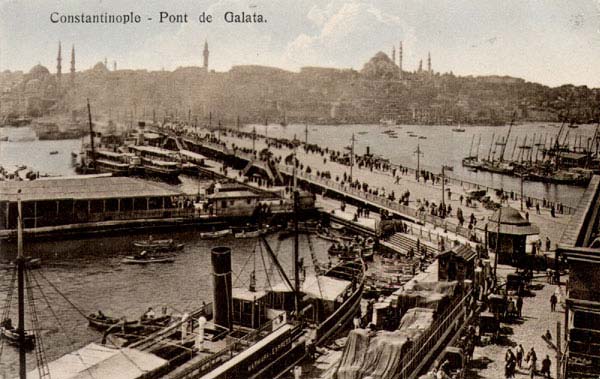
Cadde-i Kebir and Pont du Galata

Imagine Petri at Galata or dodging the police at Cadde-i Kebir in Pera.


Galata Bridge

Sinan imprint, 36


Cadde-i kebir, Pera / İstiklal Caddesi, Beyoğlu

Editeur Zellich Frères, 34

Tabachaniotika

Tabachaniotika Listen sample

The tabachaniotika (sing., tabachaniotiko) songs are a Cretan urban musical repertory which belongs to the wide family of musics, like the
rebetika and music of the Café-aman, that merge Greek and Turkish elements. This genre represents an outcome of the Greek-Turkish cultural syncretism in Crete during the period of Ottoman domination. According to Chaniá musicians, the tabachaniotika probably arose in Crete in the towns of Chaniá and Rethymnon around the middle of nineteenth century. It was then the typical musical repertory of the so-called turkokritikoí, Muslim Cretans. It developed mainly after the immigration of Smyrna's refugees in 1922, as did the more widespread rebetika.
Various conjectures are advanced to explain the meaning and origin of the term "tabachaniotika." Kostas Papadakis believes that it comes from tabakaniotikes, which may mean places where hashish was smoked and music performed, as in the tekédes of Piraeus. But a quarter named Tabahana existed in Smyrna and the name had a Turkish root (Trk., tabak: tanner; tabakhane: tannery). In Chaniá too, there was a quarter with the same name, where refugees from Smyrna lived after the 1922 diaspora. Tabachaniotiko was also the name of a song of the amané genre, which was popular in Smyrna in the period before 1922, together with some other songs called Minoré, Bournovalio, Galata, and Tzivaeri (
Kounadis 1993: 23). Compare the Greek-Turkish ballos performed by a Greek ensemble in New York City in 1928, included in the article by Karl Signell.

See more from the Article's Source posting

Petri's Tavern Song

Petri wrote the lyrics of this song and sang it in Galata taverns/dives (meyhane). His song remained popular years later and was remembered. We have no record of his song today. As part of a sources music project for Costak we want the greek wording to be proof-read and are planning a new composition based on the historic style and we plan to record it both for the film and the Sources CD that will be released before the film.

Dose mu krasi
Yemise tis asimenies palames sou
Na pio to krasi ap'tis fuhtes sou
Dipsasmena dipsasmena

Δώσε μου κρασί
Γεμισέ τις ασημένιες παλάμες σου
Να πιώ το κρασί απ'τις φούχτες σου
Διψασμένα Διψασμένα


Bana sarap ver
Gumus avuclarina doldur
Sarabi avuclarindan iceyim
Kana kana

Give me wine
Fill your silver palm
I will drink from your hands
With a great thirst


My friend Leigh Kline wrote back:"It could be done as a Kamilieriko -sort of a zeybek type but a little faster" .

The Hellinic zeimpekikos is a slow 9/8 rythm with a 15 syllable verse broken into 2, one 8 syllable and one 7. In the 'school' of Pireas the well known troumpa there was a variation of rythms, which is why we find songs from Bambakaris, Tsitsanis etc. played in a 9/18 rythm or the 'fast' 9/8 seen in the 'aptaliko' and the 'kamilieriko'.

Saturday, December 24, 2005

Baloz

Baloz: a type of Galata dance club patronized by sailors and port workers. The name probably derived from the "ballo italiano" italian ballo/baloz (from Latin: balare/to dance). In contrast to all male Galata Taverns -mostly basement or ground floor- baloz was an upper floor affair for dance and music and women were found as well working as a "konsomatris/ En.hostess,escort /Fr.consommatrice ". Today's "b-girl" woman employed by a bar to act as a companion to male customers.

Baloz became popular during the times of the Ottoman Sultan Abdulaziz (1830-1876) who visited Western Europe in 1867, being the first Ottoman sultan to do so, and he was made a "Knight of the Garter" by Queen Victoria. Austrian Emperor Franz Joseph (appointment annulled 1915) and the Russian Tzar Alexander II also received the same title in 1867.

Further Source:
Perhaps the most important late eighteenth-century technical manual was Gennaro Magri's Trattato teorico-prattico di ballo, published in Naples in 1779. By the end of the eighteenth century, the differentiation between theatrical and social dance was nearly complete; professional dancers were performing increasingly complex steps while social dancers were concentrating on the growing genre of group dances.


Palikarya

"Pallikari" (plural Pallikarya). (Turkish: yigit) Greek word for young men, brave men, it connotes strength and youth. In Petri's times Palikarya was usually assigned to Rum/Greek street gangs of istanbul.

The Pallikari of Nesmine Rifat by David Solway

For his celebrated poetry collection Saracen Island, David Solway took on the voice of a Greek poet named Andreas Karavis. So artful were these poems that many readers believed they were authentic translations from Greek by Karavis. The Pallikari of Nesmine Rifat continues Solway's inspired poetic ruse. In this new book of ostensible translations, he adopts the persona of Karavis's spurned lover, Turkish Cypriot poet Nesmine Rifat. Lushly sexual and sparkling with wit and intelligence, these extraordinary poems take the form of a series of undelivered letters, penned in the wake of Karavis's desertion and eventual marriage to Anna Zoumi. With great subtlety and sensitivity, Solway portrays a powerful woman and gifted poet undergoing a violent emotional journey from explosive anger and arrogant disdain to bitter melancholy and undying passion.

Petri at the Holy Monastery of Zographou

Petri stayed with Haci Kosti Vatakis a fishermen of the Holy Monastery of Zographou during 1877-1879. He grow a beard and befriended and shared a bed with a priests desciple of Vatakis.


Holy Monastery of Zographou

The Monastery of ZographouIt was built during the tenth century by three brother, the monks Moses, Aaron and John (Ioannis) from Achris (Ohrid). It is dedicated to Saint George. It occupies the ninth rank in the hierarchical order of the twenty Athonite monasteries. It is inhabited by 15 monks (1990) and is coenobitic (communal). Initially, the monastery was inhabited by Bulgarians, Greeks and Serbs. Its monks are all Bulgarian, since 1845, and the services are performed in Bulgarian.

The monastery is situated on a slope of the S.W. part of the peninsula. The Katholicon was built in the beginning of the last century and follows the athonite type. The monastery was founded, according to tradition, in the 10th c. by three brothers, Moses, Aaron and Ioannis from Achris. In the Late Byzantine period, the monastery is destroyed by Catalan pirates and rebuilt with the financial support of the Paleologan dynasty, as well as that of rulers of eastern Europe.

Besides two miraculous icons of St George and other two of the Virgin of the Akathistos and the Virgin Epakouousa, the monastery owns and other heirlooms and ecclesiastical vessels.
The library is located in the monastery's tower. It features rare manuscripts, Greek and Bulgarian codices, and 10,000 printed books in Greek and the Slavic languages. Its most prized treasure is the codice 1, which contains Bulgaria's first history, written by the monk Paisios in 1745.