The Professional Careers: Women Pioneers and the Male Image Seduction
Rachel Finnegan
Royal Irish Academy
Dublin
An idea of just how the female was perceived by a thinking Athenian male can be judged from a statement made by the philosopher and polymath, Aristotle. In his Politics, he discusses the idea of rulers and subjects. Having stated that it is advantageous for animals (whether wild or tame) to be governed by men, he then asserts: 'Also, as between the sexes, the male is by nature superior and the female inferior, the male ruler and the female subject.'(1) Such a concept explains and justifies why it has been necessary, throughout history, for men to hold power over women.
Earlier examples of this justification take the form of charter or matriarchal myths.(2) In accordance with this Aristotelian dictum, the sources, with revelations about double-standards in relation to women's position in society and in law, and the obvious anti-female tendencies - particularly towards those of the less respectable classes - present a very dismal picture to the modern reader of the West. The custom of seclusion made it impossible for women of the 'respectable' classes to pursue a profession - at least outside the home - and a question which has been hotly debated for many years is whether or not this system reflects men's distrust or hatred of the sex.(3)
As vividly illustrated in Xenophon's Oeconomicus - a famous treatise on household matters - the duty of a woman or wife (the same word, gyne, sufficed for both) was to manage the internal affairs of the household, while that of the man was to deal with matters outside the home.(4) Together with producing heirs to the estate, and taking part in various obligatory religious rituals, household management was a woman's sole occupation in life, and as such, the amount of education she required was minimal. It is not until the end of the fourth and the third-centuries BC. that we start to find evidence of education and schooling for girls in the Greek world.(5)
The whole subject of respectable women was taboo in Classical Athens, to the extent that it was frowned upon to even mention them by name in public - a convention realistically presented even in the otherwise unconventional world of comedy.(6) Given this, together with the fact that their life-style was hardly conducive to inspiration or creativity in the arts, it is not surprising that one of the major proofs of female literacy - literary production - is almost non-existent. Other sources, such as vase-paintings with scenes of women reading or writing, are often misleading and difficult to interpret, since subjects which have always been thought to represent ordinary women, often turn out to be Muses or the poetess Sappho.(7)
Whatever the degree of literacy among Athenian women, it is clear that only those from the less respectable classes of society, the old, or those whose families had fallen on hard times, worked outside the home. Even then, however, the occupations they undertook could hardly be described as professional careers, but rather, as the least condemnable means of earning a wage (as opposed, for instance, to prostitution). Such work included street or market-vending (which may have involved the actual production of wares), midwifery, matchmaking and child-care. The women themselves were regarded as inferior since they were not only engaged in lowly trades outside the home, but worked side-by-side with metics (resident aliens) and slaves, and necessarily came into contact with men - the avoidance of which was clearly the primary aim of keeping women at home in the first place.
Such a prejudicial attitude is apparent in a legal oration involving a man by the name of Euxitheus who had lost his rights of citizenship because his mother was a nurse and a ribbon-seller and, therefore, was assumed to be a non-citizen.(8) Demosthenes succeeded in helping his client regain his citizen status by defending the mother and other citizen women like her, who had clearly been reduced to such a life-style through pressure of continued war. When husbands went away to war for years on end, or died on the battle-field, women were often faced with the prospect of taking up some lowly job to keep the family from starvation.
However repressive a society, it is inevitable that there are always some exceptions to the general rule, and throughout history there are examples of various women who actually did manage - against all opposition - to pursue their chosen career and achieve fame - even if it meant dressing up and posing as a man! Closer to our own time, we can think of slightly less extreme situations in which English novelists had to adopt men's names in order to have their works accepted by publishers: women such as George Eliot (who is still known by this pseudonym) and the three Bronte sisters - Acton (Alice), Currer (Charlotte) and Ellis (Emily). It is significant that most of the 'influential' women from the period we are dealing with were particularly concerned with what we nowadays call women's 'issues'. This is, perhaps, because they were writing on, or in other ways concerned with, those matters which most affected them, in the same way that men - as is evident from the sources - were prone to concentrate on peculiarly male affairs. What is more interesting, however, is the contemporary male attitude to such women and their achievements, which is generally one of ridicule or condemnation.
With regard to writing - what we would possibly regard as the most respectable and genteel of occupations - the seventh-century poetess, Sappho, dedicated many of her love-songs to other women and girls.(9) Similarly, Erinna, another poetess writing in the mid-fourth-century BC, is famous for a poem she composed in memory of her dear friend Baucis - a young girl who was always at her side (GLP 3.120). Both these women dwelt on themes of the close friendships of young girls - Sappho in particular presenting the idea of happiness and innocence in childhood, and the horror of being snatched away from friends at an early age and forced into unwelcome marriage.(10)
Although the work of Sappho has been greatly admired and imitated by poets through the ages, it was continually mocked by the Athenian comic playwrights, who gave the word "lesbian" (the adjective deriving from her birth-place) obscene connotations.(11) The work and private life of Erinna, and her close friend Baucis, are similarly derided by the Alexandrian mimographer, Herodas, who, in his Mimes, uses them as comic names for olisboi (dildos);(12) and if this sort of smutty male reaction to female writers is not bad enough, commentators on their works - both ancient and modern - have further diminished the reputation of such literary talent and skill by actually denying female authorship.(13) Another example is the poetess Corinna, (of Thebes or Tanagra), who defeated Pindar five times in poetry contests and was rewarded for giving him some literary advice by being referred to in a later poem as a 'Boeotian sow'(14) - the sow being a common term of abuse used of women in the Greek world.(15) Likewise, the fifth-century poetess Praxilla wrote a Hymn to Adonis, which was duly ridiculed by other members of the literary circle.(16)
From writing, we turn to philosophy - an activity less likely to include women, since its practice often involved the discussion of theories in groups or sects. There are exceptions, however: the life and works of the sixth-century Pythagoras - known even then as the 'Feminist Philosopher' - are said to have been greatly influenced by various women. He learned most of his moral doctrines from the Delphic Priestess, Themistoclea, and - having established a Pythagorean community in the Greek colony of Croton, in southern Italy (an order which included at least twenty-eight female teachers and students), he married a famous cosmologist, Theano, who wrote treatises on mathematics, physics and medicine. Both she and her daughters were particularly interested in gynaecology and when the school was destroyed and Pythagoras killed, Theano succeeded him as leader of the community. We are told by Diogenes Laertius, who is the most important source for female philosophers,(17) that men gave their wives into the charge of Pythagoras to learn his doctrines.
Inevitably, the comic poets satirised this aspect of the Pythagorian community. We have fragments of two comedies entitled Pythagorizousae or Pythagorising Women - one the work of Cratinus and the other by Alexis.(18) Although only a few lines of each exist, it can be imagined that - as indicated by the titles - this unusual situation of influential and intellectual females was satirised to its fullest extent. Other famous women associated with later branches of the Pythagorean School included Phintys and Milissa who, in the fifth-century BC, wrote on the obligations of women.
Diogenes Laertius also records that around 300 BC a young Mantinean woman by the name of Hipparchia became fascinated by the doctrines of the Cynic philosophy and, more especially, by the Theban philosopher, Crates.(19) She was so obsessed that she not only refused to marry several eligible suitors but threatened suicide if her parents did not arrange her marriage with the man. The philosopher himself tried to dissuade her, to no avail, and eventually informed her that if she wished to marry him she would have to adopt his career - which would necessarily involve posing as a man. Having agreed to this, she then had to masquerade as a man in order to pursue her interest in philosophy - and was thus able to live the life of a Cynic.
She is reputed to have accompanied her husband to dinners and other public events and evidently incurred the wrath of the male guests. According to one tale, she annoyed a certain Theodorus by one of her quips, or sophisms, causing him to rip off her cloak and ask why she has given up weaving. Her reply was to the effect that the pursuit of education is more important than the loom. Other female philosophers include the Platonists Lastheneia of Mantinea and Axiothea of Phlius - the latter of whom was also reputed to have worn men's clothing.(20) She was, therefore, accepted in intellectual circles by a means which was to be adopted by many later female scholars.
The logic behind such an extreme requirement is difficult to follow: if a woman was actually accepted into a sect on the basis of the necessary credentials (presumably, the virtue of her superior mind), why was it obligatory for her to become, or seem to become, a man just because philosophy was traditionally a male preserve? In the case of Hipparchia, her admittance to the Cynic way of life was, perhaps, based partly on her wealth (which would have involved a large dowry for Crates) and the fact that her brother Metrocles also belonged to the sect.(21) Perhaps - like the Spartan marriage ritual of a bride cropping her hair and wearing men's clothes(22) the measure of trans-dressing was taken to put other members at ease in this unaccustomed female presence. Another interpretation could be that the sect did not wish to be regarded as having courtesans in its midst, and so insisted on its female components looking as little as possible like courtesans, who were easily identified by their colourful clothes, elaborate hair-styles and heavy make-up.(23) Whatever the case, that such a custom was not considered particularly unusual is indicated, perhaps, by the reaction of the historian, who simply records the facts without further comment.
We come now to the question of women's participation in the medical profession. We know from various iconographic and literary sources that women in childbirth were either assisted by female friends and neighbours, or employed a midwife.(24) One suspects that such work required, or rather, was given, little training, and depended mainly upon experience. It seems, too, that it was the particular preserve of old woman, who, in the Classical period, enjoyed a greater degree of freedom than the younger women.
It was perhaps perceived that once they had passed the age of child-bearing they were no longer affected by superstitious beliefs concerning sterility, which is why they alone, of all women, could take an active role in the slaughtering of sacrificial victims.(25) Neither were they concerned with marriage prospects or the threat of producing illegitimate children. Judging from the explanation in Demosthenes, mentioned earlier, and the reasons women had for going into this sort of work (for example poverty and war), such a job would also have been regarded with scant esteem. Given the fear, especially in the Classical period, of women coming into contact with men outside their own immediate family, it would have been ideal for such work to have been undertaken, properly, by women; but, as the following story reveals, such opportunities did not exist and because of this, patients had to be involved in considerable expense for the privilege of a trained, male physician or otherwise had to resort to some sort of unprofessional female help. Not surprisingly, the rates of infant mortality and mothers dying in childbirth were extremely high.(26)
As a glance at the extensive Hippocratic Corpus will show, the medical profession proper was a completely closed shop - and even the area of gynaecology was (as it is now) dominated by men. A strange story is recorded by the Roman historian Hyginus,(27) telling of an incident which is supposed to have occurred in fourth-century Athens, at around the same period as the tale about Hipparchia the Cynic. According to his report, the citizen women of Athens (presumably those of the wealthier classes) - too modest to see male doctors - were fast dying out in childbirth, and as the result of other female complaints. A young Athenian maiden called Agnodike (or Hagnodike, which translates as 'Chaste in Justice'), wishing to resolve the problem, cut off her hair, dressed up as a man and went to Alexandria, in 300 BC, where she studied medicine and midwifery under Herophilus, a famous doctor. On her return to Athens, still disguised as a man, she set up a practice and in order to put her reluctant patients at their ease, would lift up her cloak and reveal her true sex. She became so popular among female patients, however, that the male doctors - jealous of her success and eager to protect their profession - had her prosecuted on a charge of corrupting men's wives - a charge which relates to the Hippocratic Oath sworn by doctors even today.
In court, she surprised the whole company by lifting up her cloak and revealing herself to all as a woman. In this way, she inflicted two different charges on herself: first, that of being a woman physician, and secondly practising under false pretences. On hearing that their heroine was about to be sentenced to death, the furious women of Athens assembled at the law-courts, condemning their husbands as enemies rather than friends, and threatening that they would all die with her if she were put to death. Their protest succeeded and Agnodike was allowed to practice medicine as a woman. The law was changed and it became possible for free-born Athenian women to work in the medical profession so long as they treated females only.
This little-known tale could be interpreted in a variety of ways: firstly, as conforming to a certain type of myth involving the element of the symbolic exposure of the genitals (anasyrmos)(28) - something like the phenomenon of our Sheela-na-gigs; secondly, as corresponding with comic scenes of travesty, with male actors playing female roles, and the added complication of then posing as men;(29) and thirdly, as a historical account of the development of the movement towards women's education in the medical field. There is little proof, though, either way - except for the fact (which may or may not be significant) that a funerary stele dating from the fourth-century BC describes a certain Phanostrate as a midwife and physician.(30) This indicates (irrespective of Hyginus' tale) that the practice of obstetrics was beginning to be undertaken by women from the fourth-century onwards.
If true, the element of female travesty in this story differs from the others outlined above. Rather than being made a stipulation by the men in charge, this method of dress is adopted secretly, as a means of entering illegally into a male-dominated profession. Whereas the various philosophical schools in question acknowledged and accepted the intellectual capabilities of certain women, members of the medical profession chose to deny or ignore them.
One interpretation to be deduced from this is that the choice of acceptance on the one hand, and rejection on the other, depended on financial considerations. Although the comic poets would have us believe otherwise,(31) philosophy was not a profit-making organisation or profession, whereas medicine was. Therefore, a woman like Hipparchia might be allowed to practice philosophy among the Cynics, and possibly, at the same time, contribute financially by means of a dowry. This, however, was not a prerequisite for her entry, as indicated by the admission of other, less wealthy women.
As the story of Agnodike suggests, women in general were barred from the medical profession because the closed brotherhood of physicians wished to remain exclusive to members of their own sex. The latter cannot have believed that women were incapable of such work, since not only did they have an existing role in medicine (i.e. their employment as midwives), but their gradually increasing participation in education, and the resulting attributes in academic pursuits such as philosophy, cannot have gone unnoticed by educated members of the opposite sex. Rather, the doctors sought to keep women out of the medical world in a further attempt to keep the profession, and therefore the profits, to themselves.
According to the tale, at least, Agnodike, was accepted (conditionally) in intellectual circles and into a profession. Her acceptance, however, was based on the fact that she, like Hipparchia and their successors through the ages, was prepared to forgo her femininity to take up a chosen career in the male-dominated Greek world.
FOOTNOTES
1. I.ii, 12-13.
2. On the subject of ancient matriarchal myths, see J. Bamberger, 'The Myth of Matriarchy: Why Men Rule in Primitive Society', in M. Z. Rosaldo & L. Lamphere (eds), Women, Culture and Society. A Theoretical Overview (Stanford 1974), 263ff. and S. Pembroke, 'Women in Charge: the Function and the Ancient Idea of Matriarchy', JWI 30 (1967), 1ff..
3. The question of 'contempt' has been denied by some scholars, e.g. C. Seltman, Women in Antiquity (London 1956) 111 and D. C. Richter, 'The Position of Women in Classical Athens, CJ (1971), 1ff.
4. VII, 22-28.
5. For an interesting study on the subject, see S. Pomeroy, 'Technikai kai Musikai: the Education of women in the Fourth Century and in the Hellenistic Period', AJAH 2 (1977) 51ff.
6. This is an intriguing phenomenon, which has been examined and tested out in various types of literature. See, for instance, D. Schaps, 'The Women Least Mentioned: Etiquette and Women's Names', CQ N.S. 27 (1977) 223ff. and A. Sommerstein, 'The Naming of Women in Greek and Roman Comedy', QS 6 (1980) 393ff.
7. On the difficulties of assessing literacy among Greek women, see S. Guettel Cole, 'Could Greek Women Read and Write?', in H. P. Foley (ed.) Reflections of Women in Antiquity (New York 1981) 219ff..
8. Demosthenes LVII, 35-36.
9. E.g. fr. 31, Poetarum Lesbiorium Fragmenta (eds), E. Loebel & D.L. Page (Oxford 1955).
10. Tragic heroines and female choruses occasionally express similar views - cf. the chorus in Euripides' Phoenician Women 1672ff. and the Danaids, Aeschylus, Suppliant Women, who resist marriage proposals. Procne, however, has been less successful and has had to accept the foreign husband assigned to her by her father (Sophocles, fr. 521).
11. E.g. Aristophanes, Wasps 1346 and Ecclesiazusae 920.
12. 6. 20 and 7. 57-58. See R. Finnegan, 'Women in Herodian Mime', Hermathena CLII (1992) 21ff., esp. n.18.
13. See, for example, D. Page, Sappho and Alcaeus (Oxford 1955) 145, n.1, who rejects the view that Sappho, fr. 99, 1.5 is actually the work of Alcaeus.
14. See J. M. Edmonds, Lyra Graeca, iii, 644 and refs.
15. E.g. Phocylides fr. 2, 3 and Semonides The Female Mind, 2, both of whom claim that the tribes of women originated from a 'bristled sow'. See H. Lloyd-Jones, Females of the Species: Semonides on Women (London 1975), 64-65, n.2.
16. For a more favourable, modern, view, see T. F. Higham & C.M.Bowra, The Oxford Book of Greek Verse in Translation (Oxford 1938, repr. 1950), 725, n.409.
17. Vit. Pyth. xxi.
18. Kock II, 290 and 370, respectively.
19. VI, 96-98.
20. Diog. Laert. III, 46.
21. Ibid, VI, 96.
22. Plutarch, Lycurgus, XV,3. See P. Cartledge, 'Spartan Wives: Liberation or Licence?', CQ 75 (1975) 84ff., esp. 101.
23. Cf. the marvellous description in Athenaeus XIII, 568, a-d (from Alexis' comic play Fair Measure ) of the various ways of beautifying ugly prostitutes. The wearing of excessive cosmetics was considered a mark of vulgarity, not to be encouraged in respectable wives - cf. Xenophon, Oeconomicus, X, 2ff. where Ischomachus censures 'false glosses', and believes that women should exhibit only natural beauty.
24. Such female roles are comically reflected in the comedies of Aristophanes: e.g., Ecclesiazusae 528ff., where Praxagora uses her presence at a friend's birth as a fictitious excuse for her absence from the home; and the description of a feigned pregnancy in Thesmophoriazusae 502ff., where an aged nurse and the fake mother produce an infant from a jar and inform the elderly husband that it is his own. More realistic examples are mentioned in inscriptions - e.g. the "Nurses" in IG II, iii 4195-97. See H. McClees, A Study of Women in Attic Inscriptions (New York 1920).
25. See M. Detienne, 'Violentes "Eugenies" en Pleines Thesmophories: des Femmes Couvertes de Sang', in M. Detienne & K.-P. Vernant (eds), La Cuisine de Sacrifice en Pays Grec (Paris 1979) 203ff.
26. IG III, ii, 1320 and 1384, for example, are grave inscriptions for women giving the cause of death as childbirth. Further testimony are the many grateful dedications by women to Eilythuia for bringing about successful births (e.g. IG II, ii, 1590).
27. Fabula 274, 10-13.
28. See H. King, 'Agnodike and the Profession of Medicine', PCPhS 212 N.S. 32 (1986) 53ff, but esp. 64ff.
29. The most obvious example in Attic comedy is the plot of Aristophanes' Ecclesiazusae, where the women of Athens, disguised in their husbands' clothes, sneak into the Assembly and vote for women's rule. For the dramatic implications of this comic device, see L. K. Taaffe, Women & Aristophanes (London and New York 1993), esp. 103ff.
30. IG II, iii 2343.
31. Cf. the caricature of Socrates in Aristophanes' Clouds.

Tuesday, September 09, 2014

Tuesday, February 11, 2014
Antipiracy Operations in the Aegean Sea
Antipiracy Operations in the Aegean Sea
US-Greek Naval Relations Begin: Antipiracy Operations in the Aegean SeaPeter M. Swartz
CNA [Center for Naval Analyses], Center for Strategic Studies Alexandria, Virginia
[Approved for Public Release; Distribution Unlimited.]
Introduction
This paper discusses the US Navy's campaign against Greek pirates who interfered with American shipping in the Aegean during the second decade of the nineteenth century.1 This campaign was not a particularly important one in the overall history of the US Navy, nor did it strongly influence subsequent Greek-American naval relations. Nevertheless, it illustrates some key aspects of the nature of the Greek war for independence, and of the republic in North America that had itself won its independence less than half a century earlier.
America's war for independence spawned many small American naval forces-national, state, and private. Some had acquitted themselves quite well against the Royal Navy, but all had disappeared once American independence had been won. The new United States of America, however, quickly became a major international shipping power during the last decades of the eighteenth century, capitalizing on American knowledge and resources as well as European involvement in the several wars of the French revolution and of the Napoleonic Era. A particularly profitable trade had grown up between American ports and Smyrna. America's huge new merchant fleet, however, periodically became prey to French or British warships and privateers, as well as the corsairs of the Barbary States of North Africa. Therefore, in 1798 the United States commissioned a new Navy to protect its burgeoning commerce.
(more...)
Thursday, January 30, 2014
Male Belly Dance in Turkey
The male dancers had more freedom when Compared with rakkase. They could be either Muslim or non-Muslim. Historians say that there were two different types of rakkas: kocek and tavsan oglan.
Koceks had long and curly hair which was seen as a sign of beauty during that period. Koceks did not wear hats or headscarves but wore women's dresses.
The tavsan oglan (rabbit boy) wore a charming little hat and tight pants. Historians believe the majority of tavsan oglans originated from non-Muslim societies living on islands in the Aegean and Marmara regions.
Reports suggest that koceks and tavsan oglans performed mainly during Ramadan. At other times these men would work as "Sakis" (bartenders) in the meyhanes (special restaurants serving meze, raki or wine) or dance at special occasions such as weddings.

In February 2000, the Associated Press released an article about how the Turkish police rescued a 19-year-old male whose father had chained him to a bed for three days. The stated reason for this abuse? The father disapproved of his son's performances as a belly dancer!
It has become all the rage in Istanbul for nightclubs to feature young, handsome male belly dancers. They are called rakkas from the word raks, which means dance. They dress in sparkling costumes and perform nearly every night of the week. While conservatives object to male belly dancing, the practice actually ha a very long history, particularly in Turkey.
The Ottoman Empire was an era that was named for a Muslim prince called Osman I. The golden age of the Empire was during the reign of Suleyman the Magnificent (1520-66). Throughout the reigns of several sultans, the Ottoman Empire lasted from 1345 until 1922, when the sultanate was abolished and Turkey became a republic.
The center of the Empire was always the royal palace of the Sultan, the Topkapi Palace in Istanbul. Should you visit Istanbul today, you can still visit the buildings of the Palace, now presented as a tourist attraction and a museum of great historical value. The Palace was at its greatness a collection of buildings around a series of courtyards and included beautiful gardens and the Sultan's harem.
In Muslim countries, the harem was that part of a house set apart for the women of the family. It was a place in which non-family males were not allowed. Eunuchs guarded the Sultans' harems, which were quite large, including several hundred women who were wives and concubines. There, female dancers and musicians entertained the women living in the harem. Belly dance was performed by women for women. The rakkase is the female dancer of the Ottoman era. Becoming a rakkase or a singer was strictly forbidden for Muslim women. Even non-Muslim rakkase had to wear headscarves and very conservative dresses. Although forbidden by religion, the government tolerated music and dancing. Yet, female dancers hardly ever appeared in public.
With the absence of females in social and entertainment life, Ottoman men would watch male belly dancers, generally known as rakkas, to satisfy their need to see something aesthetic. The male dancers had more freedom when compared with rakkase. They could be either Muslim or non-Muslim. Historians say that there were two different kinds of rakkas: kocek and tavsan oglan.
The tavsan oglan (which means "rabbit boy") wore a charming hat and tight pants. The koceks often wore women's clothes and allowed their long, curly hair to flow freely. Koceks and tavsan oglans performed for wedding celebrations (the custom included men and women to celebrate separately), feasts, festivals, and also in the presence of the sultans.
The tradition of rakkas is a reflection of the solitary existence of the Ottoman male. The dancing boys were organized into different companies of entertainers called kol. By the mid 1600's, they were said to be about 3000 of these dancers in twelve companies. They were young boys who were sensuous, attractive, effeminate, and carefully trained in music and dance. Their dancing was sexually provocative and impersonated female dancers. It incorporated ladylike walking, finger snapping (a special two-handed finger snap), slow belly movements, suggestive gestures, acrobatics, and playing wooden clappers called calpara or, in later times, metal cymbals called zils. The boys danced as long as they stayed good looking and could hide their beards. The dancing boys were an acceptable substitute for the prohibited women dancers. Some audience members were so enamored with the koceks that they would write poetry about the male dancers. Many times audiences lost control, shattering glasses, and even shouting and attacking the dancers.
The koceks profession went out of style in the 1800's during the era of Mahmut II. It was officially banned in 1856, forcing many of the koceks to emigrate to other countries such as Egypt.
Today, male dancers dressed as women still perform in some areas of Turkey. They often entertain for weddings and special celebrations. No longer are the male dancers organized into the twelve companies that existed during the Ottoman era. The sensuality of their performances has faded and is usually considered nothing more than a folkloric show. Yet the effect of the rakkas history is still felt amongst the new millennium's fad to hire male belly dancers. They are as sexual and popular as any of the best Turkish female belly dancers.
The very concept of men performing belly dance can stir a controversy. There certainly exists a place in Middle Eastern dance for men. However, it is most often best accepted if done in a folkloric sense and with traditional garb. A great many Middle Eastern men are offended by a male dancer who moves his body the way a female dancer would. Yet, there are some wonderfully talented male belly dancers in the oriental dance world today. The history of belly dance in Turkey proves that the performance arena of oriental dance has incorporated male dancers for centuries. Then as now, the audience found enjoyment, beauty, talent and excitement.
Thursday, June 20, 2013
The Process of Violentization
"The Process of Violentization" [1] describes four stages in the development of serial killers.
Stage 1 Brutalization: Within this stage, the subject is forced into doing violent acts by a member of their primary group.
Stage 2 Belligerency: In this stage, the subject reinforces his warlike attitude to the situation by a method of different steps. They take personal responsibility to the fact that they started the brutalization stage to begin with. In turn, they feel like they must lash out in order to forget about what they did to begin with. The subject feels like the only way for them to make right to the situation is to keep acting out. With this repeating behavior they get emotionally attached to what they are doing. Because of this emotional attachment, the subject feels like anytime they are provoked, they can end the feeling by continuing the violent acts.
Stage 3 Violent Performances: The subject continues to act out violently and they feel that they get inner confidence by acting like this and that in turn builds their self esteem. With their actions being executed, they feel like they get a knack for it and they incorporate it into their daily activity. In this stage they feel most comfortable with what they are doing and do not feel like they are doing anything wrong. The subject feels like they have gained celebrity status to what they are doing, and within this stage is the defining moment of whether or not they will continue to do what they are doing.
Stage 4 Virulency: Once the subject has made it to this point, they feel like whether or not their fame is notorious or not, they believe it to be a good thing. This stage is also known as the need to show off. They feel like they can move on to bigger and better things if they wanted to and the subject tries to. They have an overcoming feeling of being invincible and that nothing can stop them, so they continue these violent acts. After this stage has been completed they are now considered to be a criminal and there is no stopping the subject to what they may do next.
[1] Lonnie Athens was senior research criminologist at Georgetown University Law Centerand now teaches in the criminology department at Seton Hall University. Athens developed a theory called The Process of Violentization.
Wednesday, April 17, 2013
Costak's City | A Poet Runs Thru This City

Constantine P. Cavafy
(1863 - 1933)
I am from Constantinople by descent, but I was born in Alexandria -- at a house on Seriph Street; I left very young, and spent much of my childhood in England. Subsequently I visited this country as an adult, but for a short period of time. I have also lived in France. During my adolescence I lived over two years in Constantinople. It has been many years since I last visited Greece.
My last employment was as a clerk at a government office under the Ministry of Public Works of Egypt. I know English, French, and a little Italian.
Monday, March 11, 2013

Friday, February 01, 2013

Wednesday, November 21, 2012
R.E.Kocu | Istanbul Encyclopedia
R.E.Kocu | Istanbul Encyclopedia
Contributors: Haluk Akbay, Mehmed Ali Akbay, Şinasi Akbatu, Saim Turgut Aktansel, Sermet Muhtar Alus, Ekrem Hakkı Ayverdi, Naşid Baylav, Pertev Naili Boratav, Münir Süleyman Çapanoğlu, Osman Nuri Ergin, Muzaffer Esen, Enver Esenkova, Dr. İsmail Ersevim, Semavi Eyice, Ali Genceli, Ali Nüzhet Göksel, Hakkı Göktürk, Reşid Halid Gönç, İhsan Hammamioğlu, Vasıf Hiç, Mehmed Baha Kahyaoğlu, İbrahim Hakkı Konyalı, Eftim Lambooğlu, Reşad Mimaroğlu, Aziz Ogan, M. Kemal Özerengin, Yılmaz Öztuna, Kevork Pamukciyan, Şevket Rado, Ali Rıza Sağman, Haluk Y. Şehsuvaroğlu, Cahide Tamer, Hadi Tamer, İbrahim Hakkı Tanışık, B. Ülker, Süheyl Ünver, A. Cabir Vada, Mahmud Yesari.
Illustratiors: Ferzan Baydar, Sabiha Bozcalı, Aydın Burteçene, Behçet Cantok, Hayri Çizer, H. Hüsnü Tengüz, Nezih İzmirlioğlu, A. Bülend Koçu, Reşad Sevinçsoy, Abdullah Tomruk
Maltese Knife
İçim, bir suskunsa tekin mi ola?
O Malta bıçağı, kınsız,uyanık,
Ve genç bir mısradır
Filinta endam...
Neden, neden alnındaki yıkkınlık,
Bakışlarındaki öldüren buğu?
Ahmed ARİF " HANİ KURŞUN SIKSAN GEÇMEZ GECEDEN"
Did Petri used a similar knife... Similar Modern Knives sometimes has a Maltese Cross mark...
İstanbul Ansiklopedisi, 1878'de işlenmiş bir "emsali çok görülmüş" bir cinayet dolayısıyla "Kara Yannis"in meyhanesinden söz eder. Cinayetle ilgili bir haberi 1880 tarihli Sabah Gazetesi'den olduğu gibi aktarır. 1878 senesinde, Kara Yannis'in meyhanesinde çırak olarak çalışan "şabbı emret" (henüz sakalı bıyığı çıkmamış) Pandelis, meyhane kapısı önünde dururken kendisine "harf endazlık" ta bulunmuş (yani laf atmış) Fosforlu namıyla maruf "mükerrere eshabından" (sabıkalı takımından) Marko'ya bir tokat aşketmiş, Marko da "hamil olduğu maltız kaması marifetiyle cerh ve katil ve bilahare firar etmişdir". SOURCE

Maltese Knife SOURCE
These unique knives known as the "Gharb Blade" ( Sikkina Tal-Gharb in Maltese ) are named after a small village Gharb situated in Malta's small sister island of Gozo. This small village became famous for the manufacture of these knives because they where considered to be the best & sharpest knives in the Islands and are still considered so today.
These knives where traditionally made by craftsmen for many generations and the method was passed on from father to son.
Unfortunately throughout the years this traditional method has been lost to all but a one craftsman in Gharb who is still forging these knives the way his ancestors did.
The Knife:
The knife is a fixed blade approximately 250mm long in total, approx. 125mm blade and approx. 125mm handle. The blade is about 25mm wide and about 1-1.5mm thick. Since each knife is individually forged the sizes may vary a few millimeters. The handle is round and slightly tapered and is hand turned out of Mahagony wood. The blade goes all the way through a hole in the handle and is secured by a copper ring on the blade side of the handle and is bent into the wood at the other side of the handle.
I do not know which kind of steel is used for the blade but it is slightly flexible, very sharp and stays sharp for very long. Unfortunately it also rusts.
I cannot be sure about this but i was told that the blade is forged out of steel file steel.
GALATA'DA BİR SERİ KATİL: "Bıçakçı Petri"
SOURCE http://kamilpark.blogspot.com/
GALATA'DA BİR SERİ KATİL: "Bıçakçı Petri"
Lövanten ve Beyoğlu başlıklı söyleşimin bir yerinde,Galata'nın kriminal dosyasının pek iç açıcı olmadığını ima eden laflar etmiştim.Galata'da suç oranının yüksek olmasını sadece "liman çevresi" insanlarının plep karakteriyle izah etmek eksik olur. Avrupa uyruklulara tanınan ekonomik ve hukuksal ayrıcalıkların, Avrupalı plepleri suça adeta teşvik etmiş olduğunu da ilave etmek gerekiyor.Kapitalist ilişkiler üzerinde yükselen modern kent hayatının, kapitalizmin tanım itibariyle ancak eşitsiz, acımasız, bireyci hayat tarzlarıyla birlikte var olabilmesi nedeniyle, suç işleme oranını arttırdığı da sosyolojik bir vak'adır.
Şimdi 1884'te ve 1890'ların başlarında Osmanlı İstanbul'u ziyaret etmiş Amerikalı yazar Francis-Marion Crawford'un yapmış olduğu Beyoğlu ve Galata betimlemelerine kulak verelim : " Pera herkesin bildiği gibi Avrupa sefarethanelerine ait kışlık ikametgahların bulunduğu ve başarılı Levanten sermaye sahiplerinin buram buram kokan perişan mahalleler arasında kendilerine muhteşem saraylar inşa ettiği aristokratik bir semt... Galata'ya gelince, dünyanın en aşağılık insanlarının mayalandığı bir fıçı adeta. Kasımpaşa'dan Tophane'ye kadar deniz kıyısında bir araya toplanmış bu güruhun bir benzerinin yeryüzünün başka herhangi bir şehrinde bulunabileceği şüpheli. Kriminal fizyonomi öğrencileri için gerçekten ilginç bir bölge; çünkü burada "medeni kriminal sınıflar" diye adlandırılabilecek insan türünün en aşağılık örnekleri yaşıyor....Bir nevi yeraltı yaşamı sürdüren Rumlar ve Ermeniler burada çeşitli illegal işlerle, kanunları hiçe sayarak, kendilerine gayet güzel geçim temin ediyorlar. Hristiyan olduklarından hepsi de Avrupa sefaretlerden birinin koruması altında ve ülkenin siyasi durumu bu suçluların tutuklanıp, cezalandırılmasını hemen hemen imkansız kılıyor. Çünkü bu kimselerin özgürlüklerine en ufak bir müdahale, koruması altında oldukları hükümetin "casus belli" siyle ("savaş nedeni") sonuçlanır " (1890'larda İstanbul, T.İş Bankası yayınları s.71-72) .
Bu akşam, Galata ve Beyoğlu'nun öteki yüzünden söz edeceğiz. Bu söyleşide son büyük İstanbul vakanivüsü merhum Reşad Ekrem Koçu başlıca referans kaynağımız olacak. Reşat Ekrem merhumun, aslına halel getirmeden romanlaştırdığını ancak yayınlamak için bir yayınevi bulamadığını belirttiği hikaye, tamamen gerçek polis kayıtlarına dayanmaktadır. Kendi ifadesi böyledir. Devrin gazeteleri ve halk tarafından "Galata canavarı" olarak adlandırılan,İstanbul'da rastlanan belki de ilk seri katil olan Bıçakçı Petri'den söz edeceğiz. Keşke Reşad Ekrem merhumun romanını onun eğlenceli dilinden okuma olanağımız olabilseydi.Burada Reşad Ekrem tarafından anlatılan hikayenin bir özetini sunmaya çalışacağım.
Ancak hikayemize başlamadan önce, Galata'yı, Beyoğlu ve civarını hikayemizin geçtiği 19 yy son çeyreğinde gözümüzde tekrar bir canlandırmaya çalışalım. Dünyaya açık önemli bir limandır Galata. Hâlâ geniş olan Osmanlı ülkesinin merkez limanıdır. Dünyanın bir çok ülkesinden buraya, ve buradan başka memleketlere, kentlere kalyonlar (hem yelken hem de kürekle işleyen gemiler), buharlı gemilerle mallar ve insanlar taşınmaktadır. İklim şartları ya da işleri gereği, yılın belli zamanlarında bu gemilerin ya da taşımacılığın, transit geçişlerin aksayabileceğini, bekleyebileceğini, yolculuk eden insanların ve mürettebatın aylarca bu limanda kalabileceklerini dikkate alalım. Elbette limanın olduğu yerde sadece gemiler, iskeleler, gemiciler, yolcular yok. Onlara bir takım liman hizmetlerini veren kurumlar, tesisler, işletmeler ve insanlar var.
Böylesine dünyaya açık ve bu açıklığı birçok devlete tanınmış olan ticari, hukuki imtiyazlarla teşvik edilmiş memleketin en önemli limanının kozmopolit bir yapısının olması kaçınılmazdır. Farklı dilleri konuşan,farklı kültürlerden,farklı toplumsal katmanlardan insanların karşılıklı ilişkiler ağı içinde bir arada bulunmak zorunda olduğu koşullardan söz ediyoruz. Liman denilince, sadece gemileri, palamar yerlerini, gemilerin, mavnaların yük ve yolcu boşaltıp aldığı bir yeri kast etmiyoruz. Liman, aynı zamanda, bu gemilere, teknelere, içindeki insanlara bir çok karasal hizmetin verildiği, ihtiyaçlarının temin edildiği bir yer. Gemilerin, teknelerin teknik bakımları buralarda yapılıyor. Denizcilerin konaklama ya da barınma, yeme içme, eğlenme, sağlık, güvenlik, dini ve başka bürokratik ihtiyaçları burada temin ediliyor. Yani yoğun sosyal, ekonomik, kültürel ilişkilerin yaşandığı bir mekan.
Galata'da sadece, bankerler, bankalar, şirketler yoktu. Bu ekonomik kuruluşların saygın, zengin, iyi eğitimli,kibar mensupları, saygın aileleri ve onların ihtiyaçlarına yanıt veren klas tesisler ve işletmeler yoktu. Burada aynı zamanda, kıyılardaki, kayıkhaneler, tersaneler, salaş barınaklar, sıradan otel ve pansiyonlar, slamlar, kafetaryalar, kahvehaneler, randevuevleri, balozlar (1) hamamlar, bakkallar, karakollar, meyhaneler, birahaneler, bitirimhaneler, hanlar, depolar,kiliseler vs vardı. Yine, tayfalar, kaptanlar, ateşçiler, kamarotlar, kürekçiler, çımacılar, balıkçılar, tersane işçileri, tamirciler, otelciler, muhabbet tellalları, fahişeler, kumarbazlar, meyhaneciler, çeşitli kültür ve gelir seviyesindeki yolcular,hamallar, işsizler, serseriler, maceracılar, kaçaklar, din adamları,kolluk kuvvetleri, liman memurları vs vardı. Ve elbette bunlar homojen bir insan grubunu oluşturmuyorlardı. Bu insanların pek de geniş olmayan bir alanda, sıkışık denebilecek şekilde iç içe bir hayatlarının ve temaslarının olduğunu da hatırlatalım.
Galata, Beyoğlu'na çok yakın olmasına rağmen iki semt arasında büyük bir sosyal klas farkı vardır. Aynısı mesela, Kasımpaşa, Tophane için de söylenebilir. Aşağıdaki Galata, sosyal olarak da, yaşam kalitesi bakımından da aşağıdadır. Burası esas olarak, dok işçilerinin, gemi çalışanlarının, sandalcıların, hamalların, küçük esnaf ve zanaatkârların, işsizlerin, ve elbette, erkek,kadın lumpenlerin ağırlıklı nüfusu teşkil ettiği bir liman çevresidir. Kapitalizmin her düzeydeki eşitsiz ilişkileri, nüfusun mekansal konumlarında da kendisini dışa vurur. Bu bakımdan modern şehirde, bazen birbirine paralel ya da bitişik iki sokak arasında bile hayat standartları, yaşam kalitesi bakımından derin farklılıklar görürüz. Adeta iki farklı sosyal dünyayla karşılaşırız. Kapitalist gelişme ne denli eşitsiz ve çarpıksa (bunun en somut görünümü parasalcı eğilimlerin güçlendiği devrelerdedir), bu çelişkiler de o kadar derin olmaktadır. İki farklı mekanının sakinleri arasında uçurum oluşmaktadır.
"Aşağı" ya da "öteki" Galata, parasalcı kapitalizmin bütün fütursuzluğuyla hakim olduğu Galata finans ekonomisinin finanse ettiği Beyoğlu'nun tüketimci şaşaalı hayatının "toplumsal safrası" dır. Her şeye rağmen, burada olumlu toplumsal değişim potansiyelini harekete geçirebilecek bir dinamizm vardır. Yani, modern kapitalist ilişkiler vardır. Oysa aynı sıralarda müslüman İstanbul henüz uykudadır. Sosyal ve mekansal farklar, Galata-Beyoğlu hattındaki kadar gelişmemiştir. Müslüman İstanbul'daki sosyal fark esas olarak geleneksel ilişkilerden kaynaklanmaktadır. Hatta bir paşayla bir hamalın aynı kıraathanede birlikte oturabildiği görülmektedir. Bu iki figürün eğitim ve kültür düzeyi arasında fark olmadığı durumlar istisnai değildir. Henüz sınıfsal farklılaşma ve onun (tüketim eğilimleri de dahil) kültürel dışavurumlarına dayalı kentsel-mekansal kompartımanlaşma seviyesi düşüktür. Esasen böyle bir kompartımanlaşmanın 1950'lere kadar "müslüman" İstanbul hayatında bariz olduğunu da söyleyemeyeceğimizi sanıyorum. Kapitalist ilişkiler henüz, özellikle de kültürel ifadeleri söz konusu olduğunda, geleneksel ilişkilere üstün gelememiştir. Bu uzun girizgahtan sonra hikayemize başlayabiliriz.
Çocuk o akşam diyakozun tecavüzüne uğrar. Sonrasında okulunu terk ederek,bir gemici meyhanesinde çalışmaya başlar. Bir süre sonra annesi öldürülünce, kimsesiz kalan Petri, kendisine tecavüz etmiş olan diyakozun evine sığınmak zorunda kalır. Bir yandan da meyhanedeki işini sürdürür. Bir akşam meyhanede sarhoş bir kaptanı, sarkıntılık etmesi nedeniyle kalbinden bıçaklayarak öldürür. Gençliği ve "aşırı güzelliği" adeta başına beladır. Ada halkı bu cinayetin bir nefsi müdafaa olduğunu düşünür. Adadan yaşını başını almış, itibarlı kaptanlardan Kefalonyalı(3) Lefteri adında bir zatın yardımıyla, ceza almaması için kaçırılır.
Bu kez bir İtalyan gemisine tayfa olarak girerek, Beyrut'tan İstanbul'a kaçar. Gemide bir yahudi pavyon şarkıcısı olan Ester'le tanışır. Ester, Tepebaşı taraflarında, Pirinçci Gazinosu'nda çalışmak için Selanik'ten İstanbul'a gitmektedir. İkilinin arasında bir gönül ilişkisi daha gemide oldukları halde başlar. Karaya çıkınca, Petri sahte bir İtalyan adı kullanarak kimliğini gizler. İstanbul'da Ester'le muhabbeti devam eder. Ancak kalmak için kendisine aşağılarda, Dolapderesi bostanlarında salaş bir baraka kiralar.
Zaman zaman, bugün İstiklal Caddesi dediğimiz, Cadde-i Kebir'de vakit geçirmektedir. Bir gün, Cadde'de yürürken, o malum kalabalık içinde, maktul Lefteri Kaptan'ın has tayfalarından ve vaktiyle kendisine zenanelik de etmiş olduğu Kefelonyalı Toma'yla neredeyse burun buruna gelir. Ondan önce davranarak üzerine atılır. Bıçakla Toma'nın işini bitirir. Bu 1876 yılındaki ikinci, toplamda beşinci cinai vakasıdır. Ama sonuncusu değildir. 1876 yılı Petri'nin hayli üretken olduğu bereketli bir yıldır. Cadde üzerindeki bu katil vak'asından sonra doğruca Ester'in çalıştığı Prinçci Gazinosu'na gider. Ona bir şey söylemez. Aynı akşam, Ester'e programı esnasında, gazinoda müşteri olarak bulunan genç bir Türk mirasyedi tacizde bulunur. Petri bu kez tabancayı tercih eder. Aynı gün ikinci, toplam olarak altıncı cinayetini de böylece işlemiş olur. Fakat o meş'um 1876 yılı henüz bitmemiştir.
Olaydan sonra Galata Kulesi istikametine doğru kaçar. Ancak henüz Osmanlı zaptiyesi Petri'nin eşkalinden bihaberdir. Ester hanım, sorgusu esnasında, zabıtanın ihtiyaç duyduğu eşkali en ince detaylarına kadar, belli durumlarda Petri'den beklenebilecek hareket tarzını da ihtiva eder şekilde verecektir. Bu olayın hemen akabinde Prinçci Gazinosu uzun bir süreliğine kapatılma cezası almıştır. Bunun üzerinde Ester hanım, Selanik'e geri dönme hazırlıklarına başlar.
Kahramanımız Petri ise Kuledibi'nde mebzul miktarda bulunan genelevlerden çıkmamaktadır. Gündüz Horoz sokağı umumhanelerindeyse, akşam Zürefa sokağındadır. Ya da tersi. Bu sırada Horoz sokağı umumhanelerinden birinin maması olan Rum Kaloferiya'nın, henüz sermaye olmamış, 13 yaşındaki kızına tutulur. Kızın adı Peruz'dur. Annesinden kızı, müteveffa Lefteri'nin terekesinden söktüğü kıymetli bir mücevher karşılığında bir geceliğine kiralar. Kızı Dolapderesi'ndeki bostanda bulunan o salaş barakasına götürür. Üstad merhumun veciz ifadesiyle, kızı oracıkta "kirletir". Bu sırada barakanın dışında, kader ağlarını örmeye devam etmektedir.
İstanbul'daki ilk iki cinayetinden sonra Petri'yi mavnasıyla doğduğu adaya kaçıran havyarcı nam Zambo, Dönüş hazırlıkları içindeki Ester hanımı kaldığı evde ziyaret eder. Bu evin bu sıralarda zaptiyenin takibi altında olduğunu hatırlatalım. Bu Zambo'nun ziyareti zaptiyenin midesini bulandırmış olsa da, bir kaç günlük takipten bir netice elde edilememesi üzerine, takibe alınanlar listesinden çıkartılır. Polisin gayesi öncelikle, Petri'nin Dolapderesi'ndeki fesat yuvasının yerini tespit etmektir.
Efendim, tekrar Zambo'nun Ester hanımı ziyaretine dönecek olursak, Zambo (yeri gelmişken, merakiler için tabii, bu zatın vaktiyle çok meşhur olan bir çiklet markasıyla hiç bir alakasının olmadığını belirtelim), Petri'yi İstanbul'dan kaçırdığı sırada, onun meyhanede çalışan bir delikanlıyı öldürdüğünü bilmektedir. Muhitinde sayılan korsan Kaptan Lefteri'yi öldürüp, hazinesini çaldığını bilmemektedir. Kefelonyalı denizci dostlarından bunu öğrendiğinde, büyük bir teessüre kapılır. Vicdanını rahatlatmak adına olsa gerek, bu hatasını telafi etmek ister. Bir plan yapar. Öncelikle Petri'ye ulaşmalıdır. Kaptan Lefteri ve diğer katledilen Kefelonyalıların intikamı için İstanbul'a gelmiş bulunan, bir başka Kefelonyalı denizci olan Argiri Papazi Zambo'nun Arnavutköyü'ndeki evinde kalmaktadır. Zambo'nun planı, bir akşam Petri'yi bu eve davet edip, orada Argiri Papazi'ye öldürtmektir.
Galata ne de olsa küçük; dünya küçük, Galata nedir ki? Petri günler sonra Zambo'yla buluşur. Petri henüz bir şeyden kuşkulanmamaktadır. Zambo'nun teklifini kabul eder. Eve yaklaşıldığında, artık uçan sinekten şüphe duyan Petri, herhalde Zambo'nun hal ve hareketlerinden pirelenmiştir. Eve girdikten bir süre sonra zaten herşeye hazırlıklı olan Petri, evde bir suikastçının olabileceğini tahmin eder. Önce suikastçı Kefelonyalıyı kalbinden bıçaklar.Sonra Zambo'ya döner. Onu da doğramaya başlar. Bereketli bir yıldır 1876. Ve "aşırı güzel delikanlı" Petri bir rekora doğru koşmaktadır. Sekizinci cinayetini de işlemiştir. Bu, aynı yıl içindeki 5. leşidir.
Petri yine Galata ve Beyoğlu civarına döner. Yine o baştan çıkarıcı Cadde-i Kebir'in çekiciliğine kapılır. Galatasaray istikametinden Tünel'e doğru yürürken, Lise'nin duvarına bitişik olarak Yeni Çarşı caddesinin hemen başında solda bulunan eski Karakol dolayısıyla Cadde'de devriye gezmekte olan, zaptiye neferi Kargılı Raif, güzelliğiyle de nam salmış cani delikanlıyı teşhis eder. Yakalamak için harekete geçtiği sırada, Petri koşarak Rus Elçiliği istikametine doğru kaçar. Emektar Raif de peşinden. Petri Rus sefaretine sığınır. Yani artık kısa bir koşu mesafesinde olan Rusya sınırları dahilindedir. Orada bir müddet kalır. Osmanlı hükümeti, Rus hükümetiyle caninin teslimi için temasa geçer. Oldum olası Osmanlı yönetimleriyle başı hoş olmayan Rus yönetimi, Pietri Mavri adına bir Avusturya-Macaristan pasaportu taşıyan Petri'yi, Osmanlı hükümetine haber vermeksizin gizlice Avusturya sefaretine teslim eder(Venedik Sarayı hakkındaki önceki söyleşimi hatırlayanlar, Avusturya-Macaristan Sefareti'nin o sıralarda Venedik Sarayı'nda ve sarayın da Rus sefaretinin altında olduğunu anımsayacaklar.Yukarıdaki resimde Venedik,Hollanda ve Rus sefaretleri neredeyse iç içeler). İstanbul zabıtası caninin hâlâ Rus sefaretinde olduğunu sanmaktadır. Onun önünde almış olduğu tertibat devam etmektedir.
Oysa Petri, Avusturya Elçiliği'nde barınmakta, elini kolunu sallayarak oradan dışarı çıkıp dolaşmaktadır. Gel gelelim bizim vazife aşkıyla meftun zabitan, tedbiri elden bırakmamak adına, tam kadro halen Rus sefareti önlerinde, ve tam teçhizatlı olduğu halde Petri nöbetindedir. Avusturya-Macaristan sefaretinin kavası (elçilik kapıcısı) Raguzalı bir Hırvat olan (Hırvatistan o zaman Avusturya-Macaristan İmparatorluğu sınırları içersindedir) Nikola, daha ilk görüşte Petri'nin güzelliğine vurulmuş, onu zenanesi olarak himayesine almıştır. Zaman zaman onu elçilikte kaldığı kulübesinden çıkartıp, düzenli olarak devam ettiği, Beyoğlu'nun Tarlabaşı tarafındaki arka sokaklarından biri olan Kalyoncu Kolluğu (4) sokağındaki meyhaneye götürmekte, beraber içmektedirler. Sonra Sefaret Petri'yi, yine o zaman Avusturya'ya bağlı olan, Trieste'ye gönderme kararı alır.
İstanbul'dan ayrılmadan bir gün önce, Hırvat kavas aşığından izin alarak, Dolapderesi'ndeki evine gidip, halen aşkıyla tutuşmakta olduğu küçük Peruz'un orada bulunan bir fotografisini hatıra olarak yanına almak ister. Bostan içindeki evine yaklaştığında, evin etrafında dolaşan zaptiye neferi Raif'i tanır. Hemen bostan kuyusunun ardına saklanır. Raif kulübeyi yoklayıp, içerde kimsenin olmadığını görür. Geri dönmek üzereyken, Petri'nin haince saldırısına maruz kalarak, aldığı bıçak yaraları neticesi oracıkta can verir. Geride kalan yetimler ne yapsın? Vah ki vah!Evet, 1876 yılı içindeyiz. Petri'nin dokuzuncu kurbanı şehadet şerbeti içmiş nefer Kargılı Raif'tir.
Petri bu hadiseden sonra o her zaman ki soğukkanlılığıyla kavasın yanına geri döner. Birlikte hiç bir şey olmamış gibi aynı meyhaneye gidip kafaları çekerler. Hatta olaydan haberi olmayan kavasın isteği üzerine, T.H. Vafiadis Fotoğrafhanesi'ne (5) gidip birlikte bir "Constantinople hatırası" fotografisi çektirirler. Bugün Petri'nin elimizide bulunan tek resmi budur. Ertesi günü Petri, sefaret görevlileri tarafından Karaköy'den Avusturya bandıralı Tirol gemisine bindirilerek Trieste'ye yolcu edildi. Osmanlı makamları tanımış oldukları imtiyazlar dolayısıyla çaresizdi.
Bir tesadüf Petri'nin planlarını (eğer vardıysa tabii) değiştirmesine neden oldu. Aynı gemiyle Selanik'e dönmekte olan Ester hanımla karşılaşmıştı. Eşkalini polise, hem de gereksiz detaylar da vererek, bildirmiş olan Ester'e çok gücenmişti. Bu kadar yemiş içmişlikleri ve muhabbetleri vardı. Bilindiği gibi, muhbirlik bütün kültürlerde hoş karşılanmayan, affedilmez bir suç olarak görülür. Petri de farklı düşünmüyordu. Gece birlikte olmuşlardır. Sonra kamarasında Ester hanımı, uykuda, yine bıçak marifetiyle, kalbine vurduğu o meşhur darbesiyle katletmiştir. Böylece onuncu katlinin altına da imzasını atmıştır. Aynı yıl içindeki 7. vakasıdır. Bu arada, Ester hanımın ölümüyle,kim bilir, belki de, bir yıldız daha doğamadan kayıp gitmiştir bu fani dünyadan.
Vak'adan sonra Petri, gemi henüz Çanakkale Boğazı'nda ağır ağır seyretmekteyken, suya atlayarak karaya doğru yüzmeye başladı. Ancak boğazın o bilinen şiddetli akıntılarından birine maruz kalıp, karaya ulaşamadan gözden kayboldu. Bunun üzerine gemi süvarisi, İstanbul'daki hem Osmanlı ve hem de sefaret makamlarına hadiseyi aktardı. Resmi olarak artık Petri "X" (eks) olmuştu. Dosyasını kapattılar. Heyhat! 1876, 1876,1876....
Öldü sanılan çevik Petri, biraz ilerde bulunan Giritli Hüseyin Arnabudaki kaptanın gemisinin arkasında bağlı olduğu halde yavaşça seyreden sandala kadar yüzmeyi başarmıştır. Akıntı da yardımcı olmuştur. Sonrasında, ona doğal olarak bir kazazede muamelesi yapan Giritli denizciler tarafından Sisam adasının bir balıkçı köyüne bırakılmıştır.
Petri, adını orada Kiryako olarak değiştirdi. Sisam'da(6) Apazya Valyanu adında bir fahişe, artık Kiryako olarak tanınan Petri'ye aşık oldu (hem nasıl!) ve onu himayesine aldı. Denizci Kefalonyalılar, tahmin edilebileceği gibi, etraftaydılar. Bir yabancının Sisam'a kazazede olarak bırakılmış olduğunu -muhtemelen Giritli denizcilerden- öğrenmişlerdi. Çok geçmeden Sisam'a geldiler. Bir intikam uğruna (yarab!!) nice Kefalonyalı palikarya (= yiğit) can vermiş olmasına, Kefalonya'nın demografik istatistiklerinde, tabii olmayan ölüm vakalarının bir kaç yıl içinde dramatik olarak artmasına rağmen, intikamdan vazgeçmiyorlardı. Aspazya hanım, aranan kişinin Petri olduğunu hemen anlamıştı. Deli gibi aşık olduğu bu güzeller güzeli delikanlının hayatını kaybetmesini istemiyordu. Hemen eski kırıklarından balıkçı Hristodulos'un aracılığıyla, onu sadece keşişlerin yaşadığı Aynaroz'a (7)kaçırttı. Bu balıkçının da kavas Nikola meşrebinde bir adam olduğunu söylemeye gerek bile yok. Rumlar arasında bu tür eğilimlerin tarihsel temellerinin, antik felsefi dayanaklarının olduğunu, ilim yuvası olan okullarda hiç değinilmeyen, popüler-ansiklopedik bilgilerimiz dolayısıyla, zaten biliyoruz. Gelgelelim, Aynaroz'a çıktıktan sonra, yolda işlediği günahların kefareti niyetine olsa gerek, Hristo orada kalarak keşiş olmaya karar verdi. Bir daha Sisam'a dönmedi.
Petri, Aynaroz'da iki yıl kaldı. 1877-9 yıllarında, Zograf Manastırı'nın (8) balıkçı keşişleriyle, özellikle de Kostas Vatakis'le birlikte yaşadı. Bu sırada, Vatakis'in Petri'den daha genç Apostolos adında - üstadın tabiriyle "tüysüz"- bir "dayak" ı yani "çömezi" vardı. Petri onunla aynı yatağı paylaşacak kadar sıkı dost olmuştu. Gelgelelim, bütün Kefelonya -haliyle- peşindeydi.Tabir caizse, küçük çaplı bir Kefelonyalı soykırımı yapmıştı Petri. Onun Aynaroz'da olduğunu öğrenmişlerdi. Fakat burasının kutsal bir konuma sahip olması onların ellerini kollarını bağlıyordu. Aynaroz'dan yardım almaları gerekiyordu. Çok geçmeden aranan kan bulundu. Petri'nin yatak arkadaşı Apostolos'u satın almayı başardılar. Aynaroz'a gizlice giren tetikçi yine bir Kefelonyalı Zaharidis, kurduğu pusuya kendisi düştü. Petri'nin kalbine sapladığı bir bıçak darbesiyle can verdi. Böylece, öbür dünyada bir "Kefelonya kolonisi" kurulmuş olabileceğini düşünmemizi meşrulaştıran, kısa bir süre zarfında, ardı ardına gelen Kefelonyalı göçüne bir yeni göçmen daha ilave edilmişti.Tabii kural gereği, dostları satanlara af yoktu. "Tüysüz" Apostolos da, Petri'nin kurbanları arasındaki yerini almıştı. Cinayet sayısı 12 olmuştur artık. Aynarozdan bir balıkçı sandalıyla civardaki Adalara ve oradan da 4 yıl aradan sonra İstanbul'a geri döner.
İstanbul'da ölmüş olduğu bilinmesine rağmen namı hâlâ yürümektedir. İlk işi Avusturya elçiliğindeki Hırvat kavas Nikola'yı aramak olur. Yardımına ihtiyacı vardır. Ancak kavasın onun ayrılığından sonra düşmüş olduğu kara sevda nedeniyle kendisini alkole vermiş olduğunu öğrenir. Hemen müdavimi olduğu Kalyoncu Kolluğu'ndaki meyhaneye gider. Kavası orada bulur. Ancak daha kapıdan girer girmez, kavasın elinde birlikte çektirdikleri resmi meyhanede bulunanlara gösterek, alkollü olduğu halde ve bağırarak, devamlı aynı nakaratı tekrar ederek, "bu ben, bu da Petri, putânam (fahişem)" deyip duruyor ve orada hep aynı hikayeyi dinlemekten bıkmış olan müdavimlerin alaylarına neden oluyordu. Petri, kavasın yanına gitmeden, uzaktan tabancasını ateşleyerek , kavasın sebep olduğu bu rahatsızlık verici ortama son veriyordu. Tekrar kaçtı. Yıl 1880. 13.cinayet!
Bir süre Kuledibi'ndeki umumhanelerde sürttü. Burada, Horoz sokağındaki umumhanelerde çıkan yangından sonra yanında küçük fahişe Aliki ve onun küçük arkadaşı (yine üstada göre "çok güzel" olan) Ahilea isimli bir oğlan çocuğu olduğu halde, o zaman ağırlıklı olarak bir Rum yerleşimi olan, B.Çekmece karşısında bulunan Kalikratya (9) isimli balıkçı köyünde, balıkçılar arasında, bir müddet huzur içinde yaşama olanağı bulmuştu. Burada kimse onu rahatsız edecek bir davranış içinde bulunmamıştı.
Ancak bir gün Galata'da bulunan Avrupa Tiyatrosu'nda kantoculuk yapan Peruz adlı bir kızın methini köydeki balıkçılardan duyduktan sonra onun halen unutamadığı kendi küçük Peruz'u olup olmadığını merak ederek, balıkçılar da yanında olduğu halde bir akşam Galata'daki tiyatroya geldi. Evet, bu onun Peruz'uydu. Gösteriden sonra yanına gittiğinde, onu Ahmet adlı Türk bir bahriye neferiyle sevişirken buldu. Genç neferi oracıkta, hem de genel kabul görmüş ananelere göre, yılanın bile dokunmaması gereken fiillerden birisini işlemekte olduğu esnada, bıçağıyla dokunarak şehid etti. Nefer Ahmed'in şehid mertebesine ulaşması, sadece müslüman bir nefer olmasından değildir; maktul olmadan az önce işlemekte olduğu fiilden dolayıdır. Irkı ve dini ne olursa her objektif beşer, bu mertebenin Ahmed için bihakkın kazanılmış olduğunu kabul edecektir. Sonraları daha da ünlü bir Galata kantocusu olacak dilber Peruz kaçmayı başarmıştı. Petri de bu 14.cinayetinden sonra kaçtı. Sene 1880.
Petri Salıpazarı istikametine doğru kaçtı. Oradan bir gemiye atlayarak İstanbul'dan tekrar ayrılmayı düşündü. Salıpazarı'na vasıl olduğunda, sanki üzerine vazifeymiş gibi, kendisini teşhis edip peşinden koşarak takip eden Hasan isimli bir sokak çocuğunu, burada bulunan bir odun deposunda pusuya düşürdü. Yine kalbine isabet ettirdiği bir darbeyle, çocuğun görünür alemle ilişkisini kesti. Hasancık da böylece üzerine vazifeler almak gibi bir dertten ebediyen feragat etmiş oluyordu. 15.cinayet! Bu limanda mebzul miktarda bulunan Rum yelkenlilerden birine atlayarak, bu kez, Odessa' ya doğru yol aldı. Vasıl olduğunda, Ayvazovski isimli bir Rus vapurunda ateşçi oldu.
Her cinayet haberi Kefelonya için Petri ihtimali demekti. Vapurda önceleri keyfi yerindeydi. Ancak ihtiyar kaptanla birlikte vapurda yaşayan kaptanın genç ve (üstada göre "ateşli" ) metresi Petri'ye göz koymuştu. Onu baştan çıkarmayı başarmıştı.. Bu kadınla geçirilmiş bir "vuslat gecesi" nin sabahında (tabir merhum Koçu üstadımızındır), gidişatı iyi görmeyen ve velinimeti olan kaptanın tepkisinden çekinen Petri, Köstence'de vapuru terk eder. Yine bir Rum yelkenlisiyle Galata'ya döner.
Karaya ayak basar basmaz, Mumhane otellerinden birine girdi. Bir müddet sonra, onu tanıyan herkesin bildiği bir eğilimi, küçük fahişelere düşkünlüğü, karşısına Magdelana takma adını kullanan genç Kiryakiça'yı (10) çıkartan ortamı hazırlamıştır. Bu kız aslında, Petri'nin bu düşkünlüğünü bilen Kefelonyalıların küçük fahişe rolü verdikleri, Petri'nin İstanbul'daki ilk kurbanı saygın korsan Lefteri'nin küçük kızıydı. Kız, Petri'yi Galata'da bol miktarda bulunan çıkmaz sokaklardan birinde bulunan odasına götürdü. Orada pusuya düşürdü. Sabah çok erken saatlerde evden çıkan Petri'yi pusudaki (belki de son kalan erkek Kefelonyalılardan biri oduğu söylenebilecek) Lambo öldürdü. Lambo, Lefteri'nin en küçük kardeşiydi. Petri vaktiyle ona da zenanelik etmişti. Böylece Petri efsanesi, 16 Ağustos 1880 yılında başladığı Galata'da bitmiş oluyordu. Öldüğünde 24-25 yaşlarındaydı. Petri'nin ölümüyle Galata, ama özellikle de soyunu yeniden üretme kaygusuna düşen, Kefelonya kavmi derin bir nefes almış oldu.
Üstad Reşad Ekrem merhumun araştırmasına göre, Petri'yle ilgili şu çarpıcı tespitler adli sicil dosyasında yer almaktadır:
-Vücut yapısı ile yüz çizgileriyle kusursuz güzeldi.
- Sesi çok güzeldi. Köçeklere taş çıkartacak kadar güzel dans ederdi.
-Zenaneliğini yaptığı adamlara kendi avuçlarıyla şarap içirirdi.
-Kendisini arzulayan erkeklere gayet uysallıkla boyun eğerdi.
-Ayaklarına asla çorap giymezdi. Çıplak ayaklarına daima tulumbacıların yumurta topuklu, sivri burunlu şıpıdık denilen terliklerini giyerdi.
-Her cinayetinden sonra şıpıdıklarını vaka mahallinde bırakır, ve çıplak ayakla kaçardı.Şıpıdıklarını böylece adeta imza gibi kullanmıştı.
-Her cinayetinden önce avuçlarını koklar. kan kokusunu hissetmek isterdi.
-Çok içerdi. Küçük fahişelere ve güzel taze erkek çocuklarına düşkündü.
-Taze erkek çocuklar arasında, Aynaroz'da Apostolos; B.Çekmece'de, Ahilea; ve Köstence'de Şileli Miloris onun hayatında önemli bir yere sahip olmuşlardı (11).
Güftesi kendisine ait rumca bir şarkı da uzun yıllar Galata'da söylenmiştir.
"Dose mu krasi
Yemise to metis asimenias palamessu
Ne piyo to krasi ap tis fuhtessu
Dipsasmena dipsasmena.
(meali şöyle: bana şarap ver/gümüş avuçlarında/avuçlarına doldur/şarabı avuçlarından içeyim/kan kana)
NOTLAR (12):
1) Baloz, Galata'ya özgü, genellikle bir bodrum ve üstündeki kattan oluşan, bodrumu meyhane; kat kısmı, canlı müzik eşliğinde dans yapılabilen bir eğlence mekanı. Özellikle bodrum kısmı bir erkek mekanıdır. Sermet Muhtar Alus, bunların daha çok Necatibey caddesi üzerinde yer almış olduklarını ve 1920'lerden sonra kaybolup gittiklerini söyler. Alus'a göre hemen hemen bütün müşterileri yabancı uyruklu denizcilerdi. Sözcük İtalyanca dans etmek fiilinden, "ballare" den türetilmiş olabilir.
2) Aya Mavri ya da Agia Mavria, bugünkü Yunanistan'ın K.batısında, Adriyatik Denizi ya da İyon Denizi denilen suların Arnavutluk'a yakın kısımlarında bulunan, tarihi kalesiyle ünlü bir adadır. Bugünkü adı Levkas (güneyindeki kayaların görünümlerine atfen "beyaz" demektir)'dır.
3) Kefolonya, yine Adriyatik ya da İyon Denizi üzerinde bulunan İyon adalarının en büyüklerinden biridir (yaklaşık 800 km2). Bilindiği gibi, bu adalar 1476'da, Fatih devrinde, Gedik Ahmet Paşa komutasında düzenlenen bir kuşatma seferinden sonra Osmanlı topraklarına dahil edilmişlerdi.
4) Kalyoncu Kulluğu sokağı ( halen bu adı taşıyan sokak) Rum Osmanlıların yoğun olarak yaşadıkları bir sokaktı. Sokağın adı, bir tür deniz ya da liman polisi işlevi gören kolluk kuvvetlerine ait (kolluk ismi, "kol vurmak" , yani devriye gezmek fiilinden türetilmiştir. "Karakol" sözcüğü de bu fiille bağıntılı olsa gerektir. Etimolojik olarak Moğolca'ya dayandığı iddia edilir) bir polis merkezinin bu sokak üzerinde bulunmasından geliyor olmalıdır. Sokak, Beyoğlu'nun Tarlabaşı tarafında olduğuna göre, bu kolluk gücü Kasımpaşa ve civarının sahil güvenliğinden sorumlu olmalıydı.
5) Vafiadis Fotografhanesi, Sirkeci Tren Garı dahilinde bulunmaktaydı.Bu Yazının sonunda, Petri ve Hırvat kavas Nicola'nın birlikte çektirmiş oldukları fotografiyi, merhume Sabiha Bozcalı hanımefendinin Istanbul Ansiklopedisi için resmettiği şekilde görebilirsiniz.
6) Sisam Adası'nın bugünkü adı Samos'tur. Yunanistan'a ait bir Ege adasıdır. "9 Adalar" tabir edilen adaların en büyüğü ve Türkiye'ye en yakın olanıdır.Aynı zamanda, Osmanlı'dan bağımsızlığını kazanan ilk Ege adasıdır.
7) Aynaroz, Yunanistan'ın K.doğusunda, Makedonya bölgesinde bulunan Athos Dağı (Oros Athos)'dur. Burası manastır ve kiliselerin bulunduğu ve sadece keşişlerin yaşadığı, bir zaman Yunanistan'ın Vatikan'ı işlevini görmüş, sadece 18 yaşından gün almış erkeklerin girebildiği bir yerdir. Aşağı yukarı 335 km2 büyüklüğünde ve 2000 m yüksekliğindedir.
8) Zograf Manastırı, Athos ya da Aynaroz Dağı'nda bulunan manastırların en eskilerinden birisidir. 10yy'da, Aziz Yorgi adına inşa edilmiştir. Yunancası Zografou'dur. Bulgar ortodokstur.
9) Kalikratya, bugünkü Mimar Sinan Köyü'dür. Eski bir Rum yerleşkesidir. Buraya bugün Mimar Sinan adının verilmiş olması, orada bulunan ve Sinan tarafından inşa edilmiş köprüden dolayıdır.
10) Kiryakiça, bu ismin erkek versiyonu Kiryaki'dir. Bu isim, Karagöz kukla tiyatrosundaki komik doktorun da adıdır. Bilindiği gibi, bu doktor konuşurken Rumca ve İtalyaca sözcükleri birbirine karıştıran bir tiptir.Bazen adı Nikolaki de olabilmektedir.
11) Apostolos Kastro'nun keşiş olarak adı Spartacus idi. Ahilea Andoni, "süslü balıkçı" namıyla bilinirdi.
12) Burada yazdığım notlar bana aittir. Reşad Ekrem merhuma atfedilmemelidir. Ayrıca yazının bütünü ve yorumlar da bana aittir. Zaten yazıda üstadın vurgularına, gerekli gördüğümde, adını zikrederek yer veriyorum. Burada sadece hikaye merhumdan alınmıştır. Hikaye ediş şeklinin sorumluluğu bana aittir.
Son olarak, dikkat edilirse, bu seri katilin hikayesi, onun ölümünden 8 yıl sonra, Londra'nın yoksulluğun ve sefaletin hakim olduğu Thames nehri liman ve kıyılarında icrai faaliyette bulunmuş olan "karındeşen" Jack adlı seri katilin hikayesiyle benzerlikler taşımaktadır. Her iki seri katil de, "seri üretim" dönemi modernizminin (Viktorya ve Hamid modernizmleri) "safra" tiplerindedir. Petri hikayesinde, eşcinsel imaların fazlaca kullanılmış olması, tipin bu yönüyle idealizasyonu Reşad Ekrem merhumun cinsel eğilim ya da fantazileriyle alakalı olabilir. Bununla birlikte, cinsiyetler arasındaki segragasyonun tarihsel olarak bariz olduğu çevrelerde bu eğilimlerin nispeten yoğun olarak görüldüğü de bir vak'adır. Ancak bu olgu üzerinde, gerek Viktorya İngilteresi ve gerekse Abdülaziz ve Abdülhamid Türkiyesinde cinsellik üzerindeki baskıların, bastıran modernlik ve siyasal yapılar da dahil, direnen gelenek arasındaki yoğunlaşmış çatışma dikkate alınarak düşünülmesi gerekir.
GALATA'DA BİR SERİ KATİL: "Bıçakçı Petri"
Lövanten ve Beyoğlu başlıklı söyleşimin bir yerinde,Galata'nın kriminal dosyasının pek iç açıcı olmadığını ima eden laflar etmiştim.Galata'da suç oranının yüksek olmasını sadece "liman çevresi" insanlarının plep karakteriyle izah etmek eksik olur. Avrupa uyruklulara tanınan ekonomik ve hukuksal ayrıcalıkların, Avrupalı plepleri suça adeta teşvik etmiş olduğunu da ilave etmek gerekiyor.Kapitalist ilişkiler üzerinde yükselen modern kent hayatının, kapitalizmin tanım itibariyle ancak eşitsiz, acımasız, bireyci hayat tarzlarıyla birlikte var olabilmesi nedeniyle, suç işleme oranını arttırdığı da sosyolojik bir vak'adır.
Şimdi 1884'te ve 1890'ların başlarında Osmanlı İstanbul'u ziyaret etmiş Amerikalı yazar Francis-Marion Crawford'un yapmış olduğu Beyoğlu ve Galata betimlemelerine kulak verelim : " Pera herkesin bildiği gibi Avrupa sefarethanelerine ait kışlık ikametgahların bulunduğu ve başarılı Levanten sermaye sahiplerinin buram buram kokan perişan mahalleler arasında kendilerine muhteşem saraylar inşa ettiği aristokratik bir semt... Galata'ya gelince, dünyanın en aşağılık insanlarının mayalandığı bir fıçı adeta. Kasımpaşa'dan Tophane'ye kadar deniz kıyısında bir araya toplanmış bu güruhun bir benzerinin yeryüzünün başka herhangi bir şehrinde bulunabileceği şüpheli. Kriminal fizyonomi öğrencileri için gerçekten ilginç bir bölge; çünkü burada "medeni kriminal sınıflar" diye adlandırılabilecek insan türünün en aşağılık örnekleri yaşıyor....Bir nevi yeraltı yaşamı sürdüren Rumlar ve Ermeniler burada çeşitli illegal işlerle, kanunları hiçe sayarak, kendilerine gayet güzel geçim temin ediyorlar. Hristiyan olduklarından hepsi de Avrupa sefaretlerden birinin koruması altında ve ülkenin siyasi durumu bu suçluların tutuklanıp, cezalandırılmasını hemen hemen imkansız kılıyor. Çünkü bu kimselerin özgürlüklerine en ufak bir müdahale, koruması altında oldukları hükümetin "casus belli" siyle ("savaş nedeni") sonuçlanır " (1890'larda İstanbul, T.İş Bankası yayınları s.71-72) .
Bu akşam, Galata ve Beyoğlu'nun öteki yüzünden söz edeceğiz. Bu söyleşide son büyük İstanbul vakanivüsü merhum Reşad Ekrem Koçu başlıca referans kaynağımız olacak. Reşat Ekrem merhumun, aslına halel getirmeden romanlaştırdığını ancak yayınlamak için bir yayınevi bulamadığını belirttiği hikaye, tamamen gerçek polis kayıtlarına dayanmaktadır. Kendi ifadesi böyledir. Devrin gazeteleri ve halk tarafından "Galata canavarı" olarak adlandırılan,İstanbul'da rastlanan belki de ilk seri katil olan Bıçakçı Petri'den söz edeceğiz. Keşke Reşad Ekrem merhumun romanını onun eğlenceli dilinden okuma olanağımız olabilseydi.Burada Reşad Ekrem tarafından anlatılan hikayenin bir özetini sunmaya çalışacağım.
Ancak hikayemize başlamadan önce, Galata'yı, Beyoğlu ve civarını hikayemizin geçtiği 19 yy son çeyreğinde gözümüzde tekrar bir canlandırmaya çalışalım. Dünyaya açık önemli bir limandır Galata. Hâlâ geniş olan Osmanlı ülkesinin merkez limanıdır. Dünyanın bir çok ülkesinden buraya, ve buradan başka memleketlere, kentlere kalyonlar (hem yelken hem de kürekle işleyen gemiler), buharlı gemilerle mallar ve insanlar taşınmaktadır. İklim şartları ya da işleri gereği, yılın belli zamanlarında bu gemilerin ya da taşımacılığın, transit geçişlerin aksayabileceğini, bekleyebileceğini, yolculuk eden insanların ve mürettebatın aylarca bu limanda kalabileceklerini dikkate alalım. Elbette limanın olduğu yerde sadece gemiler, iskeleler, gemiciler, yolcular yok. Onlara bir takım liman hizmetlerini veren kurumlar, tesisler, işletmeler ve insanlar var.
Böylesine dünyaya açık ve bu açıklığı birçok devlete tanınmış olan ticari, hukuki imtiyazlarla teşvik edilmiş memleketin en önemli limanının kozmopolit bir yapısının olması kaçınılmazdır. Farklı dilleri konuşan,farklı kültürlerden,farklı toplumsal katmanlardan insanların karşılıklı ilişkiler ağı içinde bir arada bulunmak zorunda olduğu koşullardan söz ediyoruz. Liman denilince, sadece gemileri, palamar yerlerini, gemilerin, mavnaların yük ve yolcu boşaltıp aldığı bir yeri kast etmiyoruz. Liman, aynı zamanda, bu gemilere, teknelere, içindeki insanlara bir çok karasal hizmetin verildiği, ihtiyaçlarının temin edildiği bir yer. Gemilerin, teknelerin teknik bakımları buralarda yapılıyor. Denizcilerin konaklama ya da barınma, yeme içme, eğlenme, sağlık, güvenlik, dini ve başka bürokratik ihtiyaçları burada temin ediliyor. Yani yoğun sosyal, ekonomik, kültürel ilişkilerin yaşandığı bir mekan.
Galata'da sadece, bankerler, bankalar, şirketler yoktu. Bu ekonomik kuruluşların saygın, zengin, iyi eğitimli,kibar mensupları, saygın aileleri ve onların ihtiyaçlarına yanıt veren klas tesisler ve işletmeler yoktu. Burada aynı zamanda, kıyılardaki, kayıkhaneler, tersaneler, salaş barınaklar, sıradan otel ve pansiyonlar, slamlar, kafetaryalar, kahvehaneler, randevuevleri, balozlar (1) hamamlar, bakkallar, karakollar, meyhaneler, birahaneler, bitirimhaneler, hanlar, depolar,kiliseler vs vardı. Yine, tayfalar, kaptanlar, ateşçiler, kamarotlar, kürekçiler, çımacılar, balıkçılar, tersane işçileri, tamirciler, otelciler, muhabbet tellalları, fahişeler, kumarbazlar, meyhaneciler, çeşitli kültür ve gelir seviyesindeki yolcular,hamallar, işsizler, serseriler, maceracılar, kaçaklar, din adamları,kolluk kuvvetleri, liman memurları vs vardı. Ve elbette bunlar homojen bir insan grubunu oluşturmuyorlardı. Bu insanların pek de geniş olmayan bir alanda, sıkışık denebilecek şekilde iç içe bir hayatlarının ve temaslarının olduğunu da hatırlatalım.
Galata, Beyoğlu'na çok yakın olmasına rağmen iki semt arasında büyük bir sosyal klas farkı vardır. Aynısı mesela, Kasımpaşa, Tophane için de söylenebilir. Aşağıdaki Galata, sosyal olarak da, yaşam kalitesi bakımından da aşağıdadır. Burası esas olarak, dok işçilerinin, gemi çalışanlarının, sandalcıların, hamalların, küçük esnaf ve zanaatkârların, işsizlerin, ve elbette, erkek,kadın lumpenlerin ağırlıklı nüfusu teşkil ettiği bir liman çevresidir. Kapitalizmin her düzeydeki eşitsiz ilişkileri, nüfusun mekansal konumlarında da kendisini dışa vurur. Bu bakımdan modern şehirde, bazen birbirine paralel ya da bitişik iki sokak arasında bile hayat standartları, yaşam kalitesi bakımından derin farklılıklar görürüz. Adeta iki farklı sosyal dünyayla karşılaşırız. Kapitalist gelişme ne denli eşitsiz ve çarpıksa (bunun en somut görünümü parasalcı eğilimlerin güçlendiği devrelerdedir), bu çelişkiler de o kadar derin olmaktadır. İki farklı mekanının sakinleri arasında uçurum oluşmaktadır.
"Aşağı" ya da "öteki" Galata, parasalcı kapitalizmin bütün fütursuzluğuyla hakim olduğu Galata finans ekonomisinin finanse ettiği Beyoğlu'nun tüketimci şaşaalı hayatının "toplumsal safrası" dır. Her şeye rağmen, burada olumlu toplumsal değişim potansiyelini harekete geçirebilecek bir dinamizm vardır. Yani, modern kapitalist ilişkiler vardır. Oysa aynı sıralarda müslüman İstanbul henüz uykudadır. Sosyal ve mekansal farklar, Galata-Beyoğlu hattındaki kadar gelişmemiştir. Müslüman İstanbul'daki sosyal fark esas olarak geleneksel ilişkilerden kaynaklanmaktadır. Hatta bir paşayla bir hamalın aynı kıraathanede birlikte oturabildiği görülmektedir. Bu iki figürün eğitim ve kültür düzeyi arasında fark olmadığı durumlar istisnai değildir. Henüz sınıfsal farklılaşma ve onun (tüketim eğilimleri de dahil) kültürel dışavurumlarına dayalı kentsel-mekansal kompartımanlaşma seviyesi düşüktür. Esasen böyle bir kompartımanlaşmanın 1950'lere kadar "müslüman" İstanbul hayatında bariz olduğunu da söyleyemeyeceğimizi sanıyorum. Kapitalist ilişkiler henüz, özellikle de kültürel ifadeleri söz konusu olduğunda, geleneksel ilişkilere üstün gelememiştir. Bu uzun girizgahtan sonra hikayemize başlayabiliriz.
Efendim bu Petri, 19yy sonlarına doğru İstanbul polisini yıllarca peşinden koşturmuş genç bir azılı katildir. Üstad merhumun ifadesiyle, "aşırı derecede güzel" bir delikanlıdır. Petri, Adriyatik Denizi ( Yunaniler İon Denizi demeyi tercih ediyorlar. Bilgiçlikte sınır yok. Aslında bizim "Yunan" dediğimiz de "İon" nun bir söyleniş biçimidir. Yani "Yunan" ve "İon" aynı şeydir) üzerindeki Aya Mavri (2) adasında, henüz 14 yaşında olduğu halde iğfal edilmiş bir kızın gayri meşru çocuğudur. Annesi oğlunu fahişelik yaparak büyütmüştür. Kadın evine erkek aldığında, oğlunu yakınlarda oturan komşuların bazen de papazın evine gönderirdi. Yine böyle bir durumda, 13 yaşındaki Petri'yi bir akşam diyakozun (papaz yardımcısı) evine göndermişti.
 |
| Horoz sokağı. Sağdaki sarı bina Avusturya StGeorge Hastanesi.Tam arkamda eski İngiliz Bahriye hastanesi (şimdi Göz hastanesi) var. Bu sokakta bulunan umumhaneler 1880 yangınında kül oldu. Tabii sonra işlerine yine devam ettiler. |
 |
| Petri'nin sık sık ziyaret ettiği randevuevleriyle, genelevlerin bulunduğu Horoz Sokağı. Kamondoların evlerinin bulunduğu Felek Sokağın bir üstünde. |
Bu kaptan Lefteri aslında bir korsandır. Üç yıldan fazla bir süre bu kaptanın sevgilisi(merhum üstadın tabiriyle "zenâne"si) olarak onunla bir zaman denizlerde dolaşır. 1874 senesinde de Galata'ya gelirler. Burada bulunan Marsilya Oteli'ne inerler. Buradaki oteller genelikle müşterilerinin kahir ekseriyetini gemi adamlarının, fahişelerin oluşturduğu kötü namlı işletmelerdi. İsim olarak genellikle liman kentlerinin adlarını ve gemicilikle ilgili terimleri seçmişlerdi. Marsilya Oteli 2 katlı ve 7 odalı bir oteldi. İstanbul Ansiklopedisi'nin verdiği bilgiye göre, odalarında toplam olarak 25 kişi kalabilirdi. Ancak cinayetin işlendiği gece otelde 58 kişinin konaklamakta olduğu söyleniyor. O gece Petri hiç bilmediği bu şehirde, henüz 17-18 yaşlarındayken, ilk cinayetinden 3 yıl sonra, bu Lefteri kaptanı, kalbinden bıçaklayarak ikinci cinayetini işler. Kaptanın belindeki kıymetli müccevherle dolu kemeri alarak kaçar. Galata'da adı, "bıçakçı " Petri'ye çıkar.
Merhum Koçu'nun verdiği tafsilata bakılırsa, o gece cinayete tanık olan otel müşterileri, 30 yaşındaki Üsküdarlı tulumbacı Çamur Salih; 30 yaşlarındaki Tulumbacı Ablasıgüzel Mustafa; 20 yaşındaki bahriye neferi Yunus; Hamburglu bir gemi katibiyle birlikte kalan "tüysüz" bir Rum kalopedi; Karadeniz uşağı iki genç kayıkçı ve onlarla birlikte bulunan bir fahişedir. O devirle ilgili bir İtalyan denizcinin söz konusu ansiklopedi de yayınlanan bir mektubuna göre civarda sermayeleri küçük erkek çocukları olan bir çok otel bulunmaktadır.
Merhum Koçu'nun verdiği tafsilata bakılırsa, o gece cinayete tanık olan otel müşterileri, 30 yaşındaki Üsküdarlı tulumbacı Çamur Salih; 30 yaşlarındaki Tulumbacı Ablasıgüzel Mustafa; 20 yaşındaki bahriye neferi Yunus; Hamburglu bir gemi katibiyle birlikte kalan "tüysüz" bir Rum kalopedi; Karadeniz uşağı iki genç kayıkçı ve onlarla birlikte bulunan bir fahişedir. O devirle ilgili bir İtalyan denizcinin söz konusu ansiklopedi de yayınlanan bir mektubuna göre civarda sermayeleri küçük erkek çocukları olan bir çok otel bulunmaktadır.
Petri kısa bir süre sonra, tam olarak bilinmeyen bir nedenle, Galata'da bir meyhanede çalışan genç şımarık bir Rum çocuğunu bu kez tabanca marifetiyle vurur. Üçüncü cinayetini işler. Galata'da arka arkaya işlemiş olduğu bu iki cinayet sonrasında, havyarcı Zambo adıyla bilinen bir Rum denizcinin yardımıyla İstanbul'dan tekrar doğum yeri olan Aya Mavri adasına kaçar.
Gelgelelim, Kefalonyalı denizciler ve akrabaları maktul kaptan Lefteri'nin öcünü almak için Petri'nin peşine düşmüşlerdir. Adada kalamayacağını anlayan Petri, bir balıkçı arkadaşının yardımıyla, önce Sicilya'ya oradan da Trieste'ye kaçar. Devamlı takip edilmektedir. Avusturya bandıralı Galicia isimli gemiye ateşçi olarak girer. Gemiyle Beyrut'a geldiğinde, bir genelevde karşılaştığı bir fahişeden Kefalonyalıların onu Beyrut'ta aradıklarını öğrenir. İntikam için kendisini bekleyen Anesti isimli Rumu, Beşariye Oteli'nde bıçaklayarak öldürür. Bu dördüncü cinayetinin yılı 1876'dır.
 |
| Tomtom Kaptan sokak Tophane girişinden altta venedik sarayı, hemen üstünde Hollanda elçiliği ve onun solunda Rusya Sefareti |
Zaman zaman, bugün İstiklal Caddesi dediğimiz, Cadde-i Kebir'de vakit geçirmektedir. Bir gün, Cadde'de yürürken, o malum kalabalık içinde, maktul Lefteri Kaptan'ın has tayfalarından ve vaktiyle kendisine zenanelik de etmiş olduğu Kefelonyalı Toma'yla neredeyse burun buruna gelir. Ondan önce davranarak üzerine atılır. Bıçakla Toma'nın işini bitirir. Bu 1876 yılındaki ikinci, toplamda beşinci cinai vakasıdır. Ama sonuncusu değildir. 1876 yılı Petri'nin hayli üretken olduğu bereketli bir yıldır. Cadde üzerindeki bu katil vak'asından sonra doğruca Ester'in çalıştığı Prinçci Gazinosu'na gider. Ona bir şey söylemez. Aynı akşam, Ester'e programı esnasında, gazinoda müşteri olarak bulunan genç bir Türk mirasyedi tacizde bulunur. Petri bu kez tabancayı tercih eder. Aynı gün ikinci, toplam olarak altıncı cinayetini de böylece işlemiş olur. Fakat o meş'um 1876 yılı henüz bitmemiştir.
Olaydan sonra Galata Kulesi istikametine doğru kaçar. Ancak henüz Osmanlı zaptiyesi Petri'nin eşkalinden bihaberdir. Ester hanım, sorgusu esnasında, zabıtanın ihtiyaç duyduğu eşkali en ince detaylarına kadar, belli durumlarda Petri'den beklenebilecek hareket tarzını da ihtiva eder şekilde verecektir. Bu olayın hemen akabinde Prinçci Gazinosu uzun bir süreliğine kapatılma cezası almıştır. Bunun üzerinde Ester hanım, Selanik'e geri dönme hazırlıklarına başlar.
Kahramanımız Petri ise Kuledibi'nde mebzul miktarda bulunan genelevlerden çıkmamaktadır. Gündüz Horoz sokağı umumhanelerindeyse, akşam Zürefa sokağındadır. Ya da tersi. Bu sırada Horoz sokağı umumhanelerinden birinin maması olan Rum Kaloferiya'nın, henüz sermaye olmamış, 13 yaşındaki kızına tutulur. Kızın adı Peruz'dur. Annesinden kızı, müteveffa Lefteri'nin terekesinden söktüğü kıymetli bir mücevher karşılığında bir geceliğine kiralar. Kızı Dolapderesi'ndeki bostanda bulunan o salaş barakasına götürür. Üstad merhumun veciz ifadesiyle, kızı oracıkta "kirletir". Bu sırada barakanın dışında, kader ağlarını örmeye devam etmektedir.
İstanbul'daki ilk iki cinayetinden sonra Petri'yi mavnasıyla doğduğu adaya kaçıran havyarcı nam Zambo, Dönüş hazırlıkları içindeki Ester hanımı kaldığı evde ziyaret eder. Bu evin bu sıralarda zaptiyenin takibi altında olduğunu hatırlatalım. Bu Zambo'nun ziyareti zaptiyenin midesini bulandırmış olsa da, bir kaç günlük takipten bir netice elde edilememesi üzerine, takibe alınanlar listesinden çıkartılır. Polisin gayesi öncelikle, Petri'nin Dolapderesi'ndeki fesat yuvasının yerini tespit etmektir.
Efendim, tekrar Zambo'nun Ester hanımı ziyaretine dönecek olursak, Zambo (yeri gelmişken, merakiler için tabii, bu zatın vaktiyle çok meşhur olan bir çiklet markasıyla hiç bir alakasının olmadığını belirtelim), Petri'yi İstanbul'dan kaçırdığı sırada, onun meyhanede çalışan bir delikanlıyı öldürdüğünü bilmektedir. Muhitinde sayılan korsan Kaptan Lefteri'yi öldürüp, hazinesini çaldığını bilmemektedir. Kefelonyalı denizci dostlarından bunu öğrendiğinde, büyük bir teessüre kapılır. Vicdanını rahatlatmak adına olsa gerek, bu hatasını telafi etmek ister. Bir plan yapar. Öncelikle Petri'ye ulaşmalıdır. Kaptan Lefteri ve diğer katledilen Kefelonyalıların intikamı için İstanbul'a gelmiş bulunan, bir başka Kefelonyalı denizci olan Argiri Papazi Zambo'nun Arnavutköyü'ndeki evinde kalmaktadır. Zambo'nun planı, bir akşam Petri'yi bu eve davet edip, orada Argiri Papazi'ye öldürtmektir.
Galata ne de olsa küçük; dünya küçük, Galata nedir ki? Petri günler sonra Zambo'yla buluşur. Petri henüz bir şeyden kuşkulanmamaktadır. Zambo'nun teklifini kabul eder. Eve yaklaşıldığında, artık uçan sinekten şüphe duyan Petri, herhalde Zambo'nun hal ve hareketlerinden pirelenmiştir. Eve girdikten bir süre sonra zaten herşeye hazırlıklı olan Petri, evde bir suikastçının olabileceğini tahmin eder. Önce suikastçı Kefelonyalıyı kalbinden bıçaklar.Sonra Zambo'ya döner. Onu da doğramaya başlar. Bereketli bir yıldır 1876. Ve "aşırı güzel delikanlı" Petri bir rekora doğru koşmaktadır. Sekizinci cinayetini de işlemiştir. Bu, aynı yıl içindeki 5. leşidir.
Petri yine Galata ve Beyoğlu civarına döner. Yine o baştan çıkarıcı Cadde-i Kebir'in çekiciliğine kapılır. Galatasaray istikametinden Tünel'e doğru yürürken, Lise'nin duvarına bitişik olarak Yeni Çarşı caddesinin hemen başında solda bulunan eski Karakol dolayısıyla Cadde'de devriye gezmekte olan, zaptiye neferi Kargılı Raif, güzelliğiyle de nam salmış cani delikanlıyı teşhis eder. Yakalamak için harekete geçtiği sırada, Petri koşarak Rus Elçiliği istikametine doğru kaçar. Emektar Raif de peşinden. Petri Rus sefaretine sığınır. Yani artık kısa bir koşu mesafesinde olan Rusya sınırları dahilindedir. Orada bir müddet kalır. Osmanlı hükümeti, Rus hükümetiyle caninin teslimi için temasa geçer. Oldum olası Osmanlı yönetimleriyle başı hoş olmayan Rus yönetimi, Pietri Mavri adına bir Avusturya-Macaristan pasaportu taşıyan Petri'yi, Osmanlı hükümetine haber vermeksizin gizlice Avusturya sefaretine teslim eder(Venedik Sarayı hakkındaki önceki söyleşimi hatırlayanlar, Avusturya-Macaristan Sefareti'nin o sıralarda Venedik Sarayı'nda ve sarayın da Rus sefaretinin altında olduğunu anımsayacaklar.Yukarıdaki resimde Venedik,Hollanda ve Rus sefaretleri neredeyse iç içeler). İstanbul zabıtası caninin hâlâ Rus sefaretinde olduğunu sanmaktadır. Onun önünde almış olduğu tertibat devam etmektedir.
Oysa Petri, Avusturya Elçiliği'nde barınmakta, elini kolunu sallayarak oradan dışarı çıkıp dolaşmaktadır. Gel gelelim bizim vazife aşkıyla meftun zabitan, tedbiri elden bırakmamak adına, tam kadro halen Rus sefareti önlerinde, ve tam teçhizatlı olduğu halde Petri nöbetindedir. Avusturya-Macaristan sefaretinin kavası (elçilik kapıcısı) Raguzalı bir Hırvat olan (Hırvatistan o zaman Avusturya-Macaristan İmparatorluğu sınırları içersindedir) Nikola, daha ilk görüşte Petri'nin güzelliğine vurulmuş, onu zenanesi olarak himayesine almıştır. Zaman zaman onu elçilikte kaldığı kulübesinden çıkartıp, düzenli olarak devam ettiği, Beyoğlu'nun Tarlabaşı tarafındaki arka sokaklarından biri olan Kalyoncu Kolluğu (4) sokağındaki meyhaneye götürmekte, beraber içmektedirler. Sonra Sefaret Petri'yi, yine o zaman Avusturya'ya bağlı olan, Trieste'ye gönderme kararı alır.
İstanbul'dan ayrılmadan bir gün önce, Hırvat kavas aşığından izin alarak, Dolapderesi'ndeki evine gidip, halen aşkıyla tutuşmakta olduğu küçük Peruz'un orada bulunan bir fotografisini hatıra olarak yanına almak ister. Bostan içindeki evine yaklaştığında, evin etrafında dolaşan zaptiye neferi Raif'i tanır. Hemen bostan kuyusunun ardına saklanır. Raif kulübeyi yoklayıp, içerde kimsenin olmadığını görür. Geri dönmek üzereyken, Petri'nin haince saldırısına maruz kalarak, aldığı bıçak yaraları neticesi oracıkta can verir. Geride kalan yetimler ne yapsın? Vah ki vah!Evet, 1876 yılı içindeyiz. Petri'nin dokuzuncu kurbanı şehadet şerbeti içmiş nefer Kargılı Raif'tir.
Petri bu hadiseden sonra o her zaman ki soğukkanlılığıyla kavasın yanına geri döner. Birlikte hiç bir şey olmamış gibi aynı meyhaneye gidip kafaları çekerler. Hatta olaydan haberi olmayan kavasın isteği üzerine, T.H. Vafiadis Fotoğrafhanesi'ne (5) gidip birlikte bir "Constantinople hatırası" fotografisi çektirirler. Bugün Petri'nin elimizide bulunan tek resmi budur. Ertesi günü Petri, sefaret görevlileri tarafından Karaköy'den Avusturya bandıralı Tirol gemisine bindirilerek Trieste'ye yolcu edildi. Osmanlı makamları tanımış oldukları imtiyazlar dolayısıyla çaresizdi.
Bir tesadüf Petri'nin planlarını (eğer vardıysa tabii) değiştirmesine neden oldu. Aynı gemiyle Selanik'e dönmekte olan Ester hanımla karşılaşmıştı. Eşkalini polise, hem de gereksiz detaylar da vererek, bildirmiş olan Ester'e çok gücenmişti. Bu kadar yemiş içmişlikleri ve muhabbetleri vardı. Bilindiği gibi, muhbirlik bütün kültürlerde hoş karşılanmayan, affedilmez bir suç olarak görülür. Petri de farklı düşünmüyordu. Gece birlikte olmuşlardır. Sonra kamarasında Ester hanımı, uykuda, yine bıçak marifetiyle, kalbine vurduğu o meşhur darbesiyle katletmiştir. Böylece onuncu katlinin altına da imzasını atmıştır. Aynı yıl içindeki 7. vakasıdır. Bu arada, Ester hanımın ölümüyle,kim bilir, belki de, bir yıldız daha doğamadan kayıp gitmiştir bu fani dünyadan.
Vak'adan sonra Petri, gemi henüz Çanakkale Boğazı'nda ağır ağır seyretmekteyken, suya atlayarak karaya doğru yüzmeye başladı. Ancak boğazın o bilinen şiddetli akıntılarından birine maruz kalıp, karaya ulaşamadan gözden kayboldu. Bunun üzerine gemi süvarisi, İstanbul'daki hem Osmanlı ve hem de sefaret makamlarına hadiseyi aktardı. Resmi olarak artık Petri "X" (eks) olmuştu. Dosyasını kapattılar. Heyhat! 1876, 1876,1876....
Öldü sanılan çevik Petri, biraz ilerde bulunan Giritli Hüseyin Arnabudaki kaptanın gemisinin arkasında bağlı olduğu halde yavaşça seyreden sandala kadar yüzmeyi başarmıştır. Akıntı da yardımcı olmuştur. Sonrasında, ona doğal olarak bir kazazede muamelesi yapan Giritli denizciler tarafından Sisam adasının bir balıkçı köyüne bırakılmıştır.
Petri, adını orada Kiryako olarak değiştirdi. Sisam'da(6) Apazya Valyanu adında bir fahişe, artık Kiryako olarak tanınan Petri'ye aşık oldu (hem nasıl!) ve onu himayesine aldı. Denizci Kefalonyalılar, tahmin edilebileceği gibi, etraftaydılar. Bir yabancının Sisam'a kazazede olarak bırakılmış olduğunu -muhtemelen Giritli denizcilerden- öğrenmişlerdi. Çok geçmeden Sisam'a geldiler. Bir intikam uğruna (yarab!!) nice Kefalonyalı palikarya (= yiğit) can vermiş olmasına, Kefalonya'nın demografik istatistiklerinde, tabii olmayan ölüm vakalarının bir kaç yıl içinde dramatik olarak artmasına rağmen, intikamdan vazgeçmiyorlardı. Aspazya hanım, aranan kişinin Petri olduğunu hemen anlamıştı. Deli gibi aşık olduğu bu güzeller güzeli delikanlının hayatını kaybetmesini istemiyordu. Hemen eski kırıklarından balıkçı Hristodulos'un aracılığıyla, onu sadece keşişlerin yaşadığı Aynaroz'a (7)kaçırttı. Bu balıkçının da kavas Nikola meşrebinde bir adam olduğunu söylemeye gerek bile yok. Rumlar arasında bu tür eğilimlerin tarihsel temellerinin, antik felsefi dayanaklarının olduğunu, ilim yuvası olan okullarda hiç değinilmeyen, popüler-ansiklopedik bilgilerimiz dolayısıyla, zaten biliyoruz. Gelgelelim, Aynaroz'a çıktıktan sonra, yolda işlediği günahların kefareti niyetine olsa gerek, Hristo orada kalarak keşiş olmaya karar verdi. Bir daha Sisam'a dönmedi.
Petri, Aynaroz'da iki yıl kaldı. 1877-9 yıllarında, Zograf Manastırı'nın (8) balıkçı keşişleriyle, özellikle de Kostas Vatakis'le birlikte yaşadı. Bu sırada, Vatakis'in Petri'den daha genç Apostolos adında - üstadın tabiriyle "tüysüz"- bir "dayak" ı yani "çömezi" vardı. Petri onunla aynı yatağı paylaşacak kadar sıkı dost olmuştu. Gelgelelim, bütün Kefelonya -haliyle- peşindeydi.Tabir caizse, küçük çaplı bir Kefelonyalı soykırımı yapmıştı Petri. Onun Aynaroz'da olduğunu öğrenmişlerdi. Fakat burasının kutsal bir konuma sahip olması onların ellerini kollarını bağlıyordu. Aynaroz'dan yardım almaları gerekiyordu. Çok geçmeden aranan kan bulundu. Petri'nin yatak arkadaşı Apostolos'u satın almayı başardılar. Aynaroz'a gizlice giren tetikçi yine bir Kefelonyalı Zaharidis, kurduğu pusuya kendisi düştü. Petri'nin kalbine sapladığı bir bıçak darbesiyle can verdi. Böylece, öbür dünyada bir "Kefelonya kolonisi" kurulmuş olabileceğini düşünmemizi meşrulaştıran, kısa bir süre zarfında, ardı ardına gelen Kefelonyalı göçüne bir yeni göçmen daha ilave edilmişti.Tabii kural gereği, dostları satanlara af yoktu. "Tüysüz" Apostolos da, Petri'nin kurbanları arasındaki yerini almıştı. Cinayet sayısı 12 olmuştur artık. Aynarozdan bir balıkçı sandalıyla civardaki Adalara ve oradan da 4 yıl aradan sonra İstanbul'a geri döner.
İstanbul'da ölmüş olduğu bilinmesine rağmen namı hâlâ yürümektedir. İlk işi Avusturya elçiliğindeki Hırvat kavas Nikola'yı aramak olur. Yardımına ihtiyacı vardır. Ancak kavasın onun ayrılığından sonra düşmüş olduğu kara sevda nedeniyle kendisini alkole vermiş olduğunu öğrenir. Hemen müdavimi olduğu Kalyoncu Kolluğu'ndaki meyhaneye gider. Kavası orada bulur. Ancak daha kapıdan girer girmez, kavasın elinde birlikte çektirdikleri resmi meyhanede bulunanlara gösterek, alkollü olduğu halde ve bağırarak, devamlı aynı nakaratı tekrar ederek, "bu ben, bu da Petri, putânam (fahişem)" deyip duruyor ve orada hep aynı hikayeyi dinlemekten bıkmış olan müdavimlerin alaylarına neden oluyordu. Petri, kavasın yanına gitmeden, uzaktan tabancasını ateşleyerek , kavasın sebep olduğu bu rahatsızlık verici ortama son veriyordu. Tekrar kaçtı. Yıl 1880. 13.cinayet!
 |
| Ünlü kantocu Peruz hanım. Hikayedeki Peruz ile aynı Peruz mudur bilmiyorum. Reşat Ekrem bu konuda bir bilgi vermez. Ancak başka ünlü kantocu Peruz hanım da yok. Bu Peruz'le ilgili bir hikaye de Halide Edib hanımefendinin Mor Salkımlı Ev adıyla yayınlanmış anılarında var. Peruz hanım İcadiye taraflarında Kel Hasan Tiyatrosu'nda gösteri yaparken , her vakit tiyatronun önünde oturan dilenci kılıklı yaşlı bir adama tiyatroya geliş gidişlerinde para ve simit verirmiş. Çocuk Halide Edib'i tiyatroya götüren uşak, bu adamcağızın vaktiyle hali vakti yerinde biri olduğunu, bütün parasını Peruz hanımın yediğini, sonra da adamın bu hale düşmüş olduğunu söyler. |
Bir süre Kuledibi'ndeki umumhanelerde sürttü. Burada, Horoz sokağındaki umumhanelerde çıkan yangından sonra yanında küçük fahişe Aliki ve onun küçük arkadaşı (yine üstada göre "çok güzel" olan) Ahilea isimli bir oğlan çocuğu olduğu halde, o zaman ağırlıklı olarak bir Rum yerleşimi olan, B.Çekmece karşısında bulunan Kalikratya (9) isimli balıkçı köyünde, balıkçılar arasında, bir müddet huzur içinde yaşama olanağı bulmuştu. Burada kimse onu rahatsız edecek bir davranış içinde bulunmamıştı.
Ancak bir gün Galata'da bulunan Avrupa Tiyatrosu'nda kantoculuk yapan Peruz adlı bir kızın methini köydeki balıkçılardan duyduktan sonra onun halen unutamadığı kendi küçük Peruz'u olup olmadığını merak ederek, balıkçılar da yanında olduğu halde bir akşam Galata'daki tiyatroya geldi. Evet, bu onun Peruz'uydu. Gösteriden sonra yanına gittiğinde, onu Ahmet adlı Türk bir bahriye neferiyle sevişirken buldu. Genç neferi oracıkta, hem de genel kabul görmüş ananelere göre, yılanın bile dokunmaması gereken fiillerden birisini işlemekte olduğu esnada, bıçağıyla dokunarak şehid etti. Nefer Ahmed'in şehid mertebesine ulaşması, sadece müslüman bir nefer olmasından değildir; maktul olmadan az önce işlemekte olduğu fiilden dolayıdır. Irkı ve dini ne olursa her objektif beşer, bu mertebenin Ahmed için bihakkın kazanılmış olduğunu kabul edecektir. Sonraları daha da ünlü bir Galata kantocusu olacak dilber Peruz kaçmayı başarmıştı. Petri de bu 14.cinayetinden sonra kaçtı. Sene 1880.
Petri Salıpazarı istikametine doğru kaçtı. Oradan bir gemiye atlayarak İstanbul'dan tekrar ayrılmayı düşündü. Salıpazarı'na vasıl olduğunda, sanki üzerine vazifeymiş gibi, kendisini teşhis edip peşinden koşarak takip eden Hasan isimli bir sokak çocuğunu, burada bulunan bir odun deposunda pusuya düşürdü. Yine kalbine isabet ettirdiği bir darbeyle, çocuğun görünür alemle ilişkisini kesti. Hasancık da böylece üzerine vazifeler almak gibi bir dertten ebediyen feragat etmiş oluyordu. 15.cinayet! Bu limanda mebzul miktarda bulunan Rum yelkenlilerden birine atlayarak, bu kez, Odessa' ya doğru yol aldı. Vasıl olduğunda, Ayvazovski isimli bir Rus vapurunda ateşçi oldu.
Her cinayet haberi Kefelonya için Petri ihtimali demekti. Vapurda önceleri keyfi yerindeydi. Ancak ihtiyar kaptanla birlikte vapurda yaşayan kaptanın genç ve (üstada göre "ateşli" ) metresi Petri'ye göz koymuştu. Onu baştan çıkarmayı başarmıştı.. Bu kadınla geçirilmiş bir "vuslat gecesi" nin sabahında (tabir merhum Koçu üstadımızındır), gidişatı iyi görmeyen ve velinimeti olan kaptanın tepkisinden çekinen Petri, Köstence'de vapuru terk eder. Yine bir Rum yelkenlisiyle Galata'ya döner.
Karaya ayak basar basmaz, Mumhane otellerinden birine girdi. Bir müddet sonra, onu tanıyan herkesin bildiği bir eğilimi, küçük fahişelere düşkünlüğü, karşısına Magdelana takma adını kullanan genç Kiryakiça'yı (10) çıkartan ortamı hazırlamıştır. Bu kız aslında, Petri'nin bu düşkünlüğünü bilen Kefelonyalıların küçük fahişe rolü verdikleri, Petri'nin İstanbul'daki ilk kurbanı saygın korsan Lefteri'nin küçük kızıydı. Kız, Petri'yi Galata'da bol miktarda bulunan çıkmaz sokaklardan birinde bulunan odasına götürdü. Orada pusuya düşürdü. Sabah çok erken saatlerde evden çıkan Petri'yi pusudaki (belki de son kalan erkek Kefelonyalılardan biri oduğu söylenebilecek) Lambo öldürdü. Lambo, Lefteri'nin en küçük kardeşiydi. Petri vaktiyle ona da zenanelik etmişti. Böylece Petri efsanesi, 16 Ağustos 1880 yılında başladığı Galata'da bitmiş oluyordu. Öldüğünde 24-25 yaşlarındaydı. Petri'nin ölümüyle Galata, ama özellikle de soyunu yeniden üretme kaygusuna düşen, Kefelonya kavmi derin bir nefes almış oldu.
Üstad Reşad Ekrem merhumun araştırmasına göre, Petri'yle ilgili şu çarpıcı tespitler adli sicil dosyasında yer almaktadır:
-Vücut yapısı ile yüz çizgileriyle kusursuz güzeldi.
- Sesi çok güzeldi. Köçeklere taş çıkartacak kadar güzel dans ederdi.
-Zenaneliğini yaptığı adamlara kendi avuçlarıyla şarap içirirdi.
-Kendisini arzulayan erkeklere gayet uysallıkla boyun eğerdi.
-Ayaklarına asla çorap giymezdi. Çıplak ayaklarına daima tulumbacıların yumurta topuklu, sivri burunlu şıpıdık denilen terliklerini giyerdi.
-Her cinayetinden sonra şıpıdıklarını vaka mahallinde bırakır, ve çıplak ayakla kaçardı.Şıpıdıklarını böylece adeta imza gibi kullanmıştı.
-Her cinayetinden önce avuçlarını koklar. kan kokusunu hissetmek isterdi.
-Çok içerdi. Küçük fahişelere ve güzel taze erkek çocuklarına düşkündü.
-Taze erkek çocuklar arasında, Aynaroz'da Apostolos; B.Çekmece'de, Ahilea; ve Köstence'de Şileli Miloris onun hayatında önemli bir yere sahip olmuşlardı (11).
Güftesi kendisine ait rumca bir şarkı da uzun yıllar Galata'da söylenmiştir.
"Dose mu krasi
Yemise to metis asimenias palamessu
Ne piyo to krasi ap tis fuhtessu
Dipsasmena dipsasmena.
(meali şöyle: bana şarap ver/gümüş avuçlarında/avuçlarına doldur/şarabı avuçlarından içeyim/kan kana)
NOTLAR (12):
1) Baloz, Galata'ya özgü, genellikle bir bodrum ve üstündeki kattan oluşan, bodrumu meyhane; kat kısmı, canlı müzik eşliğinde dans yapılabilen bir eğlence mekanı. Özellikle bodrum kısmı bir erkek mekanıdır. Sermet Muhtar Alus, bunların daha çok Necatibey caddesi üzerinde yer almış olduklarını ve 1920'lerden sonra kaybolup gittiklerini söyler. Alus'a göre hemen hemen bütün müşterileri yabancı uyruklu denizcilerdi. Sözcük İtalyanca dans etmek fiilinden, "ballare" den türetilmiş olabilir.
2) Aya Mavri ya da Agia Mavria, bugünkü Yunanistan'ın K.batısında, Adriyatik Denizi ya da İyon Denizi denilen suların Arnavutluk'a yakın kısımlarında bulunan, tarihi kalesiyle ünlü bir adadır. Bugünkü adı Levkas (güneyindeki kayaların görünümlerine atfen "beyaz" demektir)'dır.
3) Kefolonya, yine Adriyatik ya da İyon Denizi üzerinde bulunan İyon adalarının en büyüklerinden biridir (yaklaşık 800 km2). Bilindiği gibi, bu adalar 1476'da, Fatih devrinde, Gedik Ahmet Paşa komutasında düzenlenen bir kuşatma seferinden sonra Osmanlı topraklarına dahil edilmişlerdi.
4) Kalyoncu Kulluğu sokağı ( halen bu adı taşıyan sokak) Rum Osmanlıların yoğun olarak yaşadıkları bir sokaktı. Sokağın adı, bir tür deniz ya da liman polisi işlevi gören kolluk kuvvetlerine ait (kolluk ismi, "kol vurmak" , yani devriye gezmek fiilinden türetilmiştir. "Karakol" sözcüğü de bu fiille bağıntılı olsa gerektir. Etimolojik olarak Moğolca'ya dayandığı iddia edilir) bir polis merkezinin bu sokak üzerinde bulunmasından geliyor olmalıdır. Sokak, Beyoğlu'nun Tarlabaşı tarafında olduğuna göre, bu kolluk gücü Kasımpaşa ve civarının sahil güvenliğinden sorumlu olmalıydı.
5) Vafiadis Fotografhanesi, Sirkeci Tren Garı dahilinde bulunmaktaydı.Bu Yazının sonunda, Petri ve Hırvat kavas Nicola'nın birlikte çektirmiş oldukları fotografiyi, merhume Sabiha Bozcalı hanımefendinin Istanbul Ansiklopedisi için resmettiği şekilde görebilirsiniz.
6) Sisam Adası'nın bugünkü adı Samos'tur. Yunanistan'a ait bir Ege adasıdır. "9 Adalar" tabir edilen adaların en büyüğü ve Türkiye'ye en yakın olanıdır.Aynı zamanda, Osmanlı'dan bağımsızlığını kazanan ilk Ege adasıdır.
7) Aynaroz, Yunanistan'ın K.doğusunda, Makedonya bölgesinde bulunan Athos Dağı (Oros Athos)'dur. Burası manastır ve kiliselerin bulunduğu ve sadece keşişlerin yaşadığı, bir zaman Yunanistan'ın Vatikan'ı işlevini görmüş, sadece 18 yaşından gün almış erkeklerin girebildiği bir yerdir. Aşağı yukarı 335 km2 büyüklüğünde ve 2000 m yüksekliğindedir.
8) Zograf Manastırı, Athos ya da Aynaroz Dağı'nda bulunan manastırların en eskilerinden birisidir. 10yy'da, Aziz Yorgi adına inşa edilmiştir. Yunancası Zografou'dur. Bulgar ortodokstur.
9) Kalikratya, bugünkü Mimar Sinan Köyü'dür. Eski bir Rum yerleşkesidir. Buraya bugün Mimar Sinan adının verilmiş olması, orada bulunan ve Sinan tarafından inşa edilmiş köprüden dolayıdır.
10) Kiryakiça, bu ismin erkek versiyonu Kiryaki'dir. Bu isim, Karagöz kukla tiyatrosundaki komik doktorun da adıdır. Bilindiği gibi, bu doktor konuşurken Rumca ve İtalyaca sözcükleri birbirine karıştıran bir tiptir.Bazen adı Nikolaki de olabilmektedir.
11) Apostolos Kastro'nun keşiş olarak adı Spartacus idi. Ahilea Andoni, "süslü balıkçı" namıyla bilinirdi.
12) Burada yazdığım notlar bana aittir. Reşad Ekrem merhuma atfedilmemelidir. Ayrıca yazının bütünü ve yorumlar da bana aittir. Zaten yazıda üstadın vurgularına, gerekli gördüğümde, adını zikrederek yer veriyorum. Burada sadece hikaye merhumdan alınmıştır. Hikaye ediş şeklinin sorumluluğu bana aittir.
Son olarak, dikkat edilirse, bu seri katilin hikayesi, onun ölümünden 8 yıl sonra, Londra'nın yoksulluğun ve sefaletin hakim olduğu Thames nehri liman ve kıyılarında icrai faaliyette bulunmuş olan "karındeşen" Jack adlı seri katilin hikayesiyle benzerlikler taşımaktadır. Her iki seri katil de, "seri üretim" dönemi modernizminin (Viktorya ve Hamid modernizmleri) "safra" tiplerindedir. Petri hikayesinde, eşcinsel imaların fazlaca kullanılmış olması, tipin bu yönüyle idealizasyonu Reşad Ekrem merhumun cinsel eğilim ya da fantazileriyle alakalı olabilir. Bununla birlikte, cinsiyetler arasındaki segragasyonun tarihsel olarak bariz olduğu çevrelerde bu eğilimlerin nispeten yoğun olarak görüldüğü de bir vak'adır. Ancak bu olgu üzerinde, gerek Viktorya İngilteresi ve gerekse Abdülaziz ve Abdülhamid Türkiyesinde cinsellik üzerindeki baskıların, bastıran modernlik ve siyasal yapılar da dahil, direnen gelenek arasındaki yoğunlaşmış çatışma dikkate alınarak düşünülmesi gerekir.
 |
| Petri ve Hırvat kavas |
Sunday, November 11, 2012
Les Grecs D'Istanbul Au XIXe Siecle
Les Grecs D'Istanbul Au XIXe Siecle
Meropi Anastassiadou
Brill, Netherlands, 2012. Hardback.
ISBN: 9789004222632
This book traces the history of the Greek orthodox community of Pera (in Turkish Beyoglu), a quarter situated at the heart of Istanbul. It is mostly based on parish archives and covers the period from 1804 to 1923. Demographic aspects, administrative organization, the profile of the elite, philanthropic projects and activities (education, charity) constitute the main axes. Through the case of this Christian population, one of the most prosperous in Eastern Mediterranean, the study highlights the functioning and the aspirations of non Muslim communities of the Ottoman Empire at the age of nationalism. Were these conscious of living through the end of an era? Implicitly, the warning signs of the collapse of the imperial edifice are also sought to be identified.
See also by the same author:
Figures Anonymes, Figures D'Elite: Pour Une Anatomie de L'Homo Ottomanicus
Salonique 1830-1912. Une ville ottomane à l’âge des réformes, Leiden : E.J.Brill, 1997, xii, 466 p., 12 illus.
Tanzimat çagında bir osmanlı sehri : Selanik (1830-1912), Istanbul, Tarih vakfı yay., 2001, 414 p.
Θεσσαλονίκη 1830-1912, Μια μητρόπολη την εποχή των οθωμανικών μεταρρυθμίσεων, Athènes, Hestia, 2008, 656 p.
(avec Paul Dumont), Οι Ρωμηοί της Πόλης. Τραύματα και Προσδοκίες (Les Grecs d’Istanbul. Blessures et attentes), Athènes, Hestia, 2007, 335 p.
(ed.) Médecins et ingénieurs ottomans à l’âge des nationalismes, Paris-Istanbul : Maisonneuve & Larose et IFEA, 2003, 384 p .
(ed.) Identités confessionnelles et espace urbain en terres d’islam. Numéro thématique de la Revue des Mondes musulmans et de la Méditerranée (Aix-en-Provence, Edisud), vol. 107-110, 2005, 479 p.
Méropi Anastassiadou
EHESS/CETOBAC
190-198, avenue de France 75244 Paris Cedex 13
Mail : meropi.anastassiadou@inalco.fr
Après une maîtrise de droit obtenue à l’Université Aristote de Thessalonique (Grèce), Méropi Anastassiadou a suivi des études d’histoire à l’Université de Paris I et à l’Ecole des Hautes Etudes en Sciences Sociales où elle a soutenu une thèse de doctorat sur le changement urbain et social dans la Salonique ottomane du XIXe siècle. Outre son livre Salonique 1830-1912. Une ville ottomane à l’âge des réformes (Leiden, Brill, 1997 ; traductions turque et grecque parues en 2001 et 2008 respectivement), elle a publié des nombreux articles et dirigé des volumes collectifs sur différents thèmes concernant les sociétés urbaines de la Méditerranée orientale pendant les XIXe et XXe siècles. Elle a passé cinq ans à Istanbul (1997, 1999-2003, Institut français d’Etudes anatoliennes) avant d’intégrer, en 2003, l’équipe parisienne du CNRS « Etudes turques ottomanes ». Ses intérêts actuels portent sur les rapports entre héritage culturel et identités collectives en Grèce et en Turquie. Chargée de recherche au CNRS depuis 1997, elle a enseigné à l’EHESS (Paris) et à l’Université de Strasbourg. Depuis septembre 2011, elle est professeur des universités à l’Institut national des langues et civilisations orientales (INALCO), où elle enseigne l’histoire de la Grèce moderne dans son environnement régional.
After a law degree from the University of Thessaloniki (Greece), Meropi Anastassiadou studied history at the University of Paris and at the Ecole des Hautes Etudes en Sciences Sociales, where she defended a thesis dissertation on urban and social change in the nineteenth century Ottoman Salonica. Besides his book Salonika 1830-1912. An Ottoman town at the age of reform (Leiden, Brill, 1997, Turkish and Greek translations appeared in 2001 and 2008 respectively), she has published numerous articles and edited collective volumes on various topics concerning urban societies of the Eastern Mediterranean during the nineteenth and twentieth centuries. She spent five years in Istanbul (1997, 1999-2003, French Institute of Anatolian Studies) before joining, in 2003, the Paris team CNRS "Ottoman Turkish Studies." His current interests focus on the relationship between cultural heritage and collective identities in Greece and Turkey. Research Fellow at CNRS since 1997, she has taught at the EHESS (Paris) and the University of Strasbourg. Since September 2011, she is a university professor at the National Institute of Oriental Languages and Civilizations (INALCO), where she teaches the history of modern Greece in its regional environment.
Wednesday, November 07, 2012
Galata | Frommer's Review
Galata's history stretches back some 2000 years, and it has always been autonomous region (officially or unofficially). Indeed, the area used to be surrounded by protective walls. Galata has long been the center of two vastly different sectors: the banking and prostitution.


 From Frommer's Review
The neighborhood of Galata, located on a steep hump of land north of the Golden Horn and historic peninsula, actually sits on the earliest foundations of the city, dating, as far as present-day archaeologists can tell, to Greek and Roman times. At one time, it was covered in gardens and vineyards; indeed the ancient Greeks called the district "Sykai," meaning "place of fig gardens," and later, the hilly expanse became known as "peran en Skai," or "fig gardens on the other shore." Or just plain Pera. There is also speculation that the name Galata comes from the Italian word for descent (calata), an appropriate description of the steep and staired streets that slope down the hill from Beyoglu to the Golden Horn. The district developed into its present form in the 13th century, when Eastern Roman Emperor Michael VIII Palaeologus granted the Genoese permission to settle here.
The district became a magnet for merchants from all over Europe: Italians, Germans, Armenians, Jews, and Austrians, all re-creating their own micro-universe. The Genoese remained neutral during the Ottoman siege, so when Mehmet the Conqueror took over the city, although he installed his own Ottoman administration and assumed control of all commercial affairs, the Sultan granted them, along with the other minority communities, substantial commercial privileges. The ensuing commercial prosperity of the district fed trade throughout the Mediterranean and acted as a magnet for foreigners and ethnic minorities who established the district as centers of business, shipping, and banking. Serving the center of the financial district was a row of stately financial institutions lining both sides of what is now alternately called Bankalar Sokagi (Bank St.) and Voyvoda Caddesi. Bankers wishing to settle near their places of business constructed dignified residences for themselves and their families, and serving the community was a full complement of schools, churches, and synagogues.
As Galata prospered, the population burst its boundaries to incorporate the neighborhoods northward (and eventually up to and along the Grand Rue de Pera or Istiklal Caddesi). A stroll up and down the steep cobbled streets will reveal schools, private residences, churches, synagogues, and Ottoman-era warehouses. (There are also the ruins of a mikva or Jewish bathhouse in dire need of restoration opposite the former private mansion of the Camondo banking family, now the Galata Residence.)


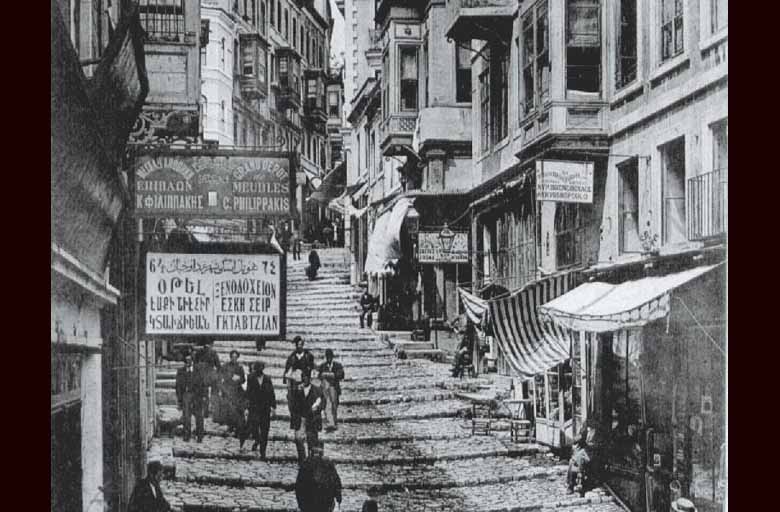
The neighborhood of Galata, located on a steep hump of land north of the Golden Horn and historic peninsula, actually sits on the earliest foundations of the city, dating, as far as present-day archaeologists can tell, to Greek and Roman times. At one time, it was covered in gardens and vineyards; indeed the ancient Greeks called the district "Sykai," meaning "place of fig gardens," and later, the hilly expanse became known as "peran en Skai," or "fig gardens on the other shore." Or just plain Pera. There is also speculation that the name Galata comes from the Italian word for descent (calata), an appropriate description of the steep and staired streets that slope down the hill from Beyoglu to the Golden Horn. The district developed into its present form in the 13th century, when Eastern Roman Emperor Michael VIII Palaeologus granted the Genoese permission to settle here.
The district became a magnet for merchants from all over Europe: Italians, Germans, Armenians, Jews, and Austrians, all re-creating their own micro-universe. The Genoese remained neutral during the Ottoman siege, so when Mehmet the Conqueror took over the city, although he installed his own Ottoman administration and assumed control of all commercial affairs, the Sultan granted them, along with the other minority communities, substantial commercial privileges. The ensuing commercial prosperity of the district fed trade throughout the Mediterranean and acted as a magnet for foreigners and ethnic minorities who established the district as centers of business, shipping, and banking. Serving the center of the financial district was a row of stately financial institutions lining both sides of what is now alternately called Bankalar Sokagi (Bank St.) and Voyvoda Caddesi. Bankers wishing to settle near their places of business constructed dignified residences for themselves and their families, and serving the community was a full complement of schools, churches, and synagogues.
As Galata prospered, the population burst its boundaries to incorporate the neighborhoods northward (and eventually up to and along the Grand Rue de Pera or Istiklal Caddesi). A stroll up and down the steep cobbled streets will reveal schools, private residences, churches, synagogues, and Ottoman-era warehouses. (There are also the ruins of a mikva or Jewish bathhouse in dire need of restoration opposite the former private mansion of the Camondo banking family, now the Galata Residence.)
Subscribe to:
Posts (Atom)