GENELEVDEN KORKMA FUHSUN GIZLISINDEN KORK
Vahdettin ENGIN
Istanbul'da halk arasinda zevk ve sefahat âlemlerinin yayginlasmasi Sultan Abdülmecit dönemine, yani 1839 ile 1861 yillari arasina rastlar.
Misir Valisi'nin aile fertleriyle birlikte pek çok Misirli beyler, pasalar ve hanimlar bu yillarda Istanbul'a geldiler ve büyük paralarla Bogaziçi'nde yalilar satin alip alafranga esyalarla süslediler. Lüks içinde yasayan ve israf derecesinde paralar harcayan Misirlilar, önceki dönemlerde mütevazi bir hayat sürdüren varlikli Osmanli ailelerini ve saray halkini da özendirince sefahat ortami genisledi, israf çogaldi ve harcamalar artti.
FRANSIZ'A ÖZENDIK
Ayni dönemde, 1853 ile 1856 yillari arasindaki Kirim Savasi sebebiyle çok sayida Fransiz ve Ingiliz askeri de aileleriyle birlikte Istanbul'a gelmislerdi. Fransizlar'in ve Ingilizler'in eglence anlayislari da Istanbul halkini etkiledi. Osmanli, Kirim Savasi sonrasinda ilk defa yabanci ülkelerden borç para almis, ülkede geçici de olsa bir refah ortami dogmustu. Bu ortamin etkisiyle padisah Abdülmecit saray halkinin eglencelerine müsamaha göstermis, sarayi örnek alan pasalar ve beyler de konaklarinda hemen her gün eglenceler yapmaya baslamisti. Durum halka da sirayet edince sefahat ve fuhus iyice çogaldi.
Fuhus, Osmanli'da her dönemde vardi ama 19. yüzyilin ikinci yarisindan itibaren "umumhane"lerin yani genelevlerin sayisinin artmasiyla yayginlasti. Abdülaziz Bey'in 'Osmanli Âdet, Merazim ve Tabirleri' isimli kitabinda umumhaneler hakkinda ayrintili bilgiler yer aliyor. Suriçi Istanbul'unda, Beyoglu civarinda ve Üsküdar'da daginik bir halde bulunan umumhanelerde çalisan kadinlar "fahise", "sermaye" veya çogu zaman kullanildigi tabirle "âlüfte" olarak adlandirilirdi.
CILVE KUTUSU IFAKAT
Sishane Karakolu Caddesi, Kisla Arkasi Papaz Köprüsü, Humbaraci Yokusu, Balik Pazari, Dervis Sokagi, Timoni Sokagi, Laleli Çesme, Küçük Balik Pazari, Tarlabasi, Kuledibi, Yüksek Kaldirim, Kasimpasa üstü, Galata, Aksaray, Çivizâde, Sena Yokusu, Salkimsögüt, Çukurbostan, Kalyoncu kullugu gibi yerler umumhanelerin yogun olarak bulundugu semtlerdi. Umumhanelerin her biri sahibinin ismiyle anilirdi ve 'Acem'in hanesi', 'Mumcu Ahmet'in hanesi', 'Alayci Kadri'nin hanesi', 'Keseci Hürmüz'ün hanesi', 'Kaymak tabagi'nin hanesi', 'Langa Fatma'nin hanesi', 'Dönme Ahmet'in hanesi', 'Gül ipek'in hanesi', 'Arnavut Samiye'nin hanesi', 'Kör Emine'nin hanesi' en çok bilinen umumhanelerdi.
Asina olanlar, umumhanelerin nerede oldugunu gayet iyi bilirdi. Ilk defa umumhaneye gidecek olanlara 'muhabbet tellâli', 'gönül postacisi', 'dert ortagi', 'sirdas', 'vasita' ve 'hevenkçi' gibi sifatlarla anilan bazi aracilar yardimci olurdu. Umumhanelerde çalisan kadinlar da gerçek adlari yerine 'Afet', 'Benli Eda', 'Ceylan', 'Dilbaz', 'Bülbül-efkende', 'Feleknaz', 'Handan', 'Cilvekutusu îfakat', 'Isve', 'Isvebaz', 'Kamer', 'Mestinaz', 'Pembe', 'Cihanyandi Pesend', 'Sadberk', 'Sevda', 'Seza', 'Suzide', 'Sazimend', 'Semsiseb', 'Sivekâr', 'Kartopu Söhret', 'Gümüs gerdan Ülfet', 'Vuslat', 'Candayanmaz Zisan', 'Kaymak tabagi Servet' ve 'Ziynet' gibi takma isim kullanirlardi. Bu isimler ayni zamanda sahibinin özelliklerini de yansitirdi.
DOST BULMAK SARTTIR
Umumhanelerde çalisan kadinlarin dinleri, yani Müslüman veya gayrimüslim olmalari fark etmezdi. Istanbullu kadinlarin yaninda ülkenin çesitli bölgelerinden gelenler, hatta Romanya, Rusya ve Avusturya uyruklu kadinlar da umumhanelerde çalisirlardi. Resmi kayitlara göre, yabanci uyruklulardan bir kismini, ülkesinde kandirilip igfal edildikten sonra kaçak olarak Istanbul'a getirilenler olusturuyordu. Çalisma iznine sahip olmayan yabancilar, zaman zaman yetkililere müracaat edip Osmanli tabiiyetine geçmek istiyorlardi.
Fuhus yapan kadinlarin mutlaka bir dayanaga ve koruyucuya Ihtiyaçlari vardi.
Kadinlar, olur-olmaz yerlerde, özellikle çalistiklari evlerde rahatsiz eden, belâ çikaran ve korkutup sahiplenmek isteyen kisilerin ellerinden kurtulmak için bazi kabadayilarin muhafizligina siginirlardi. Kabadayilar kadinlari koruma karsiliginda hanelere serbestçe girip çikarlar, evde bulunduklari zaman kadinlar baskasina çikamaz, ev sahibi tarafindan hürmet görürler, yanlarinda ahbaplarini getirmislerse onlara da alâka gösterilirdi.
Sene baslarinda ve bilhassa bayramlarda kabadayilarin her birine oldukça degerli hediyeler verilirdi.
Umumhanelerde herhangi bir olay çikmasi durumunda kabadayilar ayik ve akli basinda olmak için içki içmezler; kabadayiliklarina halel getirmemek için züppelik saydiklari hareketler yapmazlar; agirbasli, saglam, sakaya gelmez bir tavir takinirlardi. 'Arap Abdullah'. 'Kahraman Bey', 'Halil Bey'. 'Kadayifçi Riza', 'Suhte Niyazi', 'Osman Pehlivan', 'Arnavut Resit', 'Sulu Tahsin', 'Tosun Bey', 'Haci Riza', 'Amber Ali', 'Hisarli Ahmet', 'Camci Muhiddin', 'Çesme Meydanli Rifat' ve 'Fermeneci Izzet' meshur kabadayilardandi. Kabadayilara siginmak kadar, devlet katinda önemli görevleri olan kisilerin dostu olmak da kadinlar için hem güvence hem de övünme vesilesi idi.
YENIYE "HISIR" DENIR
Umumhaneye giden kisi âdet üzere muhabbet tellâlina bir miktar para ödedikten sonra eve girer, öncelikle alt katta bulunan 'muhabbet meydani' veya 'gönül pazari' denilen yere götürülürdü. Ev sahibi içeriye girer, gelen kisi önceden tanidigi biriyse büyük bir sevinçle 'uzun zamandan beri görünmedigini, hasretle beklediklerini, âlüftesinin kendisini çok özledigini abartili yeminlerle anlatirdi. Eger gelen misafir yeni ise, 'bu hanenin öyle rast gele insanlar için olmadigini, aracilik eden adamin hatiri için kendisini kabul ettiklerini söyler ve daha birtakim yalanlarla adamin gönlünü hos tutardi.
Sonra evdeki âlüftelerden birkaçi mütebbessim bir çehre ile odaya girer, ekseriya sol elleri sag koltugu arasina sokulu, sag elleri ile hafifçe çenelerini tutarak manali bakislarla adamin karsisina geçim otururlardi. Gelen kisinin haline, meslegine ve derecesine göre sohbet açarlar, her zaman gelmesini saglamak için iltifat ederlerdi. Yeni gelen kisi 'hisir' veya 'handaval' dedikleri takimdan ise lâfa ona göre baslarlardi. Eger 'gözü bagli' ve 'sigircik kusu' olarak tabir ettikleri genç ve tecrübesiz bir kisi Ise gönül alici sözlerle etkilemeye çalisirlardi. Adam evde fazla kalamayacaksa aralarindan birini seçer, digerleri odadan çikardi. Içeride kalan âlüfte, adamin arzu ve heveslerine göre isveler yapar ve misafirini hosnut ederdi.
KOLTUK BELASI
Müsteri eger gece de kalacak olursa yemek hazirliklari baslar, parasi da alinirdi. Genellikle ucuz yemekler hazirlanir, rakilar içilir, misafire birçok naz ve isveler yapilir, neselendirmek için def çalinir, sarkilar ve maniler söylenerek vakit geçirilirdi. Müsteri zengin ve bol para harcamaya egilimli ise özel muamele görürdü. O gece evde baska misafirler varsa ve birbirlerini taniyorlarsa, onlar da eglenceye istirak eder, bîr odada toplanilir, sarkilar söylenip naralar atilir, vur patlasin çal oynasin bir cümbüs baslardi. Edep disi sözler söylenir, sakalar yapilir, velhasil etraftaki evleri rahatsiz edecek tarzda bir âlem yapilirdi. Güvenlik güçleri, meshur olan bu umumhaneleri bilirler ve kontrol altinda bulundururlardi ama hükümetten bir emir gelmedigi müddetçe müdahalede bulunmazlardi.
Umumhanelerden ayri olarak, 'koltuk' adi verilen randevuevleri de vardi. Bu evler her mahallede bulunabilirdi ve gizli isletilirlerdi. Dis görünüsleri itibariyle normal bir evden hiçbir farklari olmaz, sahipleri de etrafa belli etmemeye çalisirdi. 'Yari hususi' de denilen bu evlerde kadin ve erkek bulusur, ev sahipleri hizmet ederdi. Randevuevlerine çogunlukla geceleri gizlice ve önceden kararlastirilmis parolalar ile girilirdi. Evlerde yüksek sesle konusulmaz, sokak tarafindaki odalarda oturulmaz, arka taraftaki ses geçirmeyecek odalarda kalinirdi.
Koltuklar, yani randevuevleri mahalle arasinda oldugundan normal ev olarak kabul edilirdi ve eger mahalleli fuhus yapildigini tespit ederse eve baskin düzenlerdi. Komsular, mahalleye gelen bir kiracinin ahlâka aykiri is yaptigini, evine degisik insanlarin girdigini anlar ise önce mahallenin delikanlilarina haber verilir, sonra mahalle imamina, muhtara ve ihtiyar heyetine söylenirdi. Mahalleyi fuhustan temizlemek için mahalle bekçisine, mahallenin delikanlilari ile civardaki komsulara dikkatli olmalari tembih edilirdi.
Fuhus yapildigindan süphelenilen haneye gizlice bir adamin girdigi görüldügü anda bütün mahalleli haberdar edilirdi. Allah'tan korkun, çekilin. Namus ehline tecavüzde bulunmayin' diye karsilik verip mahalleliyi inandirmaya çalisirlardi.
Içeridekiler direnirse Imamin 'kirin' emri ile kapi tekmelerle açilir, herkes birbirini iterek içeri dolar ve büyük bir gürültü kopardi. Evin her tarafi arandiktan sonra eger kimse bulunamazsa mahalleli dagilir, geride kalan imam ve muhtar efendiler, 'Bu yapilanlar çirkin bir sey ise de ahalice namusunuza bir defa daha inanilmasi bakimindan yine de hakkinizda hayirli oldu' gibi sözler sarf eder, ev sahibinden Özür dilerlerdi. Böyle olmaz da evde bir adam yakalanirsa, her tarafindan biri tutar, yüzüne tükürülür, yapilmadik hakaret kalmaz, 'Bre ise yaramaz habis, mahallemiz senin gibi rezillere mesken olamaz, senin hakkindan simdi hükümet gelir' denilerek yerde sürüklenirdi.
GENELEVE MECBURI IZIN
Baskina gidenlere, çevreden olayi duyanlarin da katilmasiyla kalabalik giderek artar, herkes pencerelere dolusur, adam hayli hirpalanmis ve süklüm püklüm bir sekilde karakola teslim edilirdi. Daha sonra mahalleli 'Hey gidi, burasi namuslu bir mahalledir. Buraya düsünüp tasinmadan girmek ne cesarettir, simdi buldu belâsini' gibi sözlerle tekrar fuhsun yapildigi eve döner, evdekîlere ertesi sabahtan tezi yok defolup gitmelerini, aksi halde gerekenin yapilacagini söyleyip dagilirlardi.
Hükümetin denetimi altinda ama gayri resmi sekilde faaliyet gösteren umumhaneler, 'koltuk' adi verilen hususi evlere göre çok daha güvenceli idi. Fuhsu engellemenin zorlugunu bilen hükümet, umumhanelerin varligina ses çikarmiyor, denetim altinda bulundurarak yayginlasmasinin Önüne geçmeye çalisiyordu. Umumhanelerin sayisinda artis olursa siki tedbirler uygulaniyordu.
Meselâ, 1859'da Istanbul'da fuhsun çogalmasi üzerine Sadrazam Âli Pasa bir emirname yayinladi. Emirnameye göre, fuhus yapanlar, fiilin derecesine göre 48 saatten üç aya kadar hapis veya üç aydan alti aya kadar sürgün ile cezalandirilacaklardi. Bu tür tedbirler fuhsun önüne geçilmesi için yeterli degildi. Hükümet de durumun farkinda oldugundan özellikle meshur umumhanelerin faaliyetlerine göz yumardi.
Umumhanelere göz yumulmasindaki amaç, fuhus sektörünü belli mekânlarda tutmak ve mahalle aralarina yayilmasini engellemekti. Bu yerler zaten güvenlik güçlerinin denetiminde bulunur, hatta umumhane sahipleri güvenlikten sorumlu yetkilileri bir sekilde memnun ederlerdi. Koltuk adi verilen ve mahalle aralarinda faaliyet gösteren mekânlar ise mahallelinin yaptigi baskinlarla kapatiliyor, baskini yapanlar arasinda resmi görevlilerin de bulunmasi yapilan isleme bir tür yasallik kazandiriyordu.
POLIS MAASA BAGLANMIS
Hükümet ve umumhaneler arasindaki bu karsilikli kabullenme, birtakim sikâyetlere de sebep oluyordu. I892'de padisah Ikinci Abdülhamit'e verilen bir jurnalde, Istanbul'da asayissizligin ve fuhsun arttigi, Zaptiye Naziri Hüseyin Nazim Pasa'nin hiçbir tedbir almadigi ifade ediliyordu. Jurnalde yazildigina göre, Nazim Pasa'nin korudugu Komiser Hüsnü ve polis memuru Saban Efendiler, sorumlu olduklari bölgelerdeki umumhanelerden ayda altisar lira rüsvet aliyorlar, ayrica gözlerine kestirdikleri namuslu kadinlarla tehdit yoluyla beraber oluyorlar, sonra da umumhanelere düsmelerine yol açiyorlardi. Tekliflerine razi olmayan kadinlari ise birtakim iftiralarla karakollara sevk ediyorlar, evli olanlari kocalarindan bosattiriyorlar, perisan edilen zavalli kadinlar sonuçta ya fahise oluyor yahut hapishaneye düsüyorlardi.
YÜZ ADET GENELEV VARDI
Mahallelerinde umumhanelerin fazlaligindan rahatsizlik duyan halk da zaman zaman sikâyetini yetkililere iletiyordu.
Tarlabasi'nda bulunan umumhanelerden sikâyetçi olan semt halki 1905'te bir dilekçe vermisti. Konuyu ele alan Beyoglu Mutasarrifligi sikâyetlere hak vermekle beraber, umumhanelerin kapatilmasi halinde her tarafa dagilacaklarina, dolayisiyla zararlarinin daha fazla olacagina ve mücadele etmenin zorlasacagina karar verdi.
1900'lü yillarin basinda Galata ve çevresinde 100 civarinda umumhane vardi ve hükümet bu yerleri mümkün oldugu kadar bir arada tutmaya gayret ediyordu.
IMAM, KADIN KALDIRDI
Unkapani'nda 1903'te ilginç bir fuhus hadisesi cereyan etti. Unkapani Salih Pasa Mahallesi Camii imami Mehmet Necip Efendi, bekârdi ve camiin içindeki bir odada kaliyordu. Cemaat, camiye kadin getirdiginden süphelendigi imami göz hapsine almisti. Nitekim bir gece, imamin yaninda bir kadinla camiye girdigini gören halk, durumu zaptiyeye haber verdi. Sikâyet üzerine gelen zaptiye memurlari, camiye girdiklerinde Imam Mehmet Efendi'nin Vasfiye adli bir fahiseyle beraber olduklarini gördüler. Imam ve kadin karakola götürüldü, ayrica Imamin bu uygunsuz davranisi Seyhülislâm'a sikayet edildi.
1904'te Bahçivan Yuvan idi, karisini ve kizini Dimitri adli birinin kandirip igfal ettigini, sonra da Beyoglu'nda bir umumhanede çalistirdigini sikâyet etmisti. Yapilan arastirma neticesinde söz konusu kadinlar umumhanede bulunmus, Rum Patrikhanesi'ne teslim edilmisti.
1905'te meydana gelen bir baska hadise ise söyle idi: Tophane'de Seyyid Nizam Mahallesi'nde oturan Mustafa adli bir sahis evini umumhane haline getirmis ve komsulari tarafindan sikâyet edilmisti. Yakalanip sorguya çekilen Mustafa kendisinin namuslu bir insan oldugunu, evi ise annesinin islettigini söylemisti.
YENI YASA GEREKTI
Ikinci Mesrutiyetin 1908'de ilaniyla birlikte yürürlüge giren anayasada, mesken dokunulmazligi hükmü vardi. Artik hane sahibinin izni olmaksizin hiç kimsenin evine zorla girilemeyecekti. Eski dönemlerdeki gibi baskin yapilamadigi için fuhus daha da yayginlasti. Ikinci Mesrutiyet'ten sonra gerek Istanbul'un birçok semtinden, gerekse çesitli vilâyetlerden gelen sikâyet yazilari, fuhsun anormal derecede arttigini gösteriyordu. Mesken dokunulmazligina güvenen birçok ahlâksiz, aleni bir sekilde fuhus yaptirmaktan kaçinmiyordu. Valiler, fuhsun önüne geçebilmek için ya eski baskin yönteminin yeniden uygulanmasini yahut boslugu giderecek yeni bir yasanin çikarilmasini talep ediyorlardi.
MADAM DESPINA'NIN EVI
Pes pese ortaya çikan savaslar, alinan yenilgiler, artan fakirlik ve issizlik de fuhsu yayginlastirdi. Sikâyette bulunanlar arasinda Müslüman ve gayrimüslim halkin yanisira Istanbul'da ikamet eden yabanci uyruklular da vardi. Sikâyetlerin ardi arkasi kesilmiyordu: 1910'da, Sisli'deki Süvari Karakolu civarinda 17 evin randevuevine dönüstürüldügü, 1911 Ocak'inda Bakirköy Bostan içi'nde, Asmali Sokak'ta Madam Despina'nin umumhane açtigi, 1913'te de Sisli'de, Nikogosyan Kiz Mektebi yaninda Nazif adli kisinin fuhus yaptirdigi sikâyet edilmis ve önlem alinmasi istenmisti.
Yetkililer sikâyetleri dikkate aliyor ama çözüm bulma konusunda sikinti çekiyorlardi. Emniyet Müdürlügü konuyla ilgili olarak Beyoglu Emniyeti'ne gönderdigi bir yazida, umumhane meselesinin giderek ciddiyet kazandigini, halkin sikâyetlerinde hakli oldugunu ama dilekçelere kesin bir cevap vermenin zorlugunu yazmisti. Emniyet Müdürlügü, umumhanelerin hepsinin kapatilmasinin mümkün olamayacagini ve bir araya toplayarak kontrol altinda tutulabilecegini düsünüyordu. Fakat umumhaneleri bir araya toplamak da uzun vadeli ve belediyenin el atmasi gereken bir isti. Yapilabilecek tek sey, fuhus mekânlarinin siki bir sekilde denetlenmesi ve mahallelinin rahatsiz olmasinin önüne geçilmesi idi.
GS'NIN KOMSU EVLERI
Umumhanelerle basa çikmakta zorlanan . yetkililer, bir yandan da kadinlari bu hayattan kurtaracak bazi tedbirler aliyorlardi. Istanbul Polis Müdürlügü'nün bu konuda Emniyet Genel Müdürlügü'ne gönderdigi bir yazida, kadinlarin fuhsa sürüklenmesinin en önemli sebebinin fakirlik ve geçimlerini temin etme endisesi oldugu söyleniyor ve bazi kadinlarin askeri dikimevinde istihdam edilmeleri teklif ediliyordu. Emniyet Genel Müdürlügü ise bu uygulamanin zaten yapildigini yazmis ve Ilginç bir tespitte bulunmustu: Umumhanelerde çalisan kadinlar geçim sikintisindan ziyade bu isi bir aliskanlik hafine getirmislerdi ve bu sebeple geri dönüsleri zordu.
Okul idareleri de umumhanelerden sikâyetçi idi ve en büyük tepkiyi Beyoglu'nda bulunan Galatasaray Lisesi yöneticileri gösteriyordu. Çünkü okulun hemen yan tarafindaki Yeni çarsi Caddesi'nde sira sira umumhaneler vardi ve ögrenciler burada çalisan kadinlari rahatlikla görebiliyordu.
Ögrenciler bu durumdan pek sikâyetçi degildiler ama idareciler, umumhanelerdeki hafifmesrep kadinlarin pencerelerde ve balkonlarda açik saçik dolastiklarim, ögrencilerin zihinlerini bulandirdiklarini söylemisler, umumhanelerin kaldirilmasini istemislerdi. Ileride milletin ve memleketin kaderi ellerine birakilacak mümtaz ögrencilerin ahlâklarinin bozulmasina izin verilmemeliydi.
PENCERENI KAPAT VE OTUR!
Umumhanelerin tek bir yerde toplanmasi bir türlü saglanamamis, halkin sikâyetleri devam etmisti. Kadiköy Duvar dibi'ndeki Riza Pasa Mahallesi'nin sakinleri, 1919'da semtlerindeki umumhanelerin kaldirilmasi için pes pese dilekçe vermisler, sikâyetlerinden sonuç alamayinca mahalleli adina Anadolu Demiryollari Komiseri bizzat Içisleri Bakani'na bir mektupla basvurmustu.
Mektupta söyle deniyordu
'Bundan iki sene evvel Türk ve Hiristiyan, namuslu ve kibar ailelerle meskun Kadiköy Duvar dibi Riza Pasa Mahallesi'nde polis müdüriyetinin karariyla iki umumhane açildi.
Biz hadiseyi duyar duymaz umumhanenin engellenmesi Için gerekli yerlere derhal müracaat ettik ama hiçbir netice alamadik. O zamandan beri araliksiz olarak müracaata devam ediyoruz. Bizi hep oyaliyorlar yahut 'Pencereni kapa otur' diyorlar.
Muhterem Beyefendi! Riza Pasa, Mühürdar ve Moda ahalisi Kadiköy'ün en kibar, en nazik ve en terbiyeli halkidir. Burada umumhane haline getirilmis alti adet ev vardir ve hepsi ahsaptir. Her gece duyulan sazlar, sarkilar, kavgalar, kadin bagrismalari ve silâh seslerinin yaninda, bu sefil kadinlar görgü kurallarina hiç riayet etmiyor ve çirkin hareketlerde bulunuyorlar. Hatta, söylemekten utaniyorum, her seyi açikta yapiyorlar. Namuslu aileler arasina saçilan bu ahlâksizlik, bu sefalet, bu müptezellik henüz bir çiçek halinde hayata atilmaya hazirlanmis genç kizlar üzerinde bir tesir meydana getirmez mi?
YANGIN VE KAVGA TEHLIKESI
Oraya gelen gençler, bekârlar veya evliler ne olursa olsun islerini sazsiz sözsüz göremezler mi? Namusumuz üzerine yemin ederek söylüyoruz, sabahlara kadar rahat bir uyku uyuyamiyoruz. Her zaman için yangin tehlikesi, kavga ve silâhli çatisma ihtimali mevcut. Bizim daha fazla istirap çekmemize bîr son verdireceginizi ayaklariniza kapanarak istirham ederiz. Talebimiz, bu umumhanelerin buradan kaldirilip münasip bir yere nakledilmeleridir.
KIMSENIN GÜCÜ YETMEDI
Içisleri Bakani, Emnîyet'ten meselenin arastirilmasini ve bilgi verilmesini istedi. Emniyet Genel Müdürlügü, Içisleri Bakanligi'na, Kadiköy civarindaki umumhanelerin Duvar dibi'nde toplanmasinin Emniyet Müdürlügü tarafindan olusturulan bir komisyonun karari oldugunu, bu evlerin yikilmasi halinde fuhsun Kadiköy'ün diger semtlerine dagilacagini ve sikâyetlerin artacagini, dolayisi ile umumhanelerin bulunduklari yerde kalmalarinin daha uygun oldugunu yazmisti. Eger içki ve çalgi yasaklanir, olay çikmasi da engellenirse mahallelinin huzuru kismen de olsa temin edilebilirdi.
Neticede yine kesin bir çözüm bulunamamis, umumhaneler faaliyetlerini icraya devam etmislerdi.
SOURCE

Wednesday, October 31, 2012

Tuesday, October 30, 2012
Prostitution in Constantinople
Due to European intervention during the 19th century, the Empire began to attempt to curtail the slave trade, which had been considered legally valid under Ottoman law since the beginning of the empire. A series of legal acts was issued that limited the slavery of white people initially and of those of all races and religions later. In 1830, a firman of Sultan Mahmud II gave freedom to white slaves. This category included the Circassians, who had the custom of selling their own children, enslaved Greeks who had revolted against the Empire in 1821, and some others. Another firman abolishing the trade of Circassian children was issued in October, 1854. A firman to the Pasha of Egypt was issued in 1857 and an order to the viziers of various local authorities in the Near East, such as the Balkans and Cyprus, in 1858, prohibited the trade of black slaves but did not order the liberation of those already enslaved. However, slavery and the slave trade in Ottoman Empire continued for decades, as legal texts like the above were not backed by a penalty system. It was not until 1871 that a circular of July 20th of that year introduced the penalty of one years imprisonment for those who practiced the slave trade. Later, slave trafficking was expressly forbidden by utilizing clever technical loopholes in the application of sharia, or Islamic law.

“Between 1870 and 1939 Jews played a conspicuous role in white slavery, as the prostitution of that era was called. Not only was this participation conspicuous, but it was, for the Jews, historically unprecedented, geographically widespread, and in an age of pandemic anti-Semitism fraught with collective political dangers.”
Edward J. Bristow, PROSTITUTION AND PREJUDICE,
The Jewish Fight Against White Slavery 1870-1939
“Yet the cases of voluntary consent escaped the control of the police, as well as such cases, where the parties were provided with a marriage testimonial; for several cases [8]indeed have been registered of men of Jewish extraction having sold their wives into servitude; after leaving Odessa with their wives, they returned within a certain time with their passport bearing the remark in the hand of the Russian consul in Constantinople: »Wife remained abroad” or »Divorced”. It is evident that such cases, presenting an appearance of complete matrimonial legality can scarcely be rooted out by administrative measures.”
...
"En Orient, principalement en Turquie d’Asie, les Grecques et les Italiennes sont les plus demandées. Constantinople, ce grand dépôt international d’esclaves blanches, fournit des Autrichiennes, des Roumaines et quelques Russes. Chose curieuse, les Hongroises ne se trouvent guère à l’étranger sauf dans les pays danubiens. On peut calculer que 33 p. 100 environ des prostituées de Smyrna et Bayrouth sont des juives Autrichiennes, avant déjà séjourné en Turquie. L’Autriche (la Galicie, Trieste et ses environs) fournit avec l’Italie à peu près 75 p. 100 des pauvres filles importées en Egypte, sans compter celles, qui viennent grossir le nombre des indigènes, qui peuplent les harems du Caïre, d’Hélonan et de l’Alexandrie.
".... a monthly magazine (G. and R.) of April 1889, which stated that in Constantinople every week loads German and Italian girls arrive, either on the road Varna-Odessa-Salonica, either through the ports of the Adriatic sea."
"...The Monthly magazine of 1 April 1889 mentions the fact that in some cities actual slave markets exists and mainly in Constantinople. There is a market, where the young women sells, which for this purpose from Austria, Germany, Italy and Russia will be charged. And what the fairs, so says the same magazine that in Constantinople a building, the Casino called, which in reality is nothing more than an exhibition, where the human merchandise as easily traded as other merchandise at a show in New York. Goron mentions in his already mentioned drawing, which has long been at San Francisco localities known under the name of "Chambres de la Reine", in truth public slave markets."
De 'handel in blanke slavinnen | Wolter Louis Albert Collard
The "white slave trade".
academic Thesis to obtain the degree of Doctor of Jurisprudence
At the University of Amsterdam,
On the authority of the Rector Dr.. S. Cramer,
Professor in the Faculty of Theology,
To publicly defend on Wednesday, July 11, 1900, in the afternoon to 4 hours,
In the auditorium of the University, by Wolter Louis Albert Collard, Born in Soestdijk.
Amsterdam,
Book, art & commercial printing v / h. Binger brothers. 1900.
MORE ARTICLES 1(TURKISH) , 2, 3

“Between 1870 and 1939 Jews played a conspicuous role in white slavery, as the prostitution of that era was called. Not only was this participation conspicuous, but it was, for the Jews, historically unprecedented, geographically widespread, and in an age of pandemic anti-Semitism fraught with collective political dangers.”
Edward J. Bristow, PROSTITUTION AND PREJUDICE,
The Jewish Fight Against White Slavery 1870-1939
“Yet the cases of voluntary consent escaped the control of the police, as well as such cases, where the parties were provided with a marriage testimonial; for several cases [8]indeed have been registered of men of Jewish extraction having sold their wives into servitude; after leaving Odessa with their wives, they returned within a certain time with their passport bearing the remark in the hand of the Russian consul in Constantinople: »Wife remained abroad” or »Divorced”. It is evident that such cases, presenting an appearance of complete matrimonial legality can scarcely be rooted out by administrative measures.”
...
"En Orient, principalement en Turquie d’Asie, les Grecques et les Italiennes sont les plus demandées. Constantinople, ce grand dépôt international d’esclaves blanches, fournit des Autrichiennes, des Roumaines et quelques Russes. Chose curieuse, les Hongroises ne se trouvent guère à l’étranger sauf dans les pays danubiens. On peut calculer que 33 p. 100 environ des prostituées de Smyrna et Bayrouth sont des juives Autrichiennes, avant déjà séjourné en Turquie. L’Autriche (la Galicie, Trieste et ses environs) fournit avec l’Italie à peu près 75 p. 100 des pauvres filles importées en Egypte, sans compter celles, qui viennent grossir le nombre des indigènes, qui peuplent les harems du Caïre, d’Hélonan et de l’Alexandrie.
".... a monthly magazine (G. and R.) of April 1889, which stated that in Constantinople every week loads German and Italian girls arrive, either on the road Varna-Odessa-Salonica, either through the ports of the Adriatic sea."
"...The Monthly magazine of 1 April 1889 mentions the fact that in some cities actual slave markets exists and mainly in Constantinople. There is a market, where the young women sells, which for this purpose from Austria, Germany, Italy and Russia will be charged. And what the fairs, so says the same magazine that in Constantinople a building, the Casino called, which in reality is nothing more than an exhibition, where the human merchandise as easily traded as other merchandise at a show in New York. Goron mentions in his already mentioned drawing, which has long been at San Francisco localities known under the name of "Chambres de la Reine", in truth public slave markets."
De 'handel in blanke slavinnen | Wolter Louis Albert Collard
The "white slave trade".
academic Thesis to obtain the degree of Doctor of Jurisprudence
At the University of Amsterdam,
On the authority of the Rector Dr.. S. Cramer,
Professor in the Faculty of Theology,
To publicly defend on Wednesday, July 11, 1900, in the afternoon to 4 hours,
In the auditorium of the University, by Wolter Louis Albert Collard, Born in Soestdijk.
Amsterdam,
Book, art & commercial printing v / h. Binger brothers. 1900.
MORE ARTICLES 1(TURKISH) , 2, 3
Destination: Alexandria, Buenos Aires, Constantinople
In the late nineteenth and early twentieth century traffickers in Habsburg Galicia and Bukovina, as well as Romania, and Russia were popularly considered to be Jews; so, too, were many of their victims. How many ended in Costak's Galata.
Few forms of socially deviant behavior received so much attention in the sexually saturated Austrian fin de siècle as Mädchenhandel, or trafficking in girls, also called white slave trafficking. Trafficking in women and girls had not been unknown in preindustrial Cisleithania, but the discourse from the turn of the century embodied concerns about the need for social control in increasingly anonymous, modernizing, urbanizing, and capitalist society. Certainly, Mädchenhandel was in many ways a modern crime, a crime associated particularly with Jews, who were popularly believed to supply white, unwilling girls to serve as prostitutes in brothels worldwide. Ever-expanding and improving communication and transportation networks, which both facilitated large-scale immigration and permitted women to travel alone as never before, as well as the anonymity of the growing metropolises in Habsburg central Europe facilitated the practice. Indeed, commercial sex was a flourishing enterprise in the expanding urban centers of the nineteenth-century Habsburg Monarchy, where prostitution was tolerated and thus regulated.
Popular debate on white slavery in late imperial Cisleithania expanded after the passage of a law eliminating the periodical-press stamp beginning on 1 January 1900, allowing for the proliferation of inexpensive and often illustrated newspapers among an increasingly literate audience. Not only did the muckraking sensationalist newspapers of the capital address the topic, but it was also the subject of discussion in provincial journals intended for women, which besides serving a didactic function (warning them of possible danger) also permitted women who were not involved in trafficking to follow with prurient interest and feigned or real horror the fates of their unfortunate sisters. This discourse focused above all on Bukovina and Galicia, two impoverished regions in the eastern reaches of the empire, both with large Jewish populations. Reflecting a variety of European-wide developments, among them eugenics, criminology, and racial nationalism, the rhetoric facilitated the language of difference. This debate included tropes like the corruption of "innocent girls," especially by eastern European Jewish "Others" who kidnapped and even "enslaved" girls and took them to racially different faraway places to ply the sex trade. A closer examination of the issue, however, reveals a more complicated picture that involves young women, attracted by the anticipated wealth of foreign liberators, hastily marrying these men and going abroad with them in the hope of a better life, often with the full support of their often poverty-stricken families. In order to supply the monarchy's tolerated bordellos with fresh supplies of sexual talent, pimps and other panderers, many of them Christian, regularly arranged for the transport of prostitutes to bordellos throughout Austria-Hungary and neighboring Germany. It was, however, the white slavers—both male and female, and popularly identified as Jewish—and those girls and women they trafficked abroad, often, but not always, poor Jews from the eastern regions of the empire, who aroused the greatest public indignation.
The worldwide traffic in women had become a concern among European reformers in the second half of the nineteenth century. By the mid-1880s, English feminist and social reformer Josephine Butler, whose International Abolitionist Association had branches throughout Great Britain and Europe dedicated to the elimination of prostitution, had been made aware of the trade in women and girls connected with prostitution. Association member William A. Coote soon formed national committees for the suppression of white slave traffic in various European capitals and also in Egypt, South America, South Africa, and the United States. Western European Jewish reformers had noticed a conspicuous involvement among eastern European Jews in white slaving. Thus, in 1885 the Jewish Association for the Protection of Girls, Women, and Children was established in London, and in 1897 the Hamburg branch of B'nai B'rith formed a Jewish Committee to Combat White Slavery.
Destination: Alexandria, Buenos Aires, Constantinople; "White Slavers" in Late Imperial Austria
Nancy M. Wingfield
From: Journal of the History of Sexuality
Volume 20, Number 2, May 2011
pp. 291-311 | 10.1353/sex.2011.0024
Jewish procuring flourished throughout the Austro-Hungarian Empire. One Jewish madam was known as "Lucky Sarah" so named because she was the founder of the Hungarian export trade. Equally famous was Sarah Grossman known as "The Turk" because of her practive of dispatching girls to Constantinople. Two major centers of sex slave exporting were the industrial towns of Czernowitz and Lemberg. In 1892 a very famous mass trial of 27 procurers was held in the latter. All 27 defendants were Galician Jews. SOURCE
Few forms of socially deviant behavior received so much attention in the sexually saturated Austrian fin de siècle as Mädchenhandel, or trafficking in girls, also called white slave trafficking. Trafficking in women and girls had not been unknown in preindustrial Cisleithania, but the discourse from the turn of the century embodied concerns about the need for social control in increasingly anonymous, modernizing, urbanizing, and capitalist society. Certainly, Mädchenhandel was in many ways a modern crime, a crime associated particularly with Jews, who were popularly believed to supply white, unwilling girls to serve as prostitutes in brothels worldwide. Ever-expanding and improving communication and transportation networks, which both facilitated large-scale immigration and permitted women to travel alone as never before, as well as the anonymity of the growing metropolises in Habsburg central Europe facilitated the practice. Indeed, commercial sex was a flourishing enterprise in the expanding urban centers of the nineteenth-century Habsburg Monarchy, where prostitution was tolerated and thus regulated.
Popular debate on white slavery in late imperial Cisleithania expanded after the passage of a law eliminating the periodical-press stamp beginning on 1 January 1900, allowing for the proliferation of inexpensive and often illustrated newspapers among an increasingly literate audience. Not only did the muckraking sensationalist newspapers of the capital address the topic, but it was also the subject of discussion in provincial journals intended for women, which besides serving a didactic function (warning them of possible danger) also permitted women who were not involved in trafficking to follow with prurient interest and feigned or real horror the fates of their unfortunate sisters. This discourse focused above all on Bukovina and Galicia, two impoverished regions in the eastern reaches of the empire, both with large Jewish populations. Reflecting a variety of European-wide developments, among them eugenics, criminology, and racial nationalism, the rhetoric facilitated the language of difference. This debate included tropes like the corruption of "innocent girls," especially by eastern European Jewish "Others" who kidnapped and even "enslaved" girls and took them to racially different faraway places to ply the sex trade. A closer examination of the issue, however, reveals a more complicated picture that involves young women, attracted by the anticipated wealth of foreign liberators, hastily marrying these men and going abroad with them in the hope of a better life, often with the full support of their often poverty-stricken families. In order to supply the monarchy's tolerated bordellos with fresh supplies of sexual talent, pimps and other panderers, many of them Christian, regularly arranged for the transport of prostitutes to bordellos throughout Austria-Hungary and neighboring Germany. It was, however, the white slavers—both male and female, and popularly identified as Jewish—and those girls and women they trafficked abroad, often, but not always, poor Jews from the eastern regions of the empire, who aroused the greatest public indignation.
The worldwide traffic in women had become a concern among European reformers in the second half of the nineteenth century. By the mid-1880s, English feminist and social reformer Josephine Butler, whose International Abolitionist Association had branches throughout Great Britain and Europe dedicated to the elimination of prostitution, had been made aware of the trade in women and girls connected with prostitution. Association member William A. Coote soon formed national committees for the suppression of white slave traffic in various European capitals and also in Egypt, South America, South Africa, and the United States. Western European Jewish reformers had noticed a conspicuous involvement among eastern European Jews in white slaving. Thus, in 1885 the Jewish Association for the Protection of Girls, Women, and Children was established in London, and in 1897 the Hamburg branch of B'nai B'rith formed a Jewish Committee to Combat White Slavery.
Destination: Alexandria, Buenos Aires, Constantinople; "White Slavers" in Late Imperial Austria
Nancy M. Wingfield
From: Journal of the History of Sexuality
Volume 20, Number 2, May 2011
pp. 291-311 | 10.1353/sex.2011.0024
Tuesday, October 02, 2012
The Maniots Redux (Expended)
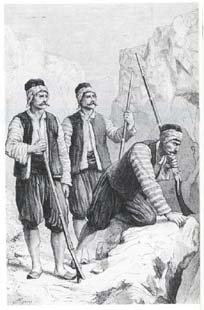 The inhabitants of Tatavla where Petri found refuge and anonimity were mainly resettled by the Ottomans with the Greeks of Mani region. They worked mostly at the admiralty shipyards of Kasimpasa by Halic/Golden Horn. The region where they came was mountainous and inaccessible hence they historically must have developed sailing skills. Homer's "Catalogue of ships in the Iliad mentions the cities of Mani: Messi, Vitilon (Itilo), Kardamli (or Skardamoula), Enopi, Gerinia, Pefnos, Avia, Githio, Kotronas, etc.
The Maniots (or Maniates; Greek: Μανιάτες)
The Mani Peninsula, also known as Maina, is a region in Greece. The Mani is the central peninsula of the three which extend southwards from the Peloponnese in southern Greece. The name "Mani" is thought to have originally meant "dry" or "treeless." Administratively, The Mani is divided between the districts of Laconia and Messenia. Messenian Maniot surnames almost uniformly end in -eas, whereas Laconian Maniot ones in -akos.
Homer refers to a number of towns in the Mani region. The area was occupied by the Dorians in about 1200 BC, and became a dependency of Sparta. The Mani was self-governing for a time before being absorbed into the Roman Empire in the 2nd century. As the power of the Byzantine Empire declined in the 9th century AD, the fortress of Maini in the south became the area's centre. After the fall of Constantinople to the Fourth Crusade in 1204, Italian and French knights (known to the Greeks as Franks), occupied parts of the Peloponnese. In 1249 the Mani was occupied by the Venetians, who made it one of the twelve baronies of the Principality of Moreas and built the fortresses of Mystras, Passavas, Gustema (Beaufort) and Megali Maini.
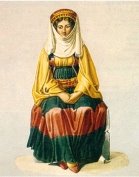 In 1460 Mystras fell to the Ottomans, but the Mani was not subdued and retained its internal self-government in exchange for an annual tribute. The Maniots continued to bear arms and sporadically refused to pay levies and taxes imposed by the Ottomans. The Maniots survived by becoming pirates. Very ferocious closely-knit clans united by blood evolved. Local chieftains or beys governed Mani on behalf of the Ottomans. As Ottoman power declined, the mountains of the Mani became a stronghold of the kleftes, bandits who also fought against the Ottomans. There is evidence of a sizeable Maniot emigration to Corsica sometime during the Ottoman years. The last bey of Mani, Petros Mavromichalis was among the leaders of the Greek War of Independence. He proclaimed the revolution at Areopoli on 17 March 1821. The Maniots contributed greatly to the struggle, but once Greek independence was won they wanted to retain their local autonomy. During the reign of Ioannis Kapodistrias they violently resisted outside interference. The Mani's local autonomy was abolished in 1870, and the area gradually became a backwater as the inhabitants abandoned the land through emigration.
Etymologically, the name "Maniot" is a diminutive implying "of Mani". Geographically, the peninsula itself is an extension of the Taygetus mountain range. Throughout history, the Maniots have been known by their neighbors and their enemies as fierce warriors, proudly independent, who practice blood feuds – so fierce and savage, in fact, that they have been compared to the Nordic Berserkers. At times they were even referred to as the "super soldiers" of the 15th, 16th, 17th, 18th and early to mid 19th centuries. Napoleon Bonaparte addressed to them as "Spartan descendants" and Theodoros Kolokotronis (leader of the Greek War of Independence) called them "The Spartans".
Their surnames uniformly end in "-eas" in what is now the Messenian part of Mani, "-akos" in what is now the Laconian part of Mani and the occasional "-oggonas". The Maniot "-akos" is not to be confused with the Cretan "-akis", which was introduced into Mani by the first Cretan refugees who fled Crete once the Ottomans eventually fully occupied Crete in 1669. The Maniot "akos" denotes strength, power andmasculinity as opposed to the Cretan "akis" which denotes weakness, being small, and being effeminate in nature.
During the early modern period, the Maniots were renowned pirates with Oitylo having the nickname Great Algiers. For the most part, the Maniots lived in fortified villages (and "house-towers") where they defended their lands against the Ottomans and even against the armies of William II Villehardouin .Dances
Two dances come from Mani: Palio Maniatiko (meaning "Old Maniot") and the Modern Maniatiko. The Palio Maniatiko is only found in Mani and is described as an ancient dance. The Modern Maniatiko is the modern version of the Palio Maniatiko dance and includes certain aspects of the Kalamatiano dance in it. Like the Palio Maniatiko, it is only performed in Mani.
Piracy
"If any ship come to anchor on their coast, many arm themselves and go to the place, over against where the ship doth ride; some of them will be in priests habits, walking by the sea side, with their wallets, in which they will have some wine and bread. Their companions lye hid behind the bushes at some convenient post. When any strangers come ashore, who do not understand their language, the feigned priests make signes to them, shewing them their bread and wine, which they offer to them for money, by which the strangers being enticed from the sea side (and it may be to sit down and taste their wine) the hidden Manjotts come and make their prey. The priests will seem to be sorry, and endeavor to make the strangers to believe they were altogether ignorant of any such design. So a white flagg is put out, and a treaty held with the ship for their ransome. The priests endeavor to moderate the price, showing a great deal of respect to their companions, who are clothed in Turkish habits. Many ships have been thus served." Bernard Randolph, Present State of the Morea.
Part of Maniot culture involved piracy. The Maniots were famous and fearsome pirates whose ships dominated the Maniot coastline. The Maniots became pirates because Mani was not a very fertile land and the Maniots did not have many natural resources. The Maniots considered piracy a legitimate response to the fact that their land was poor, and it became their main source of income.[83] The pirate raids were not stopped by the local priests of the Eastern Orthodox Church, who in fact blessed the ships before they left and sometimes accompanied them on raids. Most of the Maniot pirates came from Messa Mani.[84] The main victims of Maniot pirates were the Ottomans, but the Maniots also targeted ships of powerful European countries.
Superstition
The Maniots are a very superstitious people. Maniots mainly believe in witches, demons, vampires, and ghosts. When Henry Herbert, 3rd Earl of Carnarvon, was touring Mani in 1839, he found a fresh egg by the side of the road and offered it to a Maniot soldier who escorted him, who declined the offer claiming that if a hag had enchanted it he would have to marry her. The Maniots thought that certain areas were haunted by demons.
Vendettas
Another important aspect of Maniot culture were the vendettas which frequently plagued Mani. Usually, the decision to start a vendetta was made at a family gathering. The main aim of a vendetta was usually to wipe out the other family. The families involved locked themselves in their towers and whenever they got the chance murdered members of the opposing family.[86] The other families in the village normally locked themselves in their towers in order not to get in the way of the fighting.
Some vendettas went on for months, sometimes years. In vendettas, the families could have a truce or treva, if one family needed to attend a religious ceremony or when it was time to harvest the crops. As soon as the treva ended, the killing could resume. Vendettas usually ended when one family was exterminated or when the defeated family left the town. Sometimes families came to terms, and vendettas stopped when the Turks invaded. The longest treva occurred when the Mavromichales declared war on the Turks in 1821. Vendettas continued after the liberation of Greece even though the Regency tried to demolish the towers.
Piracy
"If any ship come to anchor on their coast, many arm themselves and go to the place, over against where the ship doth ride; some of them will be in priests habits, walking by the sea side, with their wallets, in which they will have some wine and bread. Their companions lye hid behind the bushes at some convenient post. When any strangers come ashore, who do not understand their language, the feigned priests make signes to them, shewing them their bread and wine, which they offer to them for money, by which the strangers being enticed from the sea side (and it may be to sit down and taste their wine) the hidden Manjotts come and make their prey. The priests will seem to be sorry, and endeavor to make the strangers to believe they were altogether ignorant of any such design. So a white flagg is put out, and a treaty held with the ship for their ransome. The priests endeavor to moderate the price, showing a great deal of respect to their companions, who are clothed in Turkish habits. Many ships have been thus served." Bernard Randolph, Present State of the Morea.
Part of Maniot culture involved piracy. The Maniots were famous and fearsome pirates whose ships dominated the Maniot coastline. The Maniots became pirates because Mani was not a very fertile land and the Maniots did not have many natural resources. The Maniots considered piracy a legitimate response to the fact that their land was poor, and it became their main source of income.[83] The pirate raids were not stopped by the local priests of the Eastern Orthodox Church, who in fact blessed the ships before they left and sometimes accompanied them on raids. Most of the Maniot pirates came from Messa Mani.[84] The main victims of Maniot pirates were the Ottomans, but the Maniots also targeted ships of powerful European countries.
Superstition
The Maniots are a very superstitious people. Maniots mainly believe in witches, demons, vampires, and ghosts. When Henry Herbert, 3rd Earl of Carnarvon, was touring Mani in 1839, he found a fresh egg by the side of the road and offered it to a Maniot soldier who escorted him, who declined the offer claiming that if a hag had enchanted it he would have to marry her. The Maniots thought that certain areas were haunted by demons.
Vendettas
Another important aspect of Maniot culture were the vendettas which frequently plagued Mani. Usually, the decision to start a vendetta was made at a family gathering. The main aim of a vendetta was usually to wipe out the other family. The families involved locked themselves in their towers and whenever they got the chance murdered members of the opposing family.[86] The other families in the village normally locked themselves in their towers in order not to get in the way of the fighting.
Some vendettas went on for months, sometimes years. In vendettas, the families could have a truce or treva, if one family needed to attend a religious ceremony or when it was time to harvest the crops. As soon as the treva ended, the killing could resume. Vendettas usually ended when one family was exterminated or when the defeated family left the town. Sometimes families came to terms, and vendettas stopped when the Turks invaded. The longest treva occurred when the Mavromichales declared war on the Turks in 1821. Vendettas continued after the liberation of Greece even though the Regency tried to demolish the towers.
Sunday, July 29, 2012
Ode to Galata's ‘Sakız Gülü’ Youths
19th century poem/ode by Erzurumlu Âşık İbrahim for Galata's ‘Sakız Gülü’ civans/youth and kız güzeli/girl pretty ateş oğlans/fire boys (for nargile)
Gel Âşık İbrahim, gel sefa eyle
Tûti dillice bir Pedimu peyle…
Sakız gülleridir saki civanlar
İstefo, Pandeli, Vasil, Yuvanlar…
Güler yüz, tatlı dil, işinin eri
Tezgâhta mukasser Barba Mastori…
Edremit, Bülbülce, Mürefte, Fertek
Güzeller aşkına çakalım bir tek…
Gel ey gül topuklum, gel Galata’lım
Gel havfü hicabı artık atalım…
Uyandır kalender gönlünde mumu
Gel şuh fendbazın Galata Rum’u…
Doldur be Mastori, doldur be Barba
Bir de tezgâhından âşık’a caba…
Gel Âşık İbrahim, gel sefa eyle
Tûti dillice bir Pedimu peyle…
Sakız gülleridir saki civanlar
İstefo, Pandeli, Vasil, Yuvanlar…
Güler yüz, tatlı dil, işinin eri
Tezgâhta mukasser Barba Mastori…
Edremit, Bülbülce, Mürefte, Fertek
Güzeller aşkına çakalım bir tek…
Gel ey gül topuklum, gel Galata’lım
Gel havfü hicabı artık atalım…
Uyandır kalender gönlünde mumu
Gel şuh fendbazın Galata Rum’u…
Doldur be Mastori, doldur be Barba
Bir de tezgâhından âşık’a caba…
Monday, December 05, 2011
The Taverns

(click the text image to read full size)
The tavern culture has been a part of port culture. Seamen were single in the port they landed, and they had the time and money to be spent inside.
When Turks conquered Istanbul and Galata, the taverns in this coastal city were world-class. 16. Latifi of Kastamonu, a writer of the century noted in his “Manual of Istanbul” that the taverns of Istanbul were mostly found in Tahtakale while Galata was “full of taverns”.
The Muslim population usually obeyed religious restrictions but did not interfere in the customs of Non-Muslims. There were plenty of taverns in non-Muslim districts, particularly in Galata, and some customers were Muslims who escaped for a drink. The taverns, which were the places of drinking and eating for pleasure, were also subject to the guild system. Era of Mehmet the Conqueror (1451 – 1481)
That era was one of reconstruction and settlement in Istanbul. His son Beyazit 2nd (1481 – 1512) promoted arts because of his devotion in pleasure and entertainment. Number of taverns rose in that era. During the era of his son Yavuz Selim (1512 – 1520), this number increased further, and drunkenness became more common in Istanbul.
When Suleiman the Magnificent inherited the throne, he prohibited drinking alcohol. During the era of Selim 2nd (1566 – 1574), however, the taverns were reopened with the support of Damat Ibrahim Pasha and his supporters, restarting the period of pleasure and entertainment. As a matter of fact, a decree was enacted when it was reported on 7 October 1573 that there were taverns even in the Muslim districts.
When Selim 2nd died after falling while carousing in the palace bath, his son Murat 3rd (1574 – 1595) came to power, and he enacted a firman on 13 Mart 1576 allowing the taverns for operating freely except in the Muslim districts.
But when Murat 3rd witnessed in person that Muslims were frequently going to the taverns in the Christian districts, he introduced a prohibition of alcoholic beverages (14 Mart 1583).
However, when alcoholic prohibition on soldiers was removed upon soldiers’ pressures, other people continued drinking alcohol, too. The Commander prohibited alcohol and wrote on the wall "Alcohol kills". Next morning, an answer was added under this sentence: “A soldier isn’t scared of death”.
Eremya Celebi Komurcuyan mentioned about Kasimpasa in his 17th century History of Istanbul as follows: "Ahead, there are Jewish houses and “rooms” on both sides thereof. These houses are on the coast and there are shops under them. They cook fish for the quests and serve pickles, dried sturgeon and codfish. Jewish butchers as well as seats where RAKI is sold are also in that place."
We understand that the Bosporus restaurants of today were on the Golden Horn coast in the past. And in the 17th century, drinkers were offered raki made of muscat grape in those houses. Our grand grand father might go upstairs after being steeped enough.
In the past, taverns of Istanbul were named based on the trademarks such as a wooden or metallic boat, tower or a dagger hung on the shop instead of a signboard. For example: Hancerli (Dagger), Kurkcu Hani (Furrier’s Tavern), Yahudi (Jew’s), Kandilli (Candle Shop), etc. Some of these marks were those of Janissaries. Evening customers of these taverns and Janissary drinkers depending on the district were the most respected with the title of “Dayi” (Uncle). Dockers and artilleries were the customers of taverns from Kasimpasa to Findikli and Salipazari. Boatmen, carriers, bath attendants and rowdy rogues of Istanbul could not enter in these taverns; even if they could, they drink quickly and leave only when the evening drinkers were not present. These taverns were called "Regular Taverns".
Towards the end of Abdulaziz era, these became the "Taverns of Sultans". After regular taverns were established, the demos could go to illegal places called "Seat Tavern", side street groceries and greengrocers which sold alcohol in private. A portion of seat taverns was "civil seats". These drew civil servants and clerks who did not bring alcohol to their houses.
In addition to small "seats", there were "Mobile Taverns". Mobile taverns were alcohol hawkers, most of whom were Armenian. Shop, stall, barrel, master, cupbearer were all in one person. Around their waist, they used to wrap a very long sheep bowel with plug on the end, filled with raki or wine. They wore a gown, where they carry a cup in their pocket. They put a napkin on their shoulders as marking. Mobile taverns were mostly active in Bahcekapi, Yemis Iskelesi, Galata and around.
They were going into a grocery or greengrocer to watch around when a customer appears, fill the glass under their belt and serve the beverage heated with their body temperature. Swigging the glass, rowdy alcoholic might use a piece of grapes or another fruit of season as appetizer. Most of them used to wipe their mouth with backhand, which was called "punch appetizer".
Istanbul’s regular taverns were famous for their clean kitchens and talented chefs particularly on fish and meat meals. It was said that "Chefs of mansions are not able to cook cutlet and summer vegetable stew with meat as delicious as regulars". Wide and high ceilings of regular taverns were usually supported with pillars. Salty fish (sardines) barrel at the bottom of middle pillar was a characteristic of these taverns. Salty fish was brought in barrels from Malta or Aegean islands.
Cleanliness was the focus of attention. Glasses and bowls were dried and shined with clean clothes. Floors were swept carefully while tables were cleansed. Event the servants and children serving to the drinkers were in clean clothes. Earth candle holders were put on the tables, candles were added on, and appetizers were laid around. On each table, there was also a salt shaker made of timber as a symbol of abundance. Chairs were usually short with wooden legs, while seating was made of mat. Stall customers of regular taverns were artisan foremen and apprentices called "four-browed", avoided meeting and becoming too familiar with their landlords, masters, etc. On the stall, there were always appetizers and snacks such as haricot bean salad, pickled cabbage and chickpeas. Raki and wine were first served from pumpkin, and then from a metal or glass pitchers “peeing from the stomach”. When the customer arrived at the tavern, the table was furnished with appetizer plates and drinking bowls. Heating up with the invitation of tavern keeper in but starting only after the candle on the table was lit, this drinking session used to last for hours. Appetizers, which were present when the customer sat at the table, were free. Only the beverage and appetizers ordered separately were charged. In Ramadan, taverns were closed. On the eve of holidays, the tavern keepers used to send stuffed mussel or mackerel to the prominent customers. This was called "stuffing for not to be forgotten".
Wednesday, December 08, 2010
Costak a Kouros
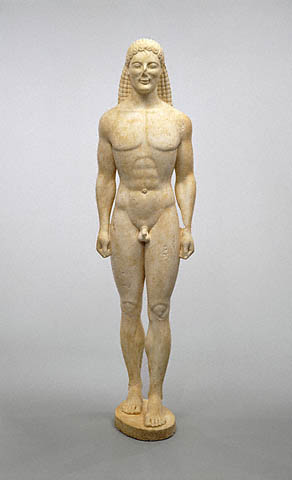
A kouros is a statue of a standing nude youth that did not represent any one individual youth but the idea of youth. Used in Archaic Greece as both a dedication to the gods in sanctuaries and as a grave monument, the standard kouros stood with his left foot forward, arms at his sides, looking straight ahead. Carved in from four sides, the statue retained the general shape of the marble block. Archaic Greek sculptors reduced human anatomy and musculature in these statues to decorative patterning on the surface of the marble.
The kouros embodies many of the ideals of the aristocratic culture of Archaic Greece. One such ideal of this period was arete, a combination of moral and physical beauty and nobility. Arete was closely connected with kalokagathia,literally a composite term for beautiful and good or noble. Writing in the mid 500s B.C., the Greek poet Theognis summed this idea up as "What is beautiful is loved, and what is not is unloved." In a society that emphasized youth and male beauty, the artistic manifestation of this world view was the kouros. Indeed, when the poet Simonides wrote about arete in the late 500s, he used a metaphor seemingly drawn from the kouros: "In hand and foot and mind alike foursquare/ fashioned without flaw."
Monday, November 15, 2010
Piracy in Mediterranean
Pirates operated in any remote areas advantageous for them to attack. Piracy was able to operate as a state without immediate reprucussions. In this case it was within the Byzantine Empire. Pirates could find quiet uninhabited areas of an island, build a camp near the water and attack ships as they came by. Or they could go to neighboring islands, surprise attack and return to their hideout. If the attacks were successful, they would probably come back to the same camp. The camp would eventually grow into a village after all the slaves and loot they would bring back.
Arab dynasties from North Africa were known to send out expeditions throughout the Mediterranean. These expeditions were usually preceded by many piratical raids. These expeditions and raids coupled with further expeditions would ultimately result in the complete conquest of certain areas, as was the case of Sicily, Corsica, Sardinia, and coastal areas of France and modern day Italy. Raids by Arabs included raids on Rome during the 800’s and 900’s AD.
In the case of the Arab conquest of Sicily, it was the Sunnite Aghlabids in the 800’s AD based out of Africa Minor (modern day Tunisia) that were responsible for the expeditions. Sicily was an important base for the Moslems, because it brought them closer to the mainland in Europe to conduct further attacks and trade.
Simultaneously, on the other side of the Mediterranean in the east was Crete. Crete was used by the Arab Muslims the same way Sicily was used in the west. The Muslims repeatedly attacked the Greek islands and mainland. Recent archeological findings in Athens have also found a possible Arabic settlement from that era in the 900’s AD.
During the Arab conquest, the islands in the Aegean had turned into pirate lairs for both Arabs and Christian mercenaries. The “profession” of piracy was considered honorable and profitable and was passed from father to son. The word leventes (brave handsome fellow) came from levante, which at the time signified a fearless pirate of the eastern Mediterranean. The east coast of the Mediterranean was also referred to as the Levante (Where the sun rises- from the Latin “levantar” which means to rise) and it included the coasts of Asia Minor, the Middle East and Egypt.
Levante was also what was referred to as the “east wind” in sailing. For educational purposes, here are the other winds and how they were referred to at one time during the middle ages.
Northwest wind: O Maestros
Southwest wind: O Garmbis
West wind: O Pounentes
Southeast wind: O Sorkos
Northeast wind: O Graigos
East wind: O Levantes
As mentioned earlier, a name tied with the people of Arab mixed with North African pirate origin is Sarakinos and all its variants. Sarakinos is a Greek word synonymous with the word Arab. There are many Greek island areas and mainland areas with the variant name of Sarakinos. There are also various other areas in other countries in the Mediterranean like in Italy and France which have either a variant of the name Sarakinos or other similar influences from pirates from North Africa. Most of these areas are located near coastline areas. These names come from North African immigrants (who were usually pirates) that settled those areas during the combined Saracen and North African raids by the various Caliphates throughout the era of the middle ages. Those raids and attacks conceivably started during the 600 AD’s and lasted arguably up till the middle 1800’s. “The town of Parparia also has some fields called “Tou Sarakinou” meaning “belonging to the Saracen”.
Piracy was directly related to the slave trade, which greatly flourished for many centuries, especially during the middle-ages starting from the 600 AD’s. Pirates made a lot of money selling people. The sufferings of the inhabitants of the coastal towns and particularly the Aegean islands at the hands of pirates of every race and origin can hardly be described. In 904 AD Arab pirates led by a Greek named Leo of Tripoli from Crete who had joined the Muslim forces, according to one source, carried off approximately 22,000 inhabitants from Thessalonica. This same Leo from Tripoli along with another Greek pirate who had converted to Islam, named Damianos, defeated the Byzantine navy off the northern coast of Chios during the Byzantine war campaign against the Arabs in an attempt to take back lost Byzantine territories.
Other towns in Chios have similar stories about Algerian (Alidzerini-Berbers) and Saracen pirates. Some of the ones I read about were Thymiana, Kardamyla, Kambia, Mesta and Neochori.
In the late 900’s AD, the island of Lesbos had the same types of attacks from a Saracen pirate chief named Sirhan. Saracens had attacked the bay of Stenacus but were defeated when the town set their ships on fire.
During the early part of the middle ages, pirate attacks on the island on Lesbos from Saracen invasions occurred in the years 821, 881 and 1055 AD. There are places on Lesbos with the name Sarikinou as well, which in all likelihood were pirate lairs at one time.
The island of Paros was also plundered by the Saracen pirate Nissiris between 821 AD and 827 AD. Nissiris as a pirate was active from 821 AD to 827 AD. Nissiris went to the island of Paros and stole all the church treasures. In Paros there are also places with the name Sarakoinou. The encounters with pirates on Paros were documented in the year 905 AD, when Nikitas Magister, a government official during the reign of Byzantine Emperor Leo VI was sent from Constantinople to Crete to negotiate with the Saracens (Crete was captured by the Saracens and Arabs in 823 AD). As they approached the island of Ios, winds drove them to the island of Paros (Which at that time was uninhabited). There he met a monk who told him about the island and their encounters with Saracen pirates.
In 961 AD the Byzantine army under emperor Nicephoros Phocas took back Crete from the Arabs and killed, according to one source 20,000 Arabs in the process. There is a town in Crete called Barbaro or Varvaro. The Byzantine soldiers that took over the town during the re-taking of Crete named it like that because of the people there who were Arabs or Berbers from Barbaria in North Africa. It is in all likelihood, the same way the town of Varvakorso and its people the Varvarousi got their names from the Greeks on the island of Chios.
There are dozens of accounts of Saracen pirates invading and settling areas of the Mediterranean between the 900’s AD and 1000’s AD. These places included
St. Tropez and La Garde Freinet (937 AD) in France
Fontanarossa (935 AD) in Italy
Malta (870 AD)
Sicily (827 AD)
Corsica (754 AD) and others. Corsica even has a pirate head as their symbol on one of their flags.
In some of these places, it was recorded that these pirate settlements once they were re-conquered by the Christians remained in those areas and converted to Christianity.
By paralleling history in other areas with pirate history in the Mediterranean an image starts to emerge for the the history of Parparia. Parparia’s history mimicks the history of dozens of other places in the Aegean that attribute their origins and history to Saracen pirates, especially islands.
The formula one sees is clear, once Christian armies started to push back Muslim forces and settlements, the prisoners or towns left behind were usually forced to convert to Christianity. In the areas of modern France, Spain and Italy, Saracens that converted to Christianity became Catholics. In areas of modern Greece they became Orthodox. The Iberian peninsula (Spain and Portugal) and a large part of southern France was under Saracen or Arab rule at one time or another. In parts of Spain, Muslim rule existed for almost 800 years (Granada).
It is written that between 840 AD and 1017 AD the three great nations in existence were the Byzantines (Greeks), the Saracens (Arabs) and the Franks (French).
Arab dynasties from North Africa were known to send out expeditions throughout the Mediterranean. These expeditions were usually preceded by many piratical raids. These expeditions and raids coupled with further expeditions would ultimately result in the complete conquest of certain areas, as was the case of Sicily, Corsica, Sardinia, and coastal areas of France and modern day Italy. Raids by Arabs included raids on Rome during the 800’s and 900’s AD.
In the case of the Arab conquest of Sicily, it was the Sunnite Aghlabids in the 800’s AD based out of Africa Minor (modern day Tunisia) that were responsible for the expeditions. Sicily was an important base for the Moslems, because it brought them closer to the mainland in Europe to conduct further attacks and trade.
Simultaneously, on the other side of the Mediterranean in the east was Crete. Crete was used by the Arab Muslims the same way Sicily was used in the west. The Muslims repeatedly attacked the Greek islands and mainland. Recent archeological findings in Athens have also found a possible Arabic settlement from that era in the 900’s AD.
During the Arab conquest, the islands in the Aegean had turned into pirate lairs for both Arabs and Christian mercenaries. The “profession” of piracy was considered honorable and profitable and was passed from father to son. The word leventes (brave handsome fellow) came from levante, which at the time signified a fearless pirate of the eastern Mediterranean. The east coast of the Mediterranean was also referred to as the Levante (Where the sun rises- from the Latin “levantar” which means to rise) and it included the coasts of Asia Minor, the Middle East and Egypt.
Levante was also what was referred to as the “east wind” in sailing. For educational purposes, here are the other winds and how they were referred to at one time during the middle ages.
Northwest wind: O Maestros
Southwest wind: O Garmbis
West wind: O Pounentes
Southeast wind: O Sorkos
Northeast wind: O Graigos
East wind: O Levantes
As mentioned earlier, a name tied with the people of Arab mixed with North African pirate origin is Sarakinos and all its variants. Sarakinos is a Greek word synonymous with the word Arab. There are many Greek island areas and mainland areas with the variant name of Sarakinos. There are also various other areas in other countries in the Mediterranean like in Italy and France which have either a variant of the name Sarakinos or other similar influences from pirates from North Africa. Most of these areas are located near coastline areas. These names come from North African immigrants (who were usually pirates) that settled those areas during the combined Saracen and North African raids by the various Caliphates throughout the era of the middle ages. Those raids and attacks conceivably started during the 600 AD’s and lasted arguably up till the middle 1800’s. “The town of Parparia also has some fields called “Tou Sarakinou” meaning “belonging to the Saracen”.
Piracy was directly related to the slave trade, which greatly flourished for many centuries, especially during the middle-ages starting from the 600 AD’s. Pirates made a lot of money selling people. The sufferings of the inhabitants of the coastal towns and particularly the Aegean islands at the hands of pirates of every race and origin can hardly be described. In 904 AD Arab pirates led by a Greek named Leo of Tripoli from Crete who had joined the Muslim forces, according to one source, carried off approximately 22,000 inhabitants from Thessalonica. This same Leo from Tripoli along with another Greek pirate who had converted to Islam, named Damianos, defeated the Byzantine navy off the northern coast of Chios during the Byzantine war campaign against the Arabs in an attempt to take back lost Byzantine territories.
Other towns in Chios have similar stories about Algerian (Alidzerini-Berbers) and Saracen pirates. Some of the ones I read about were Thymiana, Kardamyla, Kambia, Mesta and Neochori.
In the late 900’s AD, the island of Lesbos had the same types of attacks from a Saracen pirate chief named Sirhan. Saracens had attacked the bay of Stenacus but were defeated when the town set their ships on fire.
During the early part of the middle ages, pirate attacks on the island on Lesbos from Saracen invasions occurred in the years 821, 881 and 1055 AD. There are places on Lesbos with the name Sarikinou as well, which in all likelihood were pirate lairs at one time.
The island of Paros was also plundered by the Saracen pirate Nissiris between 821 AD and 827 AD. Nissiris as a pirate was active from 821 AD to 827 AD. Nissiris went to the island of Paros and stole all the church treasures. In Paros there are also places with the name Sarakoinou. The encounters with pirates on Paros were documented in the year 905 AD, when Nikitas Magister, a government official during the reign of Byzantine Emperor Leo VI was sent from Constantinople to Crete to negotiate with the Saracens (Crete was captured by the Saracens and Arabs in 823 AD). As they approached the island of Ios, winds drove them to the island of Paros (Which at that time was uninhabited). There he met a monk who told him about the island and their encounters with Saracen pirates.
In 961 AD the Byzantine army under emperor Nicephoros Phocas took back Crete from the Arabs and killed, according to one source 20,000 Arabs in the process. There is a town in Crete called Barbaro or Varvaro. The Byzantine soldiers that took over the town during the re-taking of Crete named it like that because of the people there who were Arabs or Berbers from Barbaria in North Africa. It is in all likelihood, the same way the town of Varvakorso and its people the Varvarousi got their names from the Greeks on the island of Chios.
There are dozens of accounts of Saracen pirates invading and settling areas of the Mediterranean between the 900’s AD and 1000’s AD. These places included
St. Tropez and La Garde Freinet (937 AD) in France
Fontanarossa (935 AD) in Italy
Malta (870 AD)
Sicily (827 AD)
Corsica (754 AD) and others. Corsica even has a pirate head as their symbol on one of their flags.
In some of these places, it was recorded that these pirate settlements once they were re-conquered by the Christians remained in those areas and converted to Christianity.
By paralleling history in other areas with pirate history in the Mediterranean an image starts to emerge for the the history of Parparia. Parparia’s history mimicks the history of dozens of other places in the Aegean that attribute their origins and history to Saracen pirates, especially islands.
The formula one sees is clear, once Christian armies started to push back Muslim forces and settlements, the prisoners or towns left behind were usually forced to convert to Christianity. In the areas of modern France, Spain and Italy, Saracens that converted to Christianity became Catholics. In areas of modern Greece they became Orthodox. The Iberian peninsula (Spain and Portugal) and a large part of southern France was under Saracen or Arab rule at one time or another. In parts of Spain, Muslim rule existed for almost 800 years (Granada).
It is written that between 840 AD and 1017 AD the three great nations in existence were the Byzantines (Greeks), the Saracens (Arabs) and the Franks (French).
Monday, October 25, 2010
Costumes from Aghia Mavra

ANDRE GRASSET ST. SAUVER (painter) & E. BRIONE (1729-) (engraver)
Local attire from Parga, Preveza, Vonitsa and Aghia Mavra
1800, copper engraving, 15.5 x 20 cm
Source
Friday, October 08, 2010
Carlo I Tocco, count of Cephalonia and Zante
Carlo II Tocco (died 1448) was the ruler of Epirus from 1429 until his death.
Carlo II was the son of Count Leonardo II Tocco, the younger brother and co-ruler of Carlo I Tocco, count of Cephalonia and Zante, duke of Leukas, and ruler of Epirus. In 1424 Carlo II and his sisters were adopted by their uncle Carlo I. Carlo II's sister Maddalena Tocco married the future Byzantine Emperor Constantine XI Palaiologos in 1428, but died in 1429.
In July 1429 Carlo II succeeded his uncle Carlo I in all his jurisdictions. His succession was opposed, however, by Carlo I's illegitimate sons, led by Memnone. Memnone and his brothers appealed to the Ottoman Sultan Murad II for help in securing the inheritance of their father, and the sultan duly sent forth a force under Sinan. The Ottoman general entered into negotiations with the anti-Latin faction in Ioannina and, after guaranteeing the privileges of the nobility, obtained the surrender of the city on October 9, 1430.
Carlo II continued to rule over the remnants of his principality in Epirus from Arta as an Ottoman vassal, while the illegitimate sons of his uncle received holdings in Acarnania as Ottoman dependents. Carlo II died in October 1448 and was succeeded by his son Leonardo III Tocco. Name of "Karlı İli" which was a sanjak of Ottoman Empire and its center was Preveza was derived from Carlo II.
Carlo II was the son of Count Leonardo II Tocco, the younger brother and co-ruler of Carlo I Tocco, count of Cephalonia and Zante, duke of Leukas, and ruler of Epirus. In 1424 Carlo II and his sisters were adopted by their uncle Carlo I. Carlo II's sister Maddalena Tocco married the future Byzantine Emperor Constantine XI Palaiologos in 1428, but died in 1429.
In July 1429 Carlo II succeeded his uncle Carlo I in all his jurisdictions. His succession was opposed, however, by Carlo I's illegitimate sons, led by Memnone. Memnone and his brothers appealed to the Ottoman Sultan Murad II for help in securing the inheritance of their father, and the sultan duly sent forth a force under Sinan. The Ottoman general entered into negotiations with the anti-Latin faction in Ioannina and, after guaranteeing the privileges of the nobility, obtained the surrender of the city on October 9, 1430.
Carlo II continued to rule over the remnants of his principality in Epirus from Arta as an Ottoman vassal, while the illegitimate sons of his uncle received holdings in Acarnania as Ottoman dependents. Carlo II died in October 1448 and was succeeded by his son Leonardo III Tocco. Name of "Karlı İli" which was a sanjak of Ottoman Empire and its center was Preveza was derived from Carlo II.
Saturday, May 01, 2010
Sexual Crimes and Improprieties in Late Ottoman Greece
Evdoxios Doxiadis, Sexual Crimes and Improprieties in Late Ottoman Greece
Sexual crime and sexual improprieties in Ottoman Greece has been a neglected field of study, primarily due to the lack of sources. Unlike much of contemporary, and even earlier, Europe and much of the rest of the Ottoman world where such cases quickly found themselves in front of a judge or kadi, in Ottoman Greece cases of prostitution, adultery, unlawful fornication, or even rape have been rare thus far. By examining a variety of material, however, such as wills, dowry contracts, private correspondence, as well as the correspondence and decisions of the local authorities, we can at least extrapolate some idea regarding the concerns and behavior of the the notables in Ottoman Greece who often doubled as executive and judicial authorities.
The Ottoman judicial system, as well as the administrative one, was characterized by a remarkable diversity which allowed significant autonomy to religious and regional communities. In the Aegean, as in many other parts of Greece, this diversity led to the emergence, and often dominance, of communal executive bodies and courts, usually under the control of local notables. These bodies based their decisions upon customary laws that had their origins in the Byzantine-Roman tradition but which had evolved and changed significantly over the centuries. Few of these laws were codified before the late eighteenth century, thus allowing great flexibility in the rulings of the communal courts and councils. Sexual crime was of course clearly described by Canon as well as by Roman law and included nearly all acts not leading to procreating within a lawfully conducted marriage. The notables and even the population at large, however, do not appear very concerned with applying the penalties, or even persecuting many technically illegal activities. Practices like the infamous “kepinio”, a form of unlawful marriage of limited time duration, though denounced by the Orthodox Church, endured as did the institution of “syggria” in Mani, a form of bigamy. From the cases examined in this paper it becomes evident that the notables were quite willing to tolerate what was generally deemed as immoral behavior for years and even decades, allowing families to deal with such issues by themselves. Dowry contracts and especially wills show that illegitimate children were not rare, nor were cases of what could be prostitution or perhaps concubinage, despite the efforts of parents to control the sexual behavior of their offspring.
There were, however, occasions where the communal authorities asserted their authority over the sexual behavior of individuals in the community, and acted quickly and decisively in matters of sexual crime or sexual improprieties. These few cases present us with an insight into the concerns of these notables. Under certain circumstances sexual misbehavior could threaten the peace and even the cohesion of the community and in extreme cases it could invite the involvement of outside authorities, infringing upon the autonomy and power of the notables. As a result these notables, whether secular or religious, were quick to act in order to preempt such developments, but only when such behavior threatened to escalate and disrupt the community. When such behavior crossed the boundaries of private behavior and became a public concern, however, the notables were swift to act in order to diffuse the situation, and in order to assert their own authority and power over the community.
----------
Dr. Evdoxios Doxiadis received his B.A. from Tufts University in History, Economics and Classics, and his M.A and PhD from the University of California at Berkeley, where he also received the Outstanding Graduate Student Instructor award in 2007. He has taught a number of courses on gender and on nationalism at U.C. Berkeley, and on Greece and the Balkans at San Francisco State University. He has been a post-doctoral research fellow at Princeton University, and is currently preparing his book "The Shackles of Modernity: Women, Property and the Law from Late Ottoman to Independent Greece".
Sexual crime and sexual improprieties in Ottoman Greece has been a neglected field of study, primarily due to the lack of sources. Unlike much of contemporary, and even earlier, Europe and much of the rest of the Ottoman world where such cases quickly found themselves in front of a judge or kadi, in Ottoman Greece cases of prostitution, adultery, unlawful fornication, or even rape have been rare thus far. By examining a variety of material, however, such as wills, dowry contracts, private correspondence, as well as the correspondence and decisions of the local authorities, we can at least extrapolate some idea regarding the concerns and behavior of the the notables in Ottoman Greece who often doubled as executive and judicial authorities.
The Ottoman judicial system, as well as the administrative one, was characterized by a remarkable diversity which allowed significant autonomy to religious and regional communities. In the Aegean, as in many other parts of Greece, this diversity led to the emergence, and often dominance, of communal executive bodies and courts, usually under the control of local notables. These bodies based their decisions upon customary laws that had their origins in the Byzantine-Roman tradition but which had evolved and changed significantly over the centuries. Few of these laws were codified before the late eighteenth century, thus allowing great flexibility in the rulings of the communal courts and councils. Sexual crime was of course clearly described by Canon as well as by Roman law and included nearly all acts not leading to procreating within a lawfully conducted marriage. The notables and even the population at large, however, do not appear very concerned with applying the penalties, or even persecuting many technically illegal activities. Practices like the infamous “kepinio”, a form of unlawful marriage of limited time duration, though denounced by the Orthodox Church, endured as did the institution of “syggria” in Mani, a form of bigamy. From the cases examined in this paper it becomes evident that the notables were quite willing to tolerate what was generally deemed as immoral behavior for years and even decades, allowing families to deal with such issues by themselves. Dowry contracts and especially wills show that illegitimate children were not rare, nor were cases of what could be prostitution or perhaps concubinage, despite the efforts of parents to control the sexual behavior of their offspring.
There were, however, occasions where the communal authorities asserted their authority over the sexual behavior of individuals in the community, and acted quickly and decisively in matters of sexual crime or sexual improprieties. These few cases present us with an insight into the concerns of these notables. Under certain circumstances sexual misbehavior could threaten the peace and even the cohesion of the community and in extreme cases it could invite the involvement of outside authorities, infringing upon the autonomy and power of the notables. As a result these notables, whether secular or religious, were quick to act in order to preempt such developments, but only when such behavior threatened to escalate and disrupt the community. When such behavior crossed the boundaries of private behavior and became a public concern, however, the notables were swift to act in order to diffuse the situation, and in order to assert their own authority and power over the community.
----------
Dr. Evdoxios Doxiadis received his B.A. from Tufts University in History, Economics and Classics, and his M.A and PhD from the University of California at Berkeley, where he also received the Outstanding Graduate Student Instructor award in 2007. He has taught a number of courses on gender and on nationalism at U.C. Berkeley, and on Greece and the Balkans at San Francisco State University. He has been a post-doctoral research fellow at Princeton University, and is currently preparing his book "The Shackles of Modernity: Women, Property and the Law from Late Ottoman to Independent Greece".
Sunday, January 17, 2010
Mediterranean Piracy
Piracy was a prominent feature of the Mediterranean world up through the nineteenth century. The relative poverty of the soil, the inviting expanse of the sea with its lively commercial life, and the many hiding places provided by the islets scattered across the area—particularly in the Aegean—ensured that the coastal inhabitants would always be tempted by the life of the pirate. Such low-level raiding, as constant and predictable as it was, is almost an environmental given rather than a phenomenon that begs the attention of the historian. At times, however, piracy spilled beyond such narrow limits and became a vital instrument of state building or state destruction. At such times in the Mediterranean, any explanation of historical change must include piracy in the narrative.
The early modern period in Mediterranean history—roughly the fifteenth through the eighteenth century—begins with the tapering off of one such period of piratical recrudescence. The final crumbling of Byzantine maritime power in the fourteenth century encouraged fierce competition between Latin Christians and Turkish emirs for control of the Aegean and its vital trade links. Both sides built up their navies, raided each other's territory, and preyed on each other's shipping in pursuit of supremacy in the eastern Mediterranean. Both sides recruited pirates (conveniently called corsairs once they were serving a legitimate political entity) to help them achieve their goals. The Knights of St. John, for instance, captured the island of Rhodes in 1308 with the help of a Genoese corsair (Inalcik, p. 186). The eventual victor in this fierce competition was the Turkish side, specifically the Ottoman Turks whose original base was inland but who eventually expanded outward to become a maritime power of the first order. With the conquest of Constantinople (1453), the Ottomans became masters of the vital commercial routes that linked the Black Sea and the Aegean. In 1522 they vanquished one of their most persistent naval competitors when Suleiman the Magnificent captured Rhodes and forced the departure of the Knights. Venice continued to have possessions in the eastern Mediterranean, but the Ottomans steadily eroded her power as well.
Having thus established control over the area, the Sultans quite naturally no longer looked with favor upon piracy and punished pirates whenever they were able to do so. Those who could be absorbed into the state apparatus—as naval commanders, for example—enjoyed a new life as Ottoman officials. Independent actors, however, were no longer tolerated. In 1504 the Ottomans seized the ships of a pirate who had served as a corsair in the recent wars with Venice. When he continued his raids in peacetime, he lost not only his ships; the authorities burned his house to the ground and executed seventy of his men (Brummett, p. 99). Ottoman maritime supremacy, combined with the Venetian desire to protect her commercial interests, ensured that the eastern Mediterranean enjoyed a long hiatus from piracy in the sixteenth century.
Farther to the west, in North Africa, the picture was largely similar. The corsairing captains who had raided the Spanish coastland on behalf of the Ottomans now settled down to life as the rulers of the newly acquired territories in North Africa. The high level of hostility between the sultan and the Spanish kings, however, meant that piracy was more tolerated in the western Mediterranean.
Things changed again after the Ottoman defeat at the battle of Lepanto (1571). Revisionist historiography has made it clear that this clash was not the watershed it was once presumed to be. It was important, however, in terms of piracy. The staggering and ever increasing costs of galley warfare convinced both the Ottomans and the Spaniards that it was best to turn their energies elsewhere. The Mediterranean was left to its own devices. The pirates once again took to the seas, and the seventeenth century was the golden age of the pirate republic. The slave markets of Algiers and of Valletta teemed with miserable captives from the other side, as both Muslims and Christians pursued their opponents with equal ferocity.
To a certain extent the pirates of the seventeenth century were operating on their own initiative and were motivated by the issues of economic scarcity that had always figured prominently. As with earlier centuries, however, shifts in the Mediterranean balance of power were working themselves out through piracy. It was in this period that northern newcomers—the Dutch and the English—put an end to Italian commercial supremacy in the Mediterranean and piracy was a vital instrument in this assault. The English pirate in his berton became a hated and feared figure for the Venetian merchant. This northern invasion is only the bestknown example, however. France backed Catholic pirates—particularly the Knights of St. John—as part of its ambition to replace the Venetians as the preeminent Catholic power in the eastern Mediterranean, and to hurt her economic competitors. The North African regencies of Tripoli, Tunis, and Algiers would prove similarly useful for English and French ambitions. Throughout the seventeenth and eighteenth centuries these two powers signed a number of treaties with the North Africans, agreements that were designed both to protect their own merchants from North African piracy and to encourage raids on their competitors' shipping. In the eighteenth century the power of the regencies dwindled as they themselves devoted fewer and fewer resources to such assaults and European supremacy became ever more evident. Nevertheless, remnants of the system were still at work as late as the American Revolution. Once the Americans declared their independence from the British, Lloyds of London discreetly informed the North Africans that American ships were no longer under the protection of the British navy. North African attacks on the merchant shipping of the new republic predictably ensued.
In 1798 Napoleon Bonaparte captured the island of Malta and took the previously unimaginable step of freeing all the Muslim captives held by the Knights of St. John. His dramatic actions were an illustration of a more prosaic truth. By the end of the eighteenth century combatants in the Mediterranean were strong enough to fight their naval battles and conduct their trade without the help of Mediterranean pirates turned corsairs. Once the state turned its back, piracy never again achieved the international significance that it had enjoyed from time to time in the early modern period.
Bibliography
Brummet, Palmira. Ottoman Seapower and Levantine Diplomacy in the Age of Discovery. Albany, N.Y., 1994.
Earle, Peter. Corsairs of Malta and Barbary. London and Annapolis, Md., 1970.
Inalcik, Halil. "The Rise of the Turcoman Maritime Principalities in Anatolia, Byzantium, and the Crusades." Byzantinische Forschungen 9 (1985).
Tenenti, Alberto. Piracy and the Decline of Venice, 1580–1615. Translated by Janet and Brian Pullan. London and Berkeley, 1967.
—MOLLY GREENE
The early modern period in Mediterranean history—roughly the fifteenth through the eighteenth century—begins with the tapering off of one such period of piratical recrudescence. The final crumbling of Byzantine maritime power in the fourteenth century encouraged fierce competition between Latin Christians and Turkish emirs for control of the Aegean and its vital trade links. Both sides built up their navies, raided each other's territory, and preyed on each other's shipping in pursuit of supremacy in the eastern Mediterranean. Both sides recruited pirates (conveniently called corsairs once they were serving a legitimate political entity) to help them achieve their goals. The Knights of St. John, for instance, captured the island of Rhodes in 1308 with the help of a Genoese corsair (Inalcik, p. 186). The eventual victor in this fierce competition was the Turkish side, specifically the Ottoman Turks whose original base was inland but who eventually expanded outward to become a maritime power of the first order. With the conquest of Constantinople (1453), the Ottomans became masters of the vital commercial routes that linked the Black Sea and the Aegean. In 1522 they vanquished one of their most persistent naval competitors when Suleiman the Magnificent captured Rhodes and forced the departure of the Knights. Venice continued to have possessions in the eastern Mediterranean, but the Ottomans steadily eroded her power as well.
Having thus established control over the area, the Sultans quite naturally no longer looked with favor upon piracy and punished pirates whenever they were able to do so. Those who could be absorbed into the state apparatus—as naval commanders, for example—enjoyed a new life as Ottoman officials. Independent actors, however, were no longer tolerated. In 1504 the Ottomans seized the ships of a pirate who had served as a corsair in the recent wars with Venice. When he continued his raids in peacetime, he lost not only his ships; the authorities burned his house to the ground and executed seventy of his men (Brummett, p. 99). Ottoman maritime supremacy, combined with the Venetian desire to protect her commercial interests, ensured that the eastern Mediterranean enjoyed a long hiatus from piracy in the sixteenth century.
Farther to the west, in North Africa, the picture was largely similar. The corsairing captains who had raided the Spanish coastland on behalf of the Ottomans now settled down to life as the rulers of the newly acquired territories in North Africa. The high level of hostility between the sultan and the Spanish kings, however, meant that piracy was more tolerated in the western Mediterranean.
Things changed again after the Ottoman defeat at the battle of Lepanto (1571). Revisionist historiography has made it clear that this clash was not the watershed it was once presumed to be. It was important, however, in terms of piracy. The staggering and ever increasing costs of galley warfare convinced both the Ottomans and the Spaniards that it was best to turn their energies elsewhere. The Mediterranean was left to its own devices. The pirates once again took to the seas, and the seventeenth century was the golden age of the pirate republic. The slave markets of Algiers and of Valletta teemed with miserable captives from the other side, as both Muslims and Christians pursued their opponents with equal ferocity.
To a certain extent the pirates of the seventeenth century were operating on their own initiative and were motivated by the issues of economic scarcity that had always figured prominently. As with earlier centuries, however, shifts in the Mediterranean balance of power were working themselves out through piracy. It was in this period that northern newcomers—the Dutch and the English—put an end to Italian commercial supremacy in the Mediterranean and piracy was a vital instrument in this assault. The English pirate in his berton became a hated and feared figure for the Venetian merchant. This northern invasion is only the bestknown example, however. France backed Catholic pirates—particularly the Knights of St. John—as part of its ambition to replace the Venetians as the preeminent Catholic power in the eastern Mediterranean, and to hurt her economic competitors. The North African regencies of Tripoli, Tunis, and Algiers would prove similarly useful for English and French ambitions. Throughout the seventeenth and eighteenth centuries these two powers signed a number of treaties with the North Africans, agreements that were designed both to protect their own merchants from North African piracy and to encourage raids on their competitors' shipping. In the eighteenth century the power of the regencies dwindled as they themselves devoted fewer and fewer resources to such assaults and European supremacy became ever more evident. Nevertheless, remnants of the system were still at work as late as the American Revolution. Once the Americans declared their independence from the British, Lloyds of London discreetly informed the North Africans that American ships were no longer under the protection of the British navy. North African attacks on the merchant shipping of the new republic predictably ensued.
In 1798 Napoleon Bonaparte captured the island of Malta and took the previously unimaginable step of freeing all the Muslim captives held by the Knights of St. John. His dramatic actions were an illustration of a more prosaic truth. By the end of the eighteenth century combatants in the Mediterranean were strong enough to fight their naval battles and conduct their trade without the help of Mediterranean pirates turned corsairs. Once the state turned its back, piracy never again achieved the international significance that it had enjoyed from time to time in the early modern period.
Bibliography
Brummet, Palmira. Ottoman Seapower and Levantine Diplomacy in the Age of Discovery. Albany, N.Y., 1994.
Earle, Peter. Corsairs of Malta and Barbary. London and Annapolis, Md., 1970.
Inalcik, Halil. "The Rise of the Turcoman Maritime Principalities in Anatolia, Byzantium, and the Crusades." Byzantinische Forschungen 9 (1985).
Tenenti, Alberto. Piracy and the Decline of Venice, 1580–1615. Translated by Janet and Brian Pullan. London and Berkeley, 1967.
—MOLLY GREENE
Sunday, January 10, 2010

Recipies for Costak | Braised Cod with Plums
Another monastic dish Petri must have enjoyed it during his stay in Mount Athos.
Traditional versions of this dish call for salt cod, which is cod that has been salted and dried. Though delicious, salt cod can be tedious to prepare, as it must be soaked in water for hours to remove excess salt.
This version has been adapted for fresh cod, a substitution that also reduces cooking time.
BRAISED COD WITH PLUMS
Start to finish: 30 minutes
Servings: 4 to 6
3 tablespoons olive oil
3 cloves garlic, minced
1 large yellow onion, diced
1 pound plums, halved and pitted
1 1/2 pounds cod
1/2 teaspoon kosher salt
Juice of 1 lemon
2 tablespoons chopped fresh parsley
Ground black pepper, to taste
In a large, deep skillet over medium-high, combine the olive oil, garlic and onion. Saute until the onion just begins to soften, about 3 to 4 minutes.
Add the plums and saute another 2 minutes. Arrange the cod over the onions and plums, then add enough water to come halfway up the cod. Sprinkle the cod with salt, then bring the water to a simmer, cover and cook 15 minutes, or until the cod flakes easily.
Sprinkle the lemon juice and parsley over the cod, then season with pepper.
Traditional versions of this dish call for salt cod, which is cod that has been salted and dried. Though delicious, salt cod can be tedious to prepare, as it must be soaked in water for hours to remove excess salt.
This version has been adapted for fresh cod, a substitution that also reduces cooking time.
BRAISED COD WITH PLUMS
Start to finish: 30 minutes
Servings: 4 to 6
3 tablespoons olive oil
3 cloves garlic, minced
1 large yellow onion, diced
1 pound plums, halved and pitted
1 1/2 pounds cod
1/2 teaspoon kosher salt
Juice of 1 lemon
2 tablespoons chopped fresh parsley
Ground black pepper, to taste
In a large, deep skillet over medium-high, combine the olive oil, garlic and onion. Saute until the onion just begins to soften, about 3 to 4 minutes.
Add the plums and saute another 2 minutes. Arrange the cod over the onions and plums, then add enough water to come halfway up the cod. Sprinkle the cod with salt, then bring the water to a simmer, cover and cook 15 minutes, or until the cod flakes easily.
Sprinkle the lemon juice and parsley over the cod, then season with pepper.
Tuesday, December 29, 2009
Nereids as Costak's Companion

In his sea voyages did they keep Petri company?
In Greek mythology, the Nereids (neer'-ee-eds) (Νηρηΐδες) are sea nymphs, the fifty daughters of Nereus and Doris. In modern Greek folklore, the term "nereid" (νεράϊδα, neráïda) has come to be used of all nymphs, or fairies, not merely nymphs of the sea.

Andromeda Chained to the Rock by the Nereids, painted in 1840 by Theodore Chasseriau
Monday, December 28, 2009
Malakos | Malaka
Malakos [1] μαλακός means "soft" in Greek.
Malaka Male member in Turkish slang
Malakia "softness" is the Classical Greek term for effeminacy.
Malakas is the term for "wanker" in modern Greek.
Ancient Greek Prostitutes were divided into several categories. The "pornai" πόρναι were found at the bottom end of the scale. They were, as alluded to by the etymology—the word comes from pernemi πέρνημι "to sell"—the property of πορνοβοσκός / pornoboskós, or pimps, who received a portion of their earnings. This owner could be a citizen, for this activity was considered as a source of income just like any other.
In the classical era of ancient Greece, pornai were slaves of barbarian origin; starting in the Hellenistic era the case of young girls abandoned by their citizen fathers can be added. They were considered to be slaves until proven otherwise. Pornai were usually employed in brothels located in "red-light" districts of the period, such as Piraeus (port of Athens) or the Kerameikon in Athens. These establishments were frequented by sailors and by poor citizens.
In ancient Koine Greek, the word for effeminate is kinaidos (cinaedus in its Latinized form), a man "whose most salient feature was a supposedly "feminine" love of being sexually penetrated by other men." (Winkler, 1990)[1].
"A cinaedus is a man who cross-dresses or flirts like a girl. Indeed, the word's etymology suggests an indirect sexual act emenating a promisculous woman. This term has been borrowed from the Greek kinaidos (which may itself have come from a language of Ionian Greece of Asia Minor, primarily signifying a purely effeminate dancer who entertained his audiences with a tympanum or tambourine in his hand, and adopted a lascivious style, often suggestively wiggling his buttocks in such a way as to suggest anal intercourse....The primary meaning of cinaedus never died out; the term never became a dead metaphor." (Williams, 1999)[2].
 Hetaerae (high-class prostitutes),entertain their clients, while a young girl plays the flute. Oneof the men seems to be distracted by the wine boy. | Outside of red-figure kylix (wine cup), fifth century BCE. Fogg Art Museum, Cambridge.
[1] Malakos as Soft, Christopher Lee traces the history of the Greek word on which the Latin malacus is based. In Homer, malakos usually means soft, as in a tangibly soft meadow. By Herodotus (484?-425 B.C.), it had come to mean 'soft' as in neither strong nor masculine -- in other words, 'effeminate'. Aristophanes (448?-385 B.C.) plays on the double meaning, but uses the term pejoratively. In Wasps (1455), according to Lee, Aristophanes describes a man who was once a hoplite (virile warrior), as now a degenerate malakos. In other passages of Aristophanes, as well as in Aeschines' (390-322 B.C.) attempt to discredit Demosthenes (383-322 B.C.) [Against Timarchus 131], malakos not only means soft and effeminate, but sexually submissive. Malacus, a term of Greek origin, was used by the Roman playwright Plautus (254?-184 B.C.) in conjunction with other disparaging terms to denigrate effeminate Greek males Source: Non-Standard Roman Male Sexuality
[1] Winkler, John J. (1990). The Constraints of Desire: The Anthropology of Sex and Gender in Ancient Greece. New York: Routledge.
[2] Williams, Craig A. (1999). Roman Homosexuality: Ideologies of Masculinity in Classical Antiquity. New York: Oxford University Press.
Malaka Male member in Turkish slang
Malakia "softness" is the Classical Greek term for effeminacy.
Malakas is the term for "wanker" in modern Greek.
Ancient Greek Prostitutes were divided into several categories. The "pornai" πόρναι were found at the bottom end of the scale. They were, as alluded to by the etymology—the word comes from pernemi πέρνημι "to sell"—the property of πορνοβοσκός / pornoboskós, or pimps, who received a portion of their earnings. This owner could be a citizen, for this activity was considered as a source of income just like any other.
In the classical era of ancient Greece, pornai were slaves of barbarian origin; starting in the Hellenistic era the case of young girls abandoned by their citizen fathers can be added. They were considered to be slaves until proven otherwise. Pornai were usually employed in brothels located in "red-light" districts of the period, such as Piraeus (port of Athens) or the Kerameikon in Athens. These establishments were frequented by sailors and by poor citizens.
In ancient Koine Greek, the word for effeminate is kinaidos (cinaedus in its Latinized form), a man "whose most salient feature was a supposedly "feminine" love of being sexually penetrated by other men." (Winkler, 1990)[1].
"A cinaedus is a man who cross-dresses or flirts like a girl. Indeed, the word's etymology suggests an indirect sexual act emenating a promisculous woman. This term has been borrowed from the Greek kinaidos (which may itself have come from a language of Ionian Greece of Asia Minor, primarily signifying a purely effeminate dancer who entertained his audiences with a tympanum or tambourine in his hand, and adopted a lascivious style, often suggestively wiggling his buttocks in such a way as to suggest anal intercourse....The primary meaning of cinaedus never died out; the term never became a dead metaphor." (Williams, 1999)[2].
 Hetaerae (high-class prostitutes),entertain their clients, while a young girl plays the flute. Oneof the men seems to be distracted by the wine boy. | Outside of red-figure kylix (wine cup), fifth century BCE. Fogg Art Museum, Cambridge.
 [1] Malakos as Soft, Christopher Lee traces the history of the Greek word on which the Latin malacus is based. In Homer, malakos usually means soft, as in a tangibly soft meadow. By Herodotus (484?-425 B.C.), it had come to mean 'soft' as in neither strong nor masculine -- in other words, 'effeminate'. Aristophanes (448?-385 B.C.) plays on the double meaning, but uses the term pejoratively. In Wasps (1455), according to Lee, Aristophanes describes a man who was once a hoplite (virile warrior), as now a degenerate malakos. In other passages of Aristophanes, as well as in Aeschines' (390-322 B.C.) attempt to discredit Demosthenes (383-322 B.C.) [Against Timarchus 131], malakos not only means soft and effeminate, but sexually submissive. Malacus, a term of Greek origin, was used by the Roman playwright Plautus (254?-184 B.C.) in conjunction with other disparaging terms to denigrate effeminate Greek males Source: Non-Standard Roman Male Sexuality
[1] Winkler, John J. (1990). The Constraints of Desire: The Anthropology of Sex and Gender in Ancient Greece. New York: Routledge.
[2] Williams, Craig A. (1999). Roman Homosexuality: Ideologies of Masculinity in Classical Antiquity. New York: Oxford University Press.
Cretan Pederasty
Can we find threads of Cretan pederasty in the relationship between Captain Lefteri|Lefteri Kaptan and Petri?
The Cretans, a Dorian people described by Plutarch as renowned for their moderation and conservative ways, practiced an archaic form of pederasty in which an adult aristocrat enacted a ritual kidnapping known as the harpagmos, or "seizing" of a noble boy of his choosing, with the consent of the boy's father.
The man (known as philetor, "befriender") took the boy (known as kleinos, "glorious") into the wilderness, where they spent several months hunting and feasting with their friends. If the boy was satisfied with the conduct of his would-be comrade, he changed his title from kleinos to parastates ("sidekick" indicating he had fought in battle alongside his lover) returned to the philetor and lived in close bonds of public intimacy with him. The function of the institution, beside teaching the youth adult skills, was to confirm the status of the best men, and to offer both lover and beloved the chance to give proof of a noble character deserving of respect.
The Cretans, a Dorian people described by Plutarch as renowned for their moderation and conservative ways, practiced an archaic form of pederasty in which an adult aristocrat enacted a ritual kidnapping known as the harpagmos, or "seizing" of a noble boy of his choosing, with the consent of the boy's father.
The man (known as philetor, "befriender") took the boy (known as kleinos, "glorious") into the wilderness, where they spent several months hunting and feasting with their friends. If the boy was satisfied with the conduct of his would-be comrade, he changed his title from kleinos to parastates ("sidekick" indicating he had fought in battle alongside his lover) returned to the philetor and lived in close bonds of public intimacy with him. The function of the institution, beside teaching the youth adult skills, was to confirm the status of the best men, and to offer both lover and beloved the chance to give proof of a noble character deserving of respect.
Wednesday, September 16, 2009
Recipies for Costak | Mount Athos Soup
 (Left: Food: Kitchen Xeropotamou 1942 Source)
Recipies for Costak
Petri must have enjoyed it during his stay in Mount Athos during lent. Greek Orthodox Christians fast from meat and dairy, so they were always looking for something vegan to eat.
Mount Athos Soup
7-8 Tbsp. Tahini
1 cup rice
juice of 1-2 lemons
2 medium carrots finely grated
a few parsley sprigs finely chopped
salt
10 cups water (approximately)
Boil rice in water and salt until tender. Remove from heat and add lemon juice. In small bowl mix Tahiti with enough hot liquid from boiled rice to make a smooth paste. Pour mixture back into soup stirring constantly until liquids are blended. Add grated carrots and parsley and stir well. Serve. Note: Adjust amount of lemon juice according to individual taste.
The secrets of monastery cuisine are unveiled in the cookbook "The Cooking of Mt Athos" written by Mt Athos monk Epiphanios Mylopotaminos.
It includes roughly 130 recipes for fish, seafood, and ladera (vegetable, legume (pulses), and other non-meat dishes cooked with olive oil). Monk Epiphanios cooks in the fireplace or a wood stove, and uses only olive oil and no preservatives.
" The monks live by a harsh Byzantine routine that bears no relation to our normal views of time. Their day begins at 2am with a four-hour church service. There is no breakfast - the meal they have at 6am is called lunch. After this, they work till 2.30pm; each monk has a special job, whether it's cleaning, working in the kitchens or tending the vegetables.
Then it's back to praying, with an hour's service at 3pm, taking them to dinner at four. After that, they will talk until 7pm, when they retreat to their cells for bed. Except, this is, during the big festivals, dedicated, for example, to the Madonna or St George, when they must forego sleep altogether and pray from 7pm on one day to 7pm the next.
They keep body and soul together during this routine on a spartan diet. For most meals they have vegetable broth with chunks of homemade bread. They're allowed no meat, and fish only on Sunday. On Monday, Wednesday and Friday, they eat just once and are forbidden olive oil. Wine is allowed only on special days and when they have fish."
Source: Tradition - On Holy Mountain
Friday, December 21, 2007


Saturday, November 24, 2007
Tha spáso koúpes
Tha spáso koúpes "I will smash all the glasses" (a more Eastern Greece)/Asia Minor tsifteteli-çiftetelli song.ne de güzel kulakların var
altın küpe ister osman aga
tha spaso koupes gia ta logia
pou peskai potiraki gia ta pikra logakia
aman aman yanıyorum ben
aman aman seviyorum sen
Tha Spaso Koupes Greek & Turkish Song Versions (old)
The song Tha Spaso Koupes or Ehthes To Vradhi, a tsiftetelli dance tune, which was a favorite among the Greeks of Smyrna/Izmir and western Anatolia has remained a favorite to this day. Here are excertps from the oldest Greek recordings of this song (c. 1910) as well as a Turkish original.
altın küpe ister osman aga
tha spaso koupes gia ta logia
pou peskai potiraki gia ta pikra logakia
aman aman yanıyorum ben
aman aman seviyorum sen
Tha Spaso Koupes Greek & Turkish Song Versions (old)
The song Tha Spaso Koupes or Ehthes To Vradhi, a tsiftetelli dance tune, which was a favorite among the Greeks of Smyrna/Izmir and western Anatolia has remained a favorite to this day. Here are excertps from the oldest Greek recordings of this song (c. 1910) as well as a Turkish original.
Thursday, November 22, 2007
Costak and Pasolini
Truly a great influence for Costak came from Pasolini. The description from an upcoming retrospective explains why. Obvious isn't it?
Heretical Epiphanies | The Cinematic Pilgrimages of Pier Paolo Pasolini
November 28 – December 4, 2007 at the Film Society of Lincoln Center
Pier Paolo Pasolini was many things––a poet, a provocateur, a devout Catholic, an ardent Marxist, an openly gay man: in essence, an “inconvenient guest,” as he put it, at the ongoing party known as modern society. He was also a filmmaker, unlike any other before or since. He began his career in movies as a screenwriter for Mauro Bolognini, Luciano Emmer and Federico Fellini, among others. When he directed his first film –– Accattone, in 1961 –– he more or less reinvented cinema from the ground up. The links to neorealism and New Wave modernism were there, but Pasolini’s hieratic moviemaking felt like no one else’s: imagistically and linguistically exacting (no one knew Roman slang better than Pasolini), unflinching in its vision of society’s castaways and human refuse, yet radically tender. Pasolini’s cinematic pageants of abjection, humiliation and fury were based in the devotional humanism of early Renaissance painting. From Accattone through the notorious updating of Sade’s "120 Days of Sodom" that he completed just before his murder on the outskirts of Rome in 1975, his body of work amounted to nothing less than a cry of anguish at what he saw as the horrors of progress, and a plea to return to the more humane rhythms of existence in a pre-industrial world. Pasolini stood alone, proudly and defiantly, and he stood for the common man.
Heretical Epiphanies | The Cinematic Pilgrimages of Pier Paolo Pasolini
November 28 – December 4, 2007 at the Film Society of Lincoln Center
Pier Paolo Pasolini was many things––a poet, a provocateur, a devout Catholic, an ardent Marxist, an openly gay man: in essence, an “inconvenient guest,” as he put it, at the ongoing party known as modern society. He was also a filmmaker, unlike any other before or since. He began his career in movies as a screenwriter for Mauro Bolognini, Luciano Emmer and Federico Fellini, among others. When he directed his first film –– Accattone, in 1961 –– he more or less reinvented cinema from the ground up. The links to neorealism and New Wave modernism were there, but Pasolini’s hieratic moviemaking felt like no one else’s: imagistically and linguistically exacting (no one knew Roman slang better than Pasolini), unflinching in its vision of society’s castaways and human refuse, yet radically tender. Pasolini’s cinematic pageants of abjection, humiliation and fury were based in the devotional humanism of early Renaissance painting. From Accattone through the notorious updating of Sade’s "120 Days of Sodom" that he completed just before his murder on the outskirts of Rome in 1975, his body of work amounted to nothing less than a cry of anguish at what he saw as the horrors of progress, and a plea to return to the more humane rhythms of existence in a pre-industrial world. Pasolini stood alone, proudly and defiantly, and he stood for the common man.
Subscribe to:
Posts (Atom)